

Tim Hartman’s recent remarks about Brazilian Jiu-Jitsu in self-defense situations have sparked a lively debate in the martial arts community. Hartman, a figure known for his opinions on traditional martial arts, has drawn criticism for his perspective on the practicality of BJJ when wearing shoes. His argument revolves around the idea that in a real-world scenario, particularly one where shoes are involved, BJJ practitioners would be at a disadvantage, and this has raised eyebrows among BJJ enthusiasts.
Hartman’s critique begins with a somewhat theatrical comparison of martial arts practitioners, painting BJJ athletes as part of what he dubs the “Barefoot Brigade.” He suggests that the necessity to remove shoes in BJJ makes it impractical in real-world encounters. His narrative implies that while a BJJ practitioner might be fumbling with their footwear, their opponent—presumably more seasoned in street-savvy combat techniques—would have already gained the upper hand.
However, those within the BJJ community were quick to dismantle Hartman’s assertions. They argue that his focus on footwear overlooks the essence of BJJ as a versatile and adaptive martial art. BJJ, known for its emphasis on leverage, technique, and ground control, has proven its effectiveness in countless scenarios, both in competitive environments and in self-defense. The idea that a pair of shoes could neutralize these skills seems far-fetched to many.
Many commenters invoked a recent case that shoved the real life value of BJJ. A would-be robber in Auckland, New Zealand, made a grave mistake when he targeted a Brazilian Jiu-Jitsu black belt. After a 23-hour flight, the martial artist was approached by the assailant demanding money. Despite attempts to defuse the situation and seek help from bystanders, the attacker persisted. The BJJ black belt, maintaining his composure, took control of the situation by performing a double-leg takedown, securing top control. The police arrived to find the assailant subdued, all thanks to the martial artist’s training and expertise.


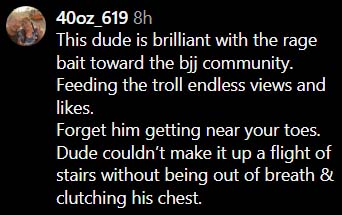

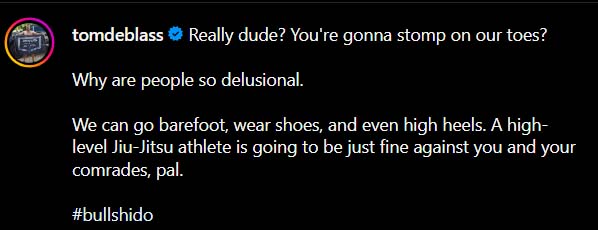

One of the main counterarguments to Hartman’s stance is the adaptability of BJJ practitioners. Whether in shoes, barefoot, or even in more unconventional footwear, the principles of BJJ remain applicable. High-level practitioners are trained to use their environment to their advantage, and footwear becomes just another factor in the equation, not a decisive weakness. The notion that a BJJ athlete would be incapacitated by a stomp to the toes seems to oversimplify the complex nature of grappling.
The criticism of Hartman’s perspective extends beyond just the practicality of shoes. Many within the community view his comments as a misunderstanding of what makes BJJ effective. It’s not about whether or not one is wearing shoes; it’s about the ability to control an opponent, to use technique over brute strength, and to find solutions in dynamic situations. BJJ practitioners argue that, in a self-defense scenario, the skills they hone on the mats would translate effectively regardless of footwear.
Moreover, the playful tone in the response from the BJJ community highlights a broader issue with Hartman’s argument—its perceived lack of depth. Many feel that his take is more about stirring the pot than offering a legitimate critique of BJJ’s effectiveness. This has led some to dismiss his comments as nothing more than a publicity stunt, designed to provoke a reaction rather than engage in meaningful discourse about martial arts.
