
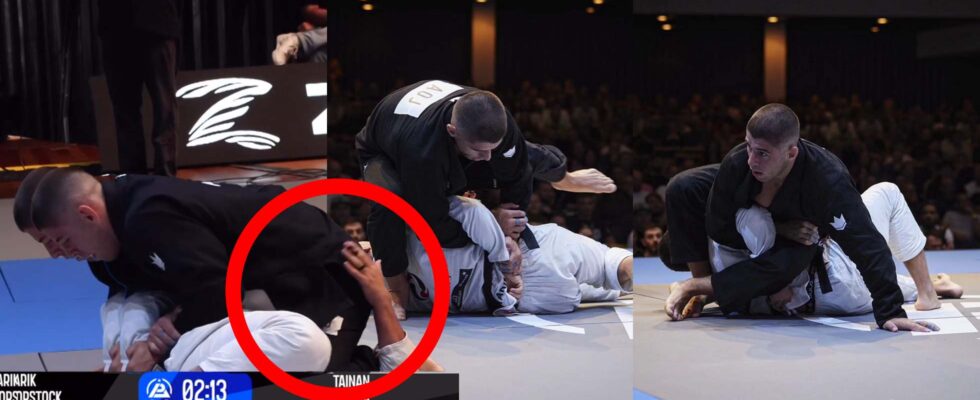
Hopstock immediately pulls guard, looking to attack Dalpra’s legs. Dalpra is able to start passing and maintain top position.
Dalpra starts working to pass Hopstock’s guard, using his technique and excellent mobility. He passes the guard, goes knee on belly. Goes straight to mount. Hopstock struggles to reguard initially but manages a reverse closed guard. He tries to go for Dalpra’s leg from this poisition.
The two grapple back and forth, with Dalpra maintaining control for the most part. Dalpra opens the reverse closed guard twice, the second time Hopstock can’t reguard. Dalpra advances to North south position.
Midway through the match, Dalpra starts looking to set up a Tarikoplata, a modified kimura lock that Hopstock is known for. Hopstock defends well initially, not wanting to get caught in his own signature submission.
The crowd gets excited as Dalpra continues to threaten with creative entries and transitions, but Hopstock’s defense holds strong. With a couple minutes remaining, Dalpra finally secures the Kimura grip and forces Hopstock to tap out.
ainan Dalpra locked in a submission against Tarik Hopstock. What should have been a straightforward submission win turned into a hot topic among BJJ fans, as many questioned whether Dalpra respected the tap, or if the referee’s indecision was to blame.
As opinions flood in, there seems to be a consensus among grapplers and spectators alike: the responsibility ultimately lies with the referee. In BJJ, the tap is often seen as a way of conceding a match to avoid injury, but it’s also the referee’s job to recognize it and halt the bout. Many are pointing fingers at the ref for not immediately stepping in, claiming that the situation escalated because of a lapse in officiating. Some feel that Dalpra was waiting for official confirmation to release the submission, as is common in high-stakes tournaments, while others think he held on a bit too long, trying to prove a point.
In many grappling sports, competitors are trained to continue progressing their position until the official steps in, especially in cases where a submission might not be clearly visible to the referee. A lot of frustration from fans stems from the belief that Dalpra, while perhaps overly cautious, did what any high-level athlete would do — secure his win and wait for the ref to intervene.
On the flip side, some argue that there’s an unspoken rule among competitors that the tap should always be respected, ref or no ref. If an opponent taps, many feel that the submission should be released, trusting that the other party isn’t faking it. As one commentator suggested, the real issue is that there’s room for ambiguity. In competitive BJJ, the stakes are high, and leaving any gray area can lead to misunderstandings or, worse, injury.
Tainan Dalpra continues submission after Tarik taps to kimura
byu/sledyeller inbjj
