
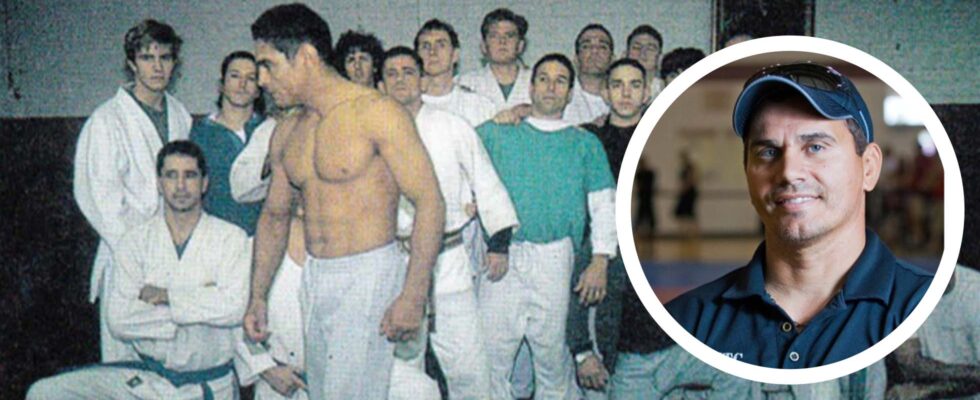
Roland Sarria’s Brazilian Jiu-Jitsu journey began in the summer of 1994 at Rickson Gracie’s West LA academy, marking the start of what would become a significant career in martial arts. After a chance encounter with Carlos Ves at a park, where Ves demonstrated his grappling skills, Sarria was immediately drawn to train at Rickson’s gym.
The academy, described by Sarria as a “hole in the wall” karate studio located in a back alley, was where he trained under instructors including Rickson Gracie. Despite having no prior martial arts background, Sarria’s natural athleticism made him a valuable training partner, often being used to test techniques against stronger opponents.
During his time at Rickson’s gym, Sarria witnessed notable moments in BJJ history, including a famous challenge match between Rickson and Japanese wrestler Yoji Anjo. The match ended with Rickson dominating his opponent in what Sarria described as an old-fashioned Brazilian vale tudo beating.
The Cult-Like Environment
In a revealing interview on the Lytes Out podcast, Sarria opened up about his experiences training at Rickson Gracie’s West LA gym in the mid-1990s and his eventual departure from the legendary academy.
“American guys followed the pack like, like little, like little, like little sheep. And yeah, they were like little sheep, and the shepherd was misleading them into the cave with the wolves. I used to sit there and warn them, saying, “Hey, dude, don’t fall for that **** dude. Trust me, I’ve been there already, man.” But they wouldn’t listen to me.”
Sarria described the environment as “primitive” and “disorganized,” noting that while the instruction was excellent, there was an exclusionary culture that made him feel like an outsider. “I knew early on that I wasn’t part of the Brazilian cult,” Sarria explained. “Back in those days it felt like a cult and I knew that I was going to be limited on my growth.”
“It felt like they were a little bit threatening, and they were trying to sort of—I wouldn’t say keep you down—but, you know, you had to do a lot of privates, and it was very secretive back then.”
The cultural challenges weren’t just social. Sarria noted that Brazilian students would frequently smoke up together after class and socialize in ways that made him feel like an outsider. Despite taking private lessons with instructors to advance more quickly, Sarria found the environment overly restrictive. “It was very secretive back then,” he recalled. “I wasn’t really totally in their circle.”
“I don’t think it was personal. I think it was just the way it was back then. I felt very liked by them—don’t get me wrong—they treated me great. It just felt like a cult to me, like, you know, I wasn’t really totally in their circle. A lot of them just wanted to smoke weed and whatever, and I wasn’t really into that.”
Competitive Tensions and Departure
Sarria particularly took issue with what he saw as favoritism during competitions, noting “I don’t like getting on the mat with some Brazilian from Brazil and my own instructors are coaching the other guy instead of me.” He described witnessing Brazilian instructors actively coaching against non-Brazilian students during competitions, even when those students trained at their academy.
The breaking point came when Sarria realized he didn’t fit into what he described as an insular Brazilian culture: “It was just too clicky, it was just too Brazilian for me that I wasn’t used to that and I didn’t like it.”
After leaving Rickson’s academy, Sarria went on to train under Ken Gabrielson, an American black belt, where he says he found a more welcoming environment. “After I left, I felt their wrath at every tournament,” Sarria recalled. “When I went to Ken Gabrielson, a white American black belt, I took so much sh*t from those guys. Conan Silveira was setting me up with all these Brazilian champions at every belt level.”
Self-Promotion Controversy
Around 2000, Sarria faced significant criticism from the Brazilian Jiu-Jitsu community after promoting himself to black belt.
“Instructors got black belts inside the academy, but they never competed in their lives—those cowards. Yet, they want to make fun of me when I competed against the best of the best, and they did not.”
“Rigan Machado called me, and I was a brown belt at the time. Had a super match with David Meyer, and I turned around and said, “Well, I’m not a black belt.” And then Higan says, “Come on, Roland, you can compete with black belts or whatever.” I said, “Yeah, I’ll take them on.” So, I went out there, we went 10 minutes, no score, and they gave him an advantage point. Then some Brazilian came up to me and said, “Hey, who promoted you?” I looked at the monkey and said, “You saw the match, right?” He goes, “Yeah.” I said, “Do I look like a black belt?” He didn’t say anything. I said, “I’ll tell you who promoted me—God did.””
The controversial decision came after a super match with David Myers.
His decision to self-promote came during an era when many early American practitioners felt systematically held back from achieving black belt rank. Notable figures like Joe Paro and Bo Herburger similarly struggled to receive promotions despite high-level competitive achievements.
Herberger actually came in third in Abu Dhabi, and they wouldn’t promote him to black belt still.
While controversial, Sarria remained unapologetic about his decision: “Let’s talk about kind of quantify this – how many guys you know that had the balls to do that back in those days?”
Reflection
While Sarria maintains he was treated well personally by Rickson and his instructors, his candid revelations provide a rare glimpse into the cultural dynamics of one of jiu-jitsu’s most famous academies during the early days of the sport’s expansion in America.
Sarria’s story mirrors those of other early American BJJ pioneers who faced similar challenges breaking into what was then a very Brazilian-dominated martial art. He would later become a prominent MMA promoter in Arizona, founding the Rage in the Cage promotion which helped launch many future UFC stars’ careers.
