
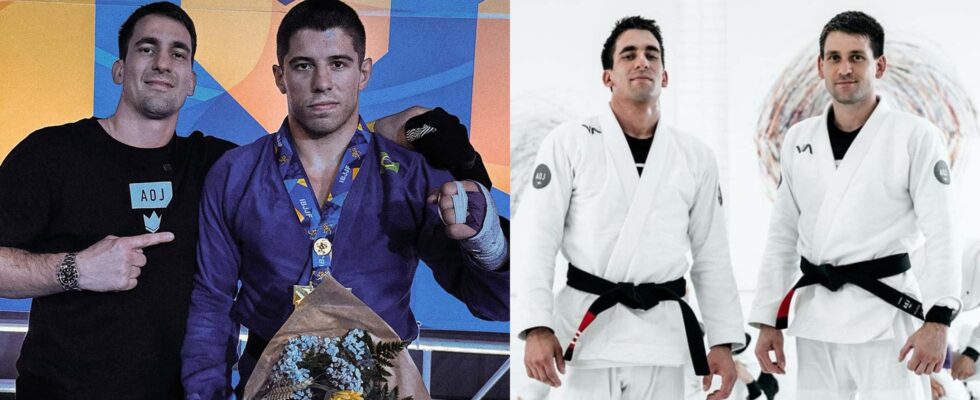
Art of Jiu-Jitsu (AOJ) continues to set itself apart—not just with its crisp white mats and aesthetic branding, but with a training philosophy that challenges the conventional. One of AOJ’s most unorthodox approaches? Running 3-minute training rounds while most of the jiu-jitsu world sticks to 6-minute or longer rounds.
This seemingly minor tweak in training structure has profound implications, as highlighted by AOJ competitor Margot Ciccarelli in a recent interview on Grapple Asia. Ciccarelli, who made the switch from the grind-heavy environment of Unity Jiu Jitsu to AOJ, initially struggled with the shorter rounds but has since embraced them fully.
The Shift from Long-Form to Short-Form Jiu-Jitsu
Ciccarelli, known for her intricate and methodical approach to jiu-jitsu, admitted the adjustment wasn’t easy.
“I was like ‘listen, I don’t know how to do jiu-jitsu in three minutes, all of my jiu-jitsu is so elaborate.'”
Coming from an environment where 8-10 minute rounds were the norm, Ciccarelli had to rethink her strategy. AOJ’s 3-minute rounds force competitors to engage with a greater sense of urgency, prioritizing quick scoring and positional control over slow-burn setups.
“I would consider my jiu-jitsu to be long-form jiu-jitsu. Short-form jiu-jitsu I would consider to be something that is very effective—when we say sentences out loud we can say something very concisely to the point, that’s short form.”
The Psychological Adjustment
Beyond the physical adaptations, training at AOJ required a psychological reset. Ciccarelli noted that the academy’s structured approach—starting classes at 6 a.m. and maintaining an intense competition focus—forced her to rethink her entire routine.
“I had to really try and understand: what is it that I’m being asked to accomplish in this competition class? What am I trying to get out of this?”
She credits AOJ’s environment, led by Gui Mendes, for breaking her out of previous mental barriers and pushing her to new heights. The results? According to Ciccarelli, more personal growth in six months at AOJ than in the last five years combined.
“I have a very strong bias and preference to three-minute rounds now—I couldn’t have said that if you had spoken to me late last year.”
The “Superfight Circle” and High-Pressure Training
Another unique element at AOJ is their “superfight circle,” where students gather to watch training rounds as if they were actual matches. This creates an additional layer of pressure, reinforcing the need for fast and decisive action—something that 3-minute rounds naturally emphasize.
While some may argue that short rounds limit deeper positional development, the success of AOJ competitors speaks for itself. The methodology fosters an environment where athletes become accustomed to competition-style pacing, ensuring they can execute under high-pressure conditions.
Will the Trend Catch On?
As jiu-jitsu evolves, AOJ’s training philosophy may influence broader trends in the sport. While traditionalists may resist the shift from longer rounds, it’s hard to ignore the results. Ciccarelli’s transformation and AOJ’s continued success suggest that perhaps the rest of us should reconsider how we structure our training.
Shorter rounds might not just be an AOJ quirk—they could be the key to faster, more efficient skill development in modern competitive jiu-jitsu.
