
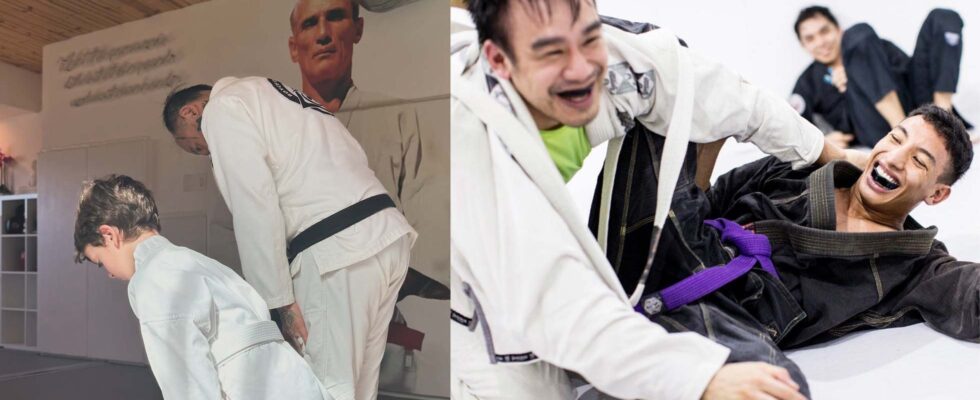
There’s a fine line between healthy respect for tradition and unhealthy devotion. Chris Haueter, a member of the prestigious “Dirty Dozen” (the first 12 non-Brazilian BJJ black belts), recently discussed this distinction on his podcast “Combat Base,” offering valuable insights on cult-like behaviors in martial arts communities.
Understanding Cult Dynamics in Martial Arts
“Everything is a spectrum,” Haueter explains when discussing cult-like behaviors. “Something isn’t automatically a cult or automatically not.”
This nuanced perspective acknowledges that even healthy communities can have cult-like elements, while people can participate in cult-like organizations without fully subscribing to their doctrines.
What makes a martial arts community unhealthy? According to Haueter, key warning signs include:
- Unquestioning loyalty to a leader
- Isolation and control of members
- Fear and manipulation tactics
- Secretiveness
- Shaming or banishing members who leave
These characteristics appear in varying degrees across different martial arts schools, with some crossing into dangerous territory while others maintain mostly healthy environments with occasional problematic elements.
The False Promise of Power
“Cults usually have an underlying, often subliminal promise of power, sex, or wealth,” Haueter notes.
This insight is particularly relevant to martial arts, where the acquisition of fighting skills inherently involves power dynamics.
The appeal is understandable—many people join martial arts communities seeking structure, belonging, and a sense of control.
“Most people that are attracted to cults have an insecurity and they feel like they have no control over their life,” Haueter observes. “They often feel like the world around them is chaos, and the cult brings a sense of order and control to that chaos.”
Martial Arts Communities: When They Cross the Line
Haueter recounts a troubling example from about 15 years ago, where a BJJ instructor had created an environment where students lived at the school. What began as a successful competition team evolved into something more sinister, with allegations of sexual abuse eventually emerging. The structure protected the leader until defections began.
This scenario illustrates how martial arts can become breeding grounds for cult-like dynamics:
- The hierarchical belt system creates built-in authority structures
- The physical nature of training involves submission and control
- The promise of special knowledge or power appeals to insecurities
- The community aspect fulfills the human need for belonging
Healthy Respect vs. Unhealthy Worship
A critical distinction emerges in Haueter‘s discussion: there’s a difference between respecting experience and worshiping a leader.
“It’s not to say though that it’s not healthy and good to respect the elders,” Haueter emphasizes. “You need to respect the elders, but there is a difference between respect and worship. Respect is important, but it’s mutual respect. Elders should respect younger people as well.”
The healthier approach, as Haueter notes, is when practitioners are “more into the thing rather than the leader.” Using Judo as an example, he points out that Jigoro Kano (Judo’s founder) is respected for establishing the art rather than being idolized as an unbeatable figure.
Warning Signs for Practitioners
Several warning signs emerged from the discussion that practitioners should watch for:
- Instructors who control where students can train
- Repercussions for training elsewhere or being photographed at other academies
- The idea that no one will ever surpass the master’s abilities
- Unhealthy identification with the art (where an injury becomes “the end of the world”)
- Excessive focus on student retention rather than student development
Finding Balance
For those concerned about unhealthy dynamics, Haueter suggests developing values that define yourself beyond your affiliation with any particular group.
“As an individual, you might want to consider having a value set that allows you to define yourself that’s not your affiliation with something.”
The podcast co-host adds: “Jiu-Jitsu should enhance my life, not become this source of ad diction… I have to win, I have to become the best… my self-worth [shouldn’t be tied to] showing up to the mat this amount of time.”
This balanced approach allows practitioners to enjoy the benefits of martial arts communities while maintaining the freedom and perspective to recognize when dynamics become unhealthy.
For the BJJ community, Haueter‘s message is clear: learn from experience, respect tradition, but maintain enough independence to recognize when loyalty becomes blind devotion. The martial arts journey should enhance your life, not consume it.
