
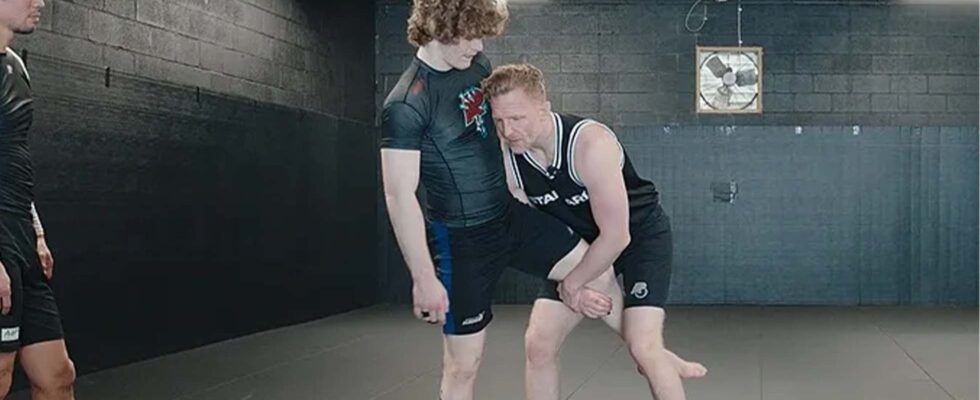
In one of the most provocative statements to emerge from the Brazilian Jiu-Jitsu community in recent years, ecological training advocate Greg Souders has boldly declared that
“moves aren’t basic and moves aren’t fundamental. Basics are functional things based on what’s happening within that environment. Foundations or fundamentals are not specific things. They’re functional things uh based on what’s going on within that environment.”
The Foundation of a Revolutionary Perspective
Souders’ rejection of fundamentals isn’t merely contrarian – it stems from his comprehensive understanding of the ecological approach to skill acquisition. Having trained under Lloyd Irvin from 2004 to 2013 alongside elite practitioners like Ryan Hall, DJ Jackson, and Mike Fowler, Souders experienced firsthand the traditional drilling-heavy methodology that dominates most Brazilian Jiu-Jitsu academies.
“We were big on [drilling],” Souders acknowledges of his formative years. “We had specific drilling practices and a way we were asked to do it and way we were told to do it.”
Redefining Fundamentals Through Environmental Context
Central to Souders’ argument is his belief that what the martial arts community traditionally considers “fundamentals” are actually functional adaptations based on environmental conditions rather than inherently basic techniques.
“Basics are functional things based on what’s happening within that environment.”
This perspective flows directly from Souders’ ecological approach to skill acquisition, which he defines as “a view of how to acquire skill based on the understanding of the relationship between the individual, the task, and environment system.” In this framework, behavior emerges from the dynamic interaction between these three elements, making movements and techniques highly sensitive to contextual variables.
Rather than viewing an armbar, triangle, or guard pass as a fundamental technique to be drilled repeatedly, Souders sees these as emergent solutions that arise from specific environmental pressures and constraints. The implication is profound: if techniques emerge from context, then removing that context through traditional drilling strips away the very conditions that make them effective.
The Challenge to Traditional Pedagogy
Souders’ stance directly confronts the pedagogical foundation upon which most martial arts instruction is built. Traditional Brazilian Jiu-Jitsu instruction typically begins with what are considered “fundamental” techniques – basic positions, escapes, and submissions that form the building blocks for more advanced skills.
During his debate with Firas Zahabi, this philosophical divide became particularly apparent. Zahabi, who comes from a systematic training background influenced by John Danaher‘s methodical approach, defended the value of drilling fundamentals:
“Because the Gracies figured it out, they taught it to us in such a short period of time… we had a massive edge just by drilling the stuff that they discovered.”
This represents a classic tension between two educational philosophies: the building-block approach that sees complex skills as combinations of simpler fundamental elements, versus the ecological approach that views skills as emergent properties of environmental interaction.
The Muscle Memory Controversy
Souders’ rejection of fundamentals extends to his controversial denial of muscle memory itself.
“Automaticity or muscle memory, these are not real things,”
he declared, challenging one of the most widely accepted concepts in martial arts training.
This statement prompted Zahabi to defend the neurological basis of repetitive practice:
“If you’ve repeated it more and more often, if you do it on a regular basis, you could do it quicker, faster, and with less energy.”
Following their debate, Zahabi provided scientific backing for his position, citing research on motor learning and neuroplasticity. He referenced studies showing that “muscle memory” – scientifically termed “motor learning” – is indeed an empirical phenomenon rooted in neurological adaptations. As Zahabi explained, when we repeatedly practice movements, the brain’s motor cortex forms new neural pathways through synaptic plasticity, strengthening connections between neurons. Over time, these established pathways allow movements to become more automatic, requiring less conscious effort.
Souders countered that
“there’s no direct correlation between how much you repeat a movement and its neurological robustness.”
Instead, he argues that adaptation comes from exposure to varied resistance in context-specific environments, suggesting that the traditional understanding of muscle memory oversimplifies how skills actually develop.
The Ecological Alternative to Fundamentals
If moves aren’t fundamental, how does Souders propose that students develop essential skills? His answer lies in what he calls “scaled live training” with specific constraints that create learning environments more closely resembling actual application.
“We would start with the experience we would need to have to start getting people doing arm locks,” Souders explains. “We would define it for them, then put them right in the situation and have them start performing tasks that allow them to build the skills to arm lock.”
Rather than drilling an armbar step-by-step, Souders might place students directly in the finishing position and give them specific tasks: the attacking student must maintain control while the defending student attempts to escape. This creates immediate problem-solving scenarios that develop functional skills within realistic constraints.
“The coordination pattern that we develop is very sensitive to the environment in which it’s developed,” Souders explains. “Rather than build coordination in an athlete in a static environment, we build the coordination in the athlete in a resistant environment.”
Practical Implications for Training
Souders’ rejection of fundamentals has profound implications for how Brazilian Jiu-Jitsu should be taught and learned. Instead of progressing through a predetermined curriculum of fundamental techniques, students would be exposed to constrained problem-solving scenarios from day one.
The ecological approach emphasizes three key principles: maintaining contextual dependence, embracing variation in application, and preparing for adaptation to novelty. By keeping as much context as possible in training, embracing variability, and preparing for novel situations, practitioners develop more adaptable skills that transfer effectively to competitive environments.
“We want to use live resistance,” Souders explained. “The problem with using live resistance is scalability.”
His solution involves breaking down complex situations into manageable components while maintaining the essential element of resistance, allowing students to develop functional skills within realistic frameworks.
The Academic Foundation
Souders’ perspective draws heavily from ecological psychology and contemporary skill acquisition research, particularly the constraints-led approach to learning. This academic foundation provides theoretical support for his practical observations about the limitations of traditional drilling methods.
“The funniest thing to me about drilling… is you see drillers do all this nuance crazy stuff and you watch their matches. It looks nothing like that,”
Souders observed. This disconnect between drilling performance and competitive application reinforces his belief that skills developed in isolation don’t transfer effectively to dynamic, resistant environments.
Despite his criticism of traditional training methods and instructional content, Souders has recently entered the instructional market himself.
“We just put out our first like purchase instructional… just a way we can organize practice for standing, learning how, and it was all centered around the single leg and the conditions that let it happen,”
he revealed.
This apparent contradiction highlights the practical challenges of disseminating revolutionary training methodologies. While Souders criticizes traditional instructionals for focusing on technique accumulation, he clarifies that his content differs by emphasizing practice design rather than technique catalogs.
“We’re trying to enter the instructional market by offering a new way to consume instructional material that’s not just a collection of facts but a way you can use knowledge and apply it directly to practice design,”
Souders explained.
Finding Middle Ground
During his discussion with Zahabi, both coaches found some common ground despite their philosophical differences. Zahabi expressed interest in incorporating elements of Souders’ approach into his own coaching, demonstrating the kind of open-mindedness that has helped Brazilian Jiu-Jitsu evolve beyond its traditional roots.
“I think it’s a blend of the two… they both bring something to the table. Not one of them brings something perfect,”
Zahabi concluded, suggesting that the most effective training approaches might combine elements from both traditional and ecological methodologies.
