Gordon Ryan has publicly challenged the legitimacy of the Craig Jones Invitational 2 (CJI 2) results in a detailed social media post accompanied by contract documentation. His team, New Wave Jiu-Jitsu, lost in the finals but Ryan claims they should have been declared winners based on the original contractual rules.
The Core Argument: Tiebreaker Rule Changes
Ryan’s primary argument centers on conflicting tiebreaker rules. According to the contract documentation he provided, the original tiebreaker rule (which he calls “Bullet 1”) stated: “In the event of five double eliminations, or any such instance where each teams final athletes are double eliminated, the team with more individual wins by judges decisions wins.”
However, an additional rule was allegedly added later (which Ryan calls “Bullet 2”): “If tied on scorecard, the teams whose athlete won the final bout wins.”
Ryan argues this second rule was not in the original athlete contracts and directly contradicts the first rule. The contract images show Clause 7.5, which states: “No variation of this Agreement is of effect unless it is in writing and signed by both parties.”
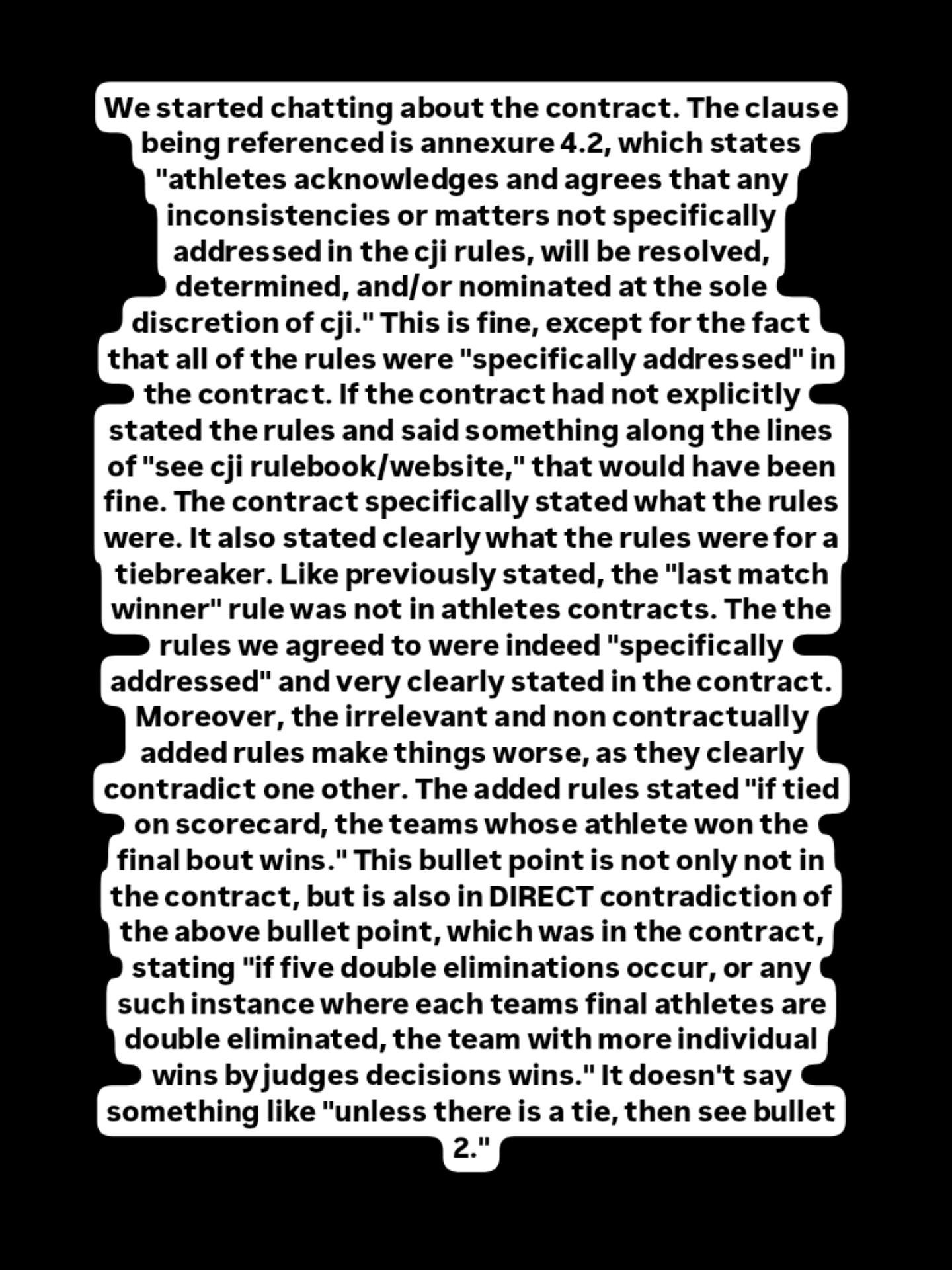
Ryan cites Annexure 4.2 of the contract, which gives CJI discretion over “inconsistencies or matters not specifically addressed in the CJI rules.” His counterargument is that the tiebreaker rules were explicitly addressed in the original contract, making this discretionary clause inapplicable.
From a contract law perspective, Ryan’s argument has some merit. If the original contract explicitly stated the tiebreaking procedure and required written agreement from both parties for modifications, then unilateral rule changes could constitute a breach of contract. However, the enforceability would depend on specific legal jurisdictions and how courts interpret sports competition contracts.
Beyond the tiebreaker dispute, Ryan raises several administrative concerns that have largely been addressed by tournament organizers:
Seeding Controversies – Already Addressed
Ryan claims unfair seeding that forced New Wave to face stronger teams earlier. He cites ADCC credentials: Team Atos had 6 ADCC golds, New Wave had 3, while B Team (given the #1 seed) had 0.
However, Craig Jones has explained that he specifically asked John Danaher to name the #4 seed, which Danaher then designated as B-Team. This reveals that New Wave had direct input into the tournament structure they’re now complaining about. If Ryan genuinely believed the seeding was unfair, the appropriate time to object was before competition began, not after losing. The fact that his own coach participated in the seeding process completely undermines this complaint.
Scoring Inconsistencies – Thoroughly Explained
Ryan challenges the 10-8 scoring in the final round, arguing that if this round merited a 10-8 score for “overwhelming dominance,” then other similar performances throughout the tournament should have received the same scoring. He specifically mentions instances where Dorian dominated Crelinsten ‘more decisively’ but received standard 10-9 scores.
Head judge Miha Perhavec, who resigned after the event due to the controversy, has provided detailed breakdowns of the disputed rounds that completely refute Ryan’s claims:
- For the Dorian versus Ethan match, Perhavec explained how the score shifted from a dominant 10-8 for Dorian to a closer 10-9 when Ethan’s defensive work and submission attempts in the final minutes changed the dynamic.
- Regarding the Nicky versus Luke match, Perhavec highlighted how Nicky’s takedown, guard passing and late submission attempts, particularly a north-south choke and triangle attempt, earned him the 10-8 victory despite a competitive opening phase.
Both Jones and Perhavec stressed that the judging was unanimous and consistent with pre-established criteria focusing on initiating effective action, close submissions, dynamic actions and positional control. The controversy ultimately stemmed from misunderstanding the cumulative scoring system rather than any judging bias, with all coaches having agreed to these rules during pre-event meetings.
Wildcard Allocation – Factually Incorrect
Ryan alleges Team Atos received 2 wildcards while other teams received only 1, claiming this was only changed after backlash and when other roster spots were filled, making the correction irrelevant.
This claim appears to be factually incorrect – both New Wave and Atos had 2 wildcards. If Ryan actually had a problem with wildcard distribution, he should have gotten his team to withdraw rather than complaining after the fact, knowing he wouldn’t have complained had they won.
Financial Allegations – The Numbers Don’t Add Up
Ryan’s post includes allegations about financial impropriety, claiming:
- CJI initially promised $1 million payouts that were later rescinded
- Prize money was “80% LESS per athlete than it was the year before”
However, the actual prize structure contradicts these claims:
- CJI 2 promised and delivered: $1 million to the winning team, $10,002 show money to every competitor, and $100,000 to winner of the 4-person bracket
- Unexpected bonuses: An additional $250,000 in submission bonuses ($50k each) that came on day 2
- Mathematical comparison: CJI 1 had 32 competitors in two brackets plus special matches, while CJI 2 had 40 competitors (8 teams × 5), making the per-competitor show money essentially equivalent
Ryan’s claim of drastically reduced payouts appears to play at the fact there was a single tournament over two individual ones. Given the time constraints, it would be hard to jam another bracket into what already turned out to be close to 14 hours of BJJ competition in two days.
Why It’s Hard to Take Ryan Seriously
Ryan’s use of juvenile nicknames like “crooked creg” and “sackless seth” completely undermines any legitimate points he might have. This isn’t just unprofessional – it reveals someone more interested in public tantrum-throwing than serious dispute resolution. When you’re making legal arguments about contract breaches, credibility is everything. Ryan’s tone makes him sound like a sore loser rather than someone with genuine grievances.
The Bad Faith Timeline
The most damaging aspect to Ryan’s case is that many of his “concerns” were actually known conditions that his team explicitly agreed to participate under:
- Seeding was collaborative – his own coach participated in the process
- Wildcard distribution was equal – his claims of preferential treatment are factually wrong
- Judging criteria were agreed upon – all coaches signed off on the rules beforehand
- Prize structure was transparent – the financial terms were known in advance
This transforms his complaints from legitimate grievances into what appears to be sour grapes from a losing competitor.
The “Would They Complain If They Won?” Test
Ryan’s post-facto complaints fail the most basic credibility test: would he have raised these same concerns if New Wave had won? The obvious answer is no. This selective outrage over rules and procedures that were acceptable when he thought his team might benefit reveals the bad faith nature of his arguments.
Problems with Ryan’s Argument
While Ryan raises some technical contractual concerns, several issues severely weaken his case:
Selective Evidence and Confirmation Bias
While Ryan provides contract excerpts, he acknowledges these are “not the entire rules sheet.” Without complete documentation, it’s difficult to fully evaluate competing interpretations. Additionally, Ryan’s interpretation consistently favors his team’s position, suggesting confirmation bias rather than objective analysis.
Contract Law Reality Check
Even if Ryan’s contract interpretation were correct, courts and arbitrators consider the totality of circumstances, including:
- Whether parties acted in good faith
- Industry customs and practices
- Whether complainants participated despite knowing the allegedly problematic conditions
- The reasonableness of interpretations
Ryan’s behavior fails most of these tests, severely weakening any potential legal case.
Industry Impact and Broader Issues
This dispute highlights legitimate concerns about combat sports governance:
- Contract Clarity: The need for unambiguous rules and modification procedures
- Tournament Integrity: How rule changes during competitions affect legitimacy
- Financial Transparency: Athlete payment obligations and prize structure communications
- Dispute Resolution: Lack of standardized arbitration processes in BJJ competitions
However, Ryan’s approach – waiting until after losing to raise concerns he could have addressed beforehand – sets a dangerous precedent that could undermine future tournament legitimacy.
A Case Study in Bad Faith
Gordon Ryan’s complaints represent a textbook example of post-hoc rationalization by a disappointed competitor. While his core argument about unauthorized rule changes might have technical merit if proven, the combination of:
- Participating despite knowing the conditions he now objects to
- Waiting until after losing to raise concerns
- Making factually incorrect claims about wildcards and prize structures
- Ignoring expert explanations of judging decisions
- Using inflammatory language that undermines his credibility
…makes it nearly impossible to take his arguments seriously, regardless of their technical merits.
Whether Ryan’s team was truly wronged remains a matter of legal interpretation that would likely require independent arbitration or court proceedings to resolve definitively. What’s clear is that this dispute has exposed significant gaps in how major BJJ competitions are administered – but Ryan’s inflammatory approach and selective outrage make him an unreliable messenger for these otherwise important reforms.
Unfortunately, Ryan’s tantrum-like response does more to damage the sport’s credibility than to advance these necessary improvements.
Full rant below:
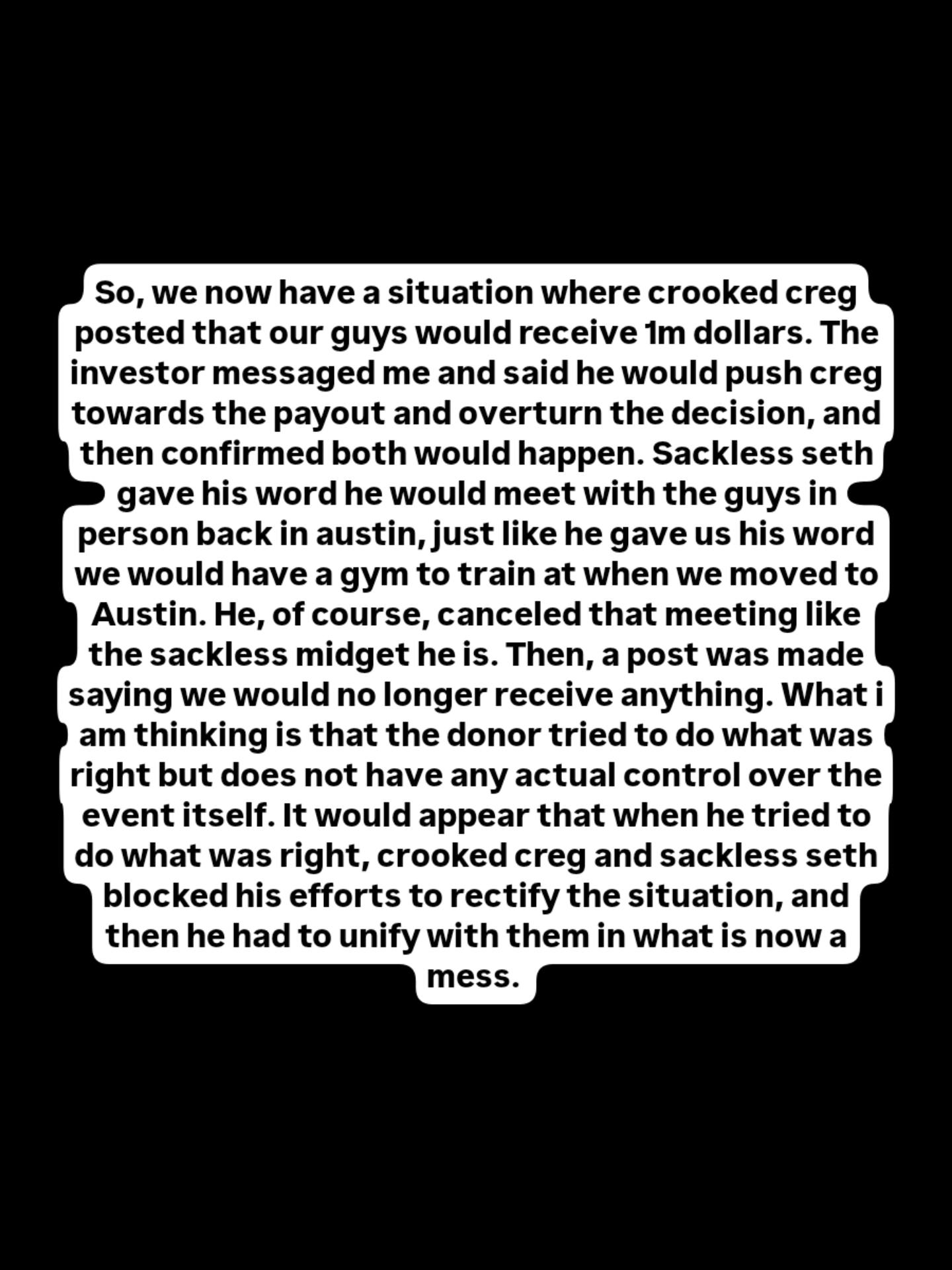
“So, we now have a situation where crooked Creg posted that our guys would receive $1 million. The investor messaged me and said he would push Creg towards the payout and overturn the decision, then confirmed both would happen. Sackless Seth gave his word he would meet with the guys in person back in Austin, just like he gave us his word we would have a gym to train at when we moved to Austin. He, of course, canceled that meeting like the sackless midget he is. Then, a post was made saying we would no longer receive anything. What I am thinking is that the donor tried to do what was right but does not have any actual control over the event itself. It would appear that when he tried to do what was right, crooked Creg and sackless Seth blocked his efforts to rectify the situation, and then he had to unify with them in what is now a mess.
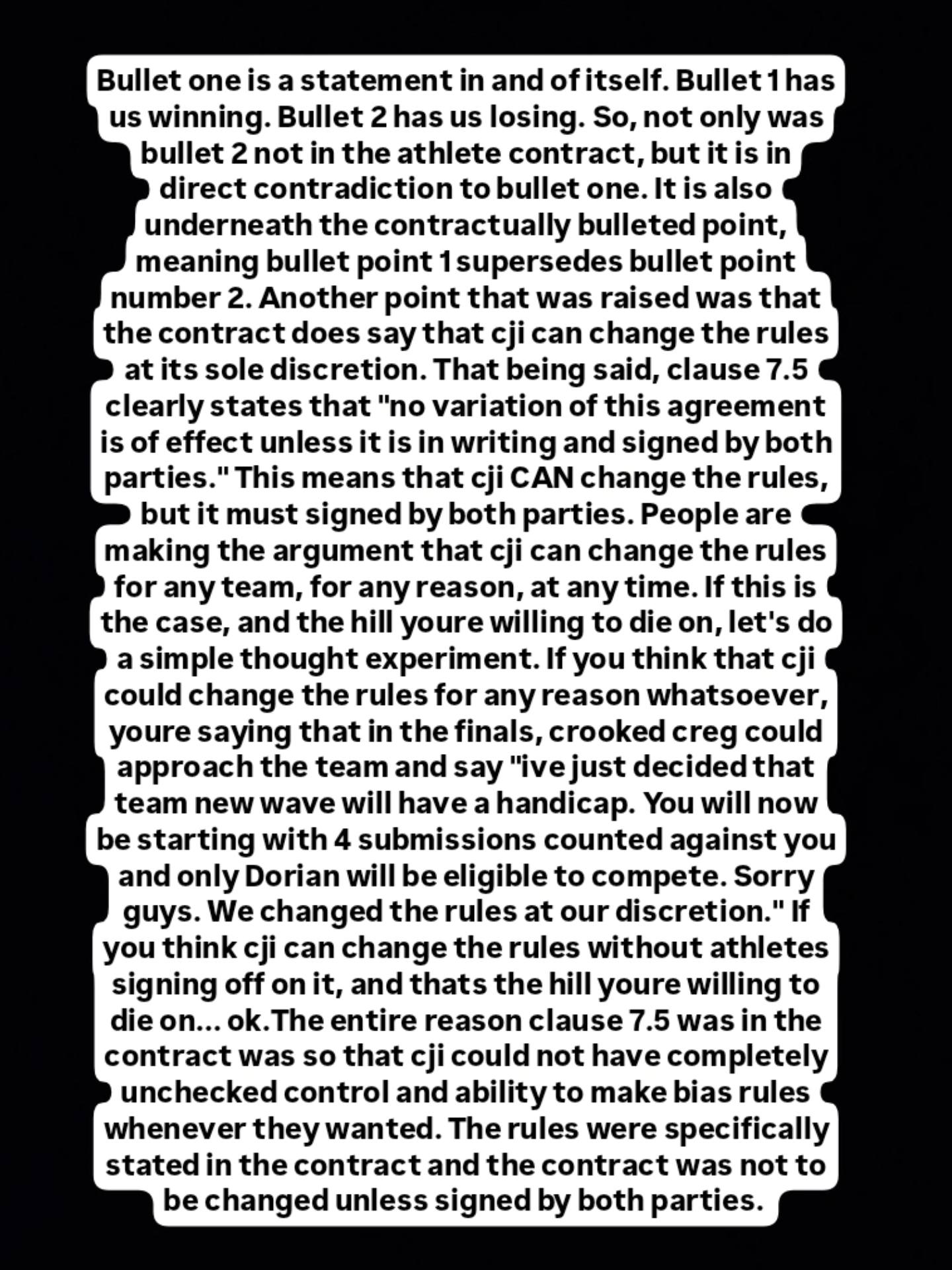
Bullet one is a statement in and of itself. Bullet 1 has us winning. Bullet 2 has us losing. So, not only was bullet 2 not in the athlete contract, but it is in direct contradiction to bullet one. It is also underneath the contractually bulleted point, meaning bullet point 1 supersedes bullet point number 2. Another point that was raised was that the contract does say that CJI can change the rules at its sole discretion. That being said, clause 7.5 clearly states that “no variation of this agreement is of effect unless it is in writing and signed by both parties.” This means that CJI CAN change the rules, but it must be signed by both parties. People are making the argument that CJI can change the rules for any team, for any reason, at any time. If this is the case, and the hill you’re willing to de on, let’s do a simple thought experiment. If you think that CJI could change the rules for any reason whatsoever, you’re saying that in the finals, crooked Greg could approach the team and say “I’ve just decided that team New Wave will have a handicap. You will now be starting with 4 submissions counted against you and only Dorian will be eligible to compete. Sorry guys. We changed the rules at our discretion.” If you think CJI can change the rules without athletes signing off on it, and that’s the hill you’re willing to de on… ok. The entire reason clause 7.5 was in the contract was so that CJI could not have completely unchecked control and ability to make biased rules whenever they wanted. The rules were specifically stated in the contract and the contract was not to be changed unless signed by both parties.
We started chatting about the contract. The clause being referenced is annexure 4.2, which states “athlete acknowledges and agrees that any inconsistencies or matters not specifically addressed in the CJI rules, will be resolved, determined, and/or nominated at the sole discretion of CJI.” This is fine, except for the fact that all of the rules were “specifically addressed” in the contract. If the contract had not explicitly stated the rules and said something along the lines of “see CJI rulebook/website,” that would have been fine. The contract specifically stated what the rules were. It also stated clearly what the rules were for a tiebreaker. Like previously stated, the “last match winner” rule was not in the athletes’ contracts. The rules we agreed to were indeed “specifically addressed” and very clearly stated in the contract. Moreover, the irrelevant and non-contractually added rules make things worse, as they clearly contradict one another. The added rules stated “if tied on scorecard, the team whose athlete won the final bout wins.” This bullet point is not only not in the contract, but is also in DIRECT contradiction of the above bullet point, which was in the contract, stating “if five double eliminations occur, or any such instance where each team’s final athletes are double eliminated, the team with more individual wins by judges’ decisions wins.” It doesn’t say something like “unless there is a tie, then see bullet 2.”
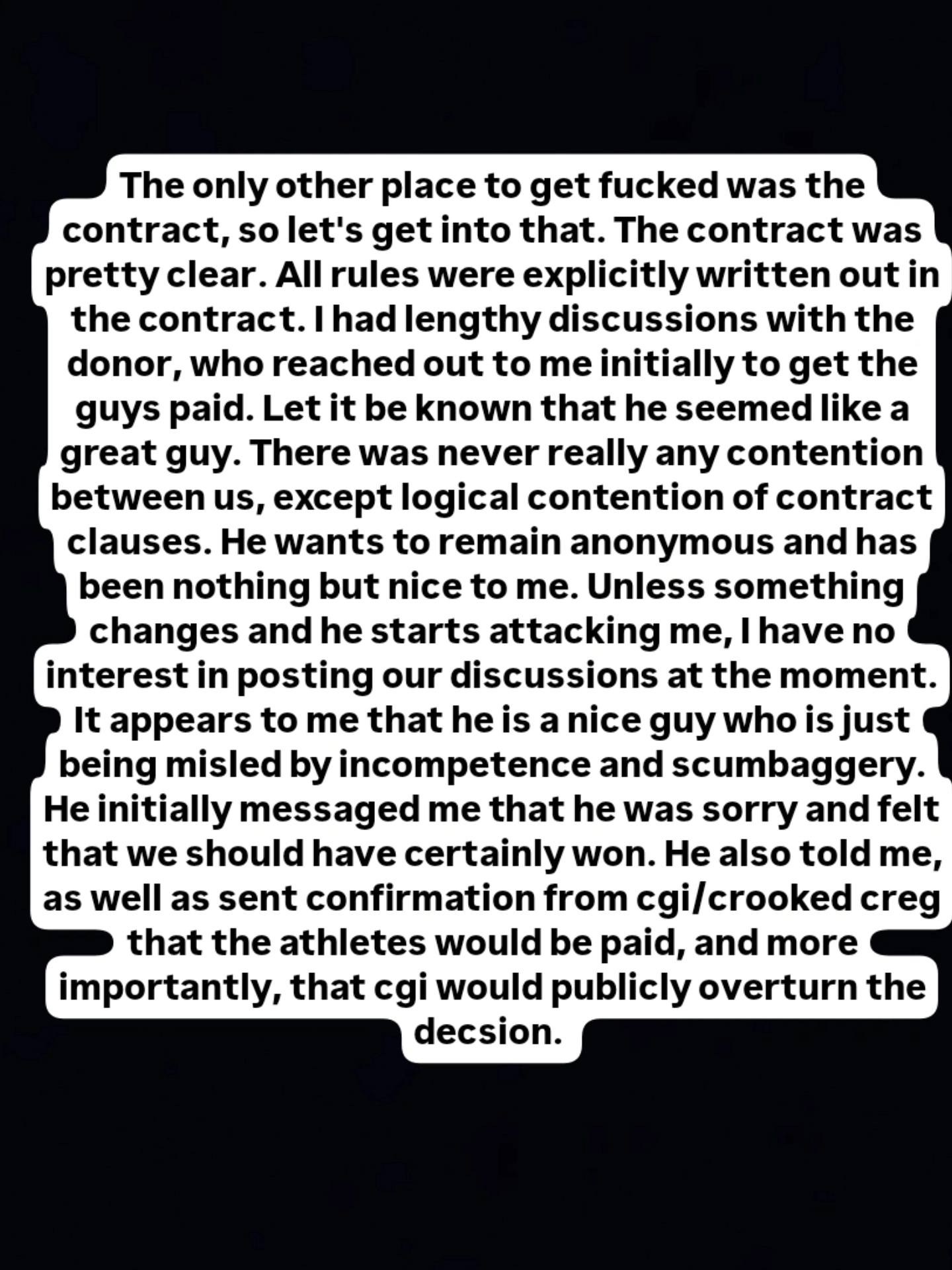
The only other place to get screwed was the contract, so let’s get into that. The contract was pretty clear. All rules were explicitly written out in the contract. I had lengthy discussions with the donor, who reached out to me initially to get the guys paid. Let it be known that he seemed like a great guy. There was never really any contention between us, except logical contention of contract clauses. He wants to remain anonymous and has been nothing but nice to me. Unless something changes and he starts attacking me, I have no interest in posting our discussions at the moment. It appears to me that he is a nice guy who is just being misled by incompetence and scumbaggery. He initially messaged me that he was sorry and felt that we should have certainly won. He also told me, as well as sent confirmation from CJI/crooked Greg that the athletes would be paid, and more importantly, that CJI would publicly overturn the decision.
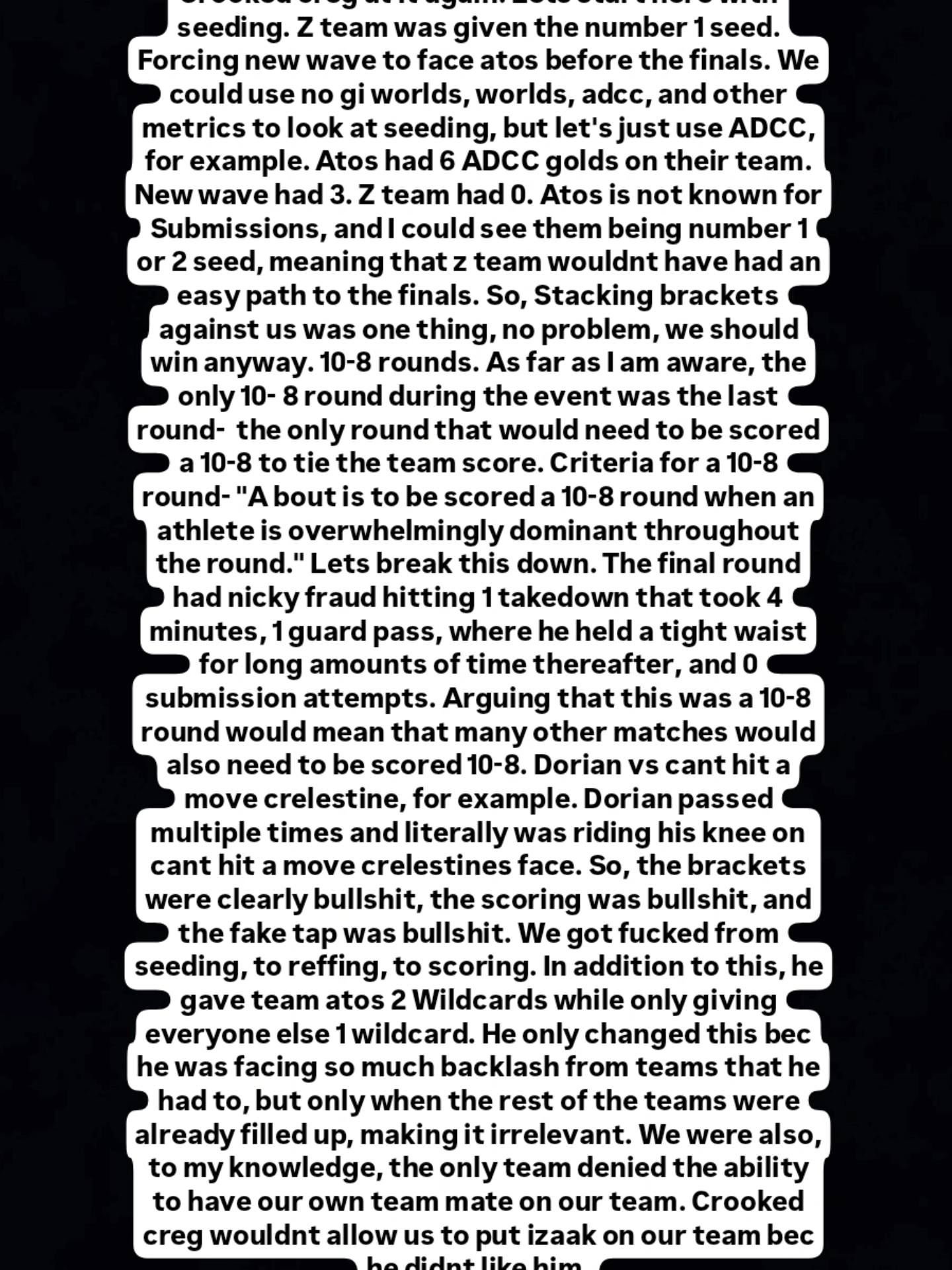
Crooked Greg did again 2018 CJI. More unfair seeding. Z Team was given the number 1 seed. Forcing New Wave to face ATOS before the finals. We could use no-gi worlds, worlds, ADCC, and other metrics to look at seeding, but let’s just use ADCC, for example. ATOS had 6 ADCC golds on their team. New Wave had 3. Z Team had 0. ATOS is not known for submissions, and I could see them being number 1 or 2 seed, meaning that Z Team wouldn’t have had an easy path to the finals. So, stacking brackets against us was one thing, no problem, we should win anyway. 10-8 rounds. As far as I am aware, the only 10-8 round during the event was the last round—the only round that would need to be scored a 10-8 to tie the team score. Criteria for a 10-8 round: “A bout is to be scored a 10-8 round when an athlete is overwhelmingly dominant throughout the round.” Let’s break this down. The final round had Nicky Ryan hitting 1 takedown that took 4 minutes, 1 guard pass, where he held a tight waist for long amounts of time thereafter, and 0 submission attempts. Arguing that this was a 10-8 round would mean that many other matches would also need to be scored 10-8. Dorian vs. Crelinsten, for example. Dorian passed multiple times and literally was riding his knee on Crelinsten’s face. So, the brackets were clearly unfair, the scoring was unfair, and the fake tap was unfair. We got screwed from seeding, to reffing, to scoring. In addition to this, he gave Team ATOS 2 wildcards while only giving everyone else 1 wildcard. He only changed this because he was facing so much backlash from teams that he had to, but only when the rest of the teams were already filled up, making it irrelevant. We were also, to my knowledge, the only team denied the ability to have our own teammate on our team. Crooked Greg wouldn’t allow us to put Izaak on our team because he didn’t like him.
All the receipts—if you have interest. From the dozens of fake Reddit and social media accounts he has of him trying to control the narrative, to rumors he spreads about those who have helped him, you can only hide who you really are for so long. The world will slowly realize, just as Z Team realized when they kicked him out, and just as my teammates have realized. The guy didn’t even stick around to congratulate the winners and his “team” on winning the prize at HIS event, which was 80% LESS per athlete than it was the year before, by the way. The JJ community awakening is beginning. Looking forward to the @flograppling article stating that their baby, CJI, who spent an entire 2 years trying to bankrupt them, promised New Wave a rightful $1M and decision overturn, then turned around and said no. Yeah, let’s make that article, @flograppling.
PS—every post I have made and text I’ve sent has been run by the team. I’m not speaking for them and inserting myself where I shouldn’t be. I’m amplifying the voices of my family who have been wronged, as any friend would. Be a best friend and a worst enemy, always.”
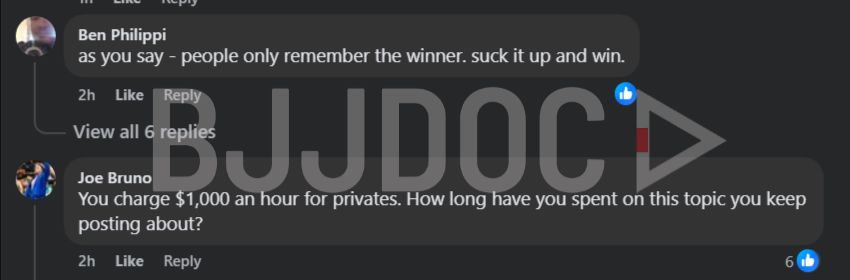
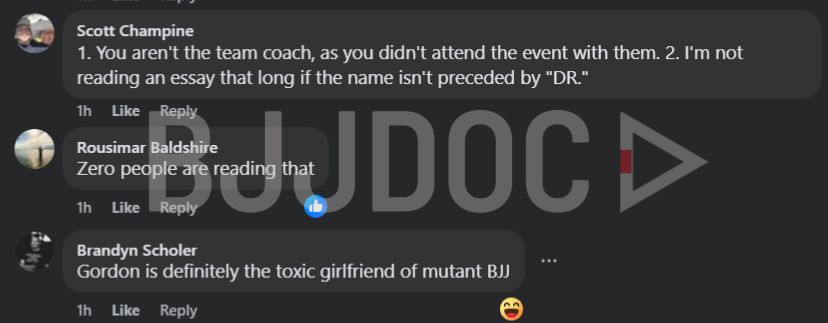
For what it’s worth we’re not the only skeptical parties when it comes to Ryan’s rant. While he deactivated comments on instagram, he’s getting pretty much trolled on facebook over the same grievances.