

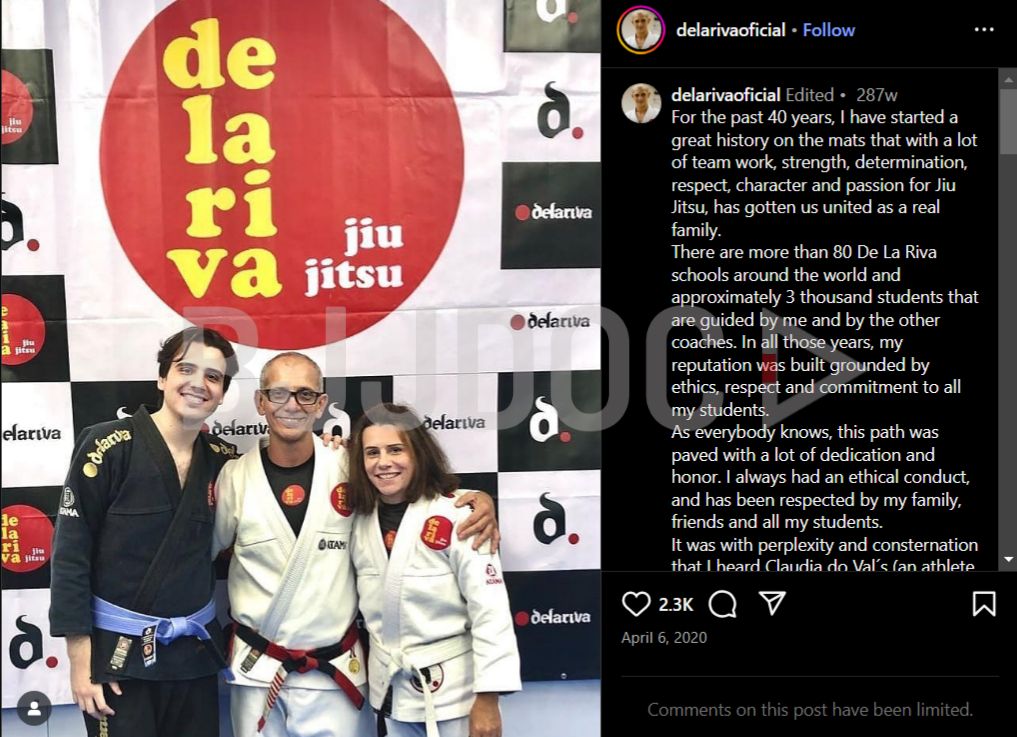
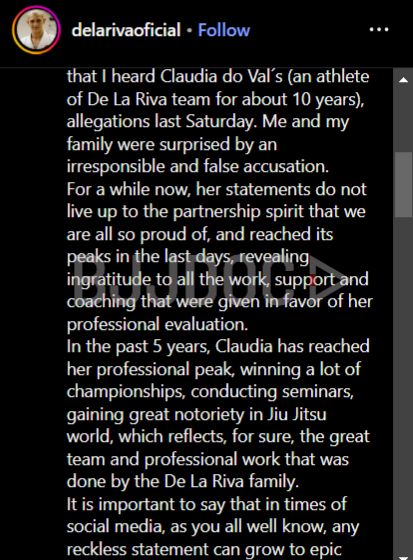
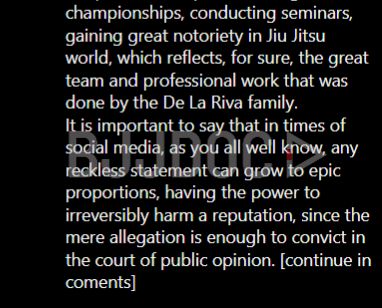
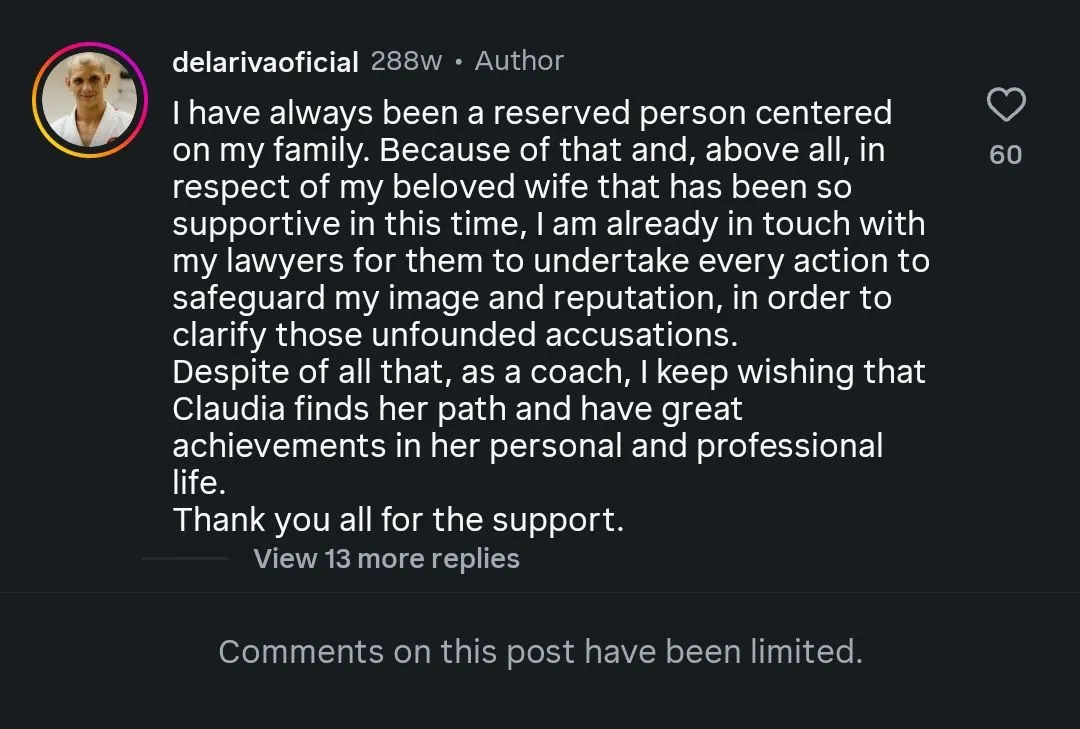
*pictured: Ricardo De La Riva and Claudia Do Val. Do Val accused De La Riva of inappropriate behavior in 2020 resulting with De La Riva basically refusing to train with all women, his statement attached on bottom
Maria Munhos conducted research for ESPNW in 2017 that surveyed 259 female practitioners and revealed a concerning statistic: 61.6% of women have experienced harassment during BJJ training. The study also found that 48.4% reported knowing someone close to them who had also been harassed. Even more alarming: 34.1% reported harassment from their instructor while 50.4% experienced it from training partners. The people supposed to create safe learning environments—coaches and training partners—are the primary perpetrators. For male practitioners who genuinely love this art, this should be a wake-up call. The culture we’ve built, often unintentionally, is driving women away from the mats.
Here’s what makes harassment in BJJ particularly insidious: the intimate nature of grappling creates plausible deniability. A hand placed inappropriately during a pass can be dismissed as “just part of the position.” Excessive grinding or rubbing during mount can be written off as “applying pressure.” Unnecessary contact with breasts or groin areas is explained away as “accidental” or “that’s just how the technique works.” One research participant, a black belt with over a decade of experience, described her experience as a white belt:
“A situation of s*xual harassment happened to me during sparring when I was a white belt, and at the time I couldn’t identify it because I thought it was part of training, even though it bothered me. I thought it was in my head, that I was imagining things. But after I graduated and started training with less experienced students, I saw that there was no need for a guy much bigger than me and stronger to rub against me the way it was done. And I saw that it wasn’t part of the sport.”
This is the critical problem: beginners don’t know what’s “normal” in BJJ. They don’t yet have the technical knowledge to distinguish between necessary contact and violation. And harassers exploit this ignorance.
While we don’t yet have comprehensive research on why women leave BJJ at such high rates, harassment is almost certainly a significant factor. Think about the women who came to your academy for a trial class and never returned. The white belts who trained for a few months and disappeared. The blue belts who suddenly stopped showing up. Now consider: how many of them left because of an experience they never reported? According to the research, many women experience harassment but never speak up because they question whether it “really happened,” they fear not being believed, they don’t want to cause problems, they’re unsure who to report to, they worry about retaliation or being ostracized and they feel ashamed or embarrassed. One participant shared:
“When I was a white belt, in the beginning, I didn’t notice, I didn’t complain to anyone. I don’t blame anyone for not intervening because I really didn’t notice the situation at the time. It was only later when I understood what s*xual harassment was.”
By the time women have enough experience to recognize harassment, many have already been subjected to it—or have already left.
Harassment in BJJ isn’t always obvious. It exists on a spectrum. Subtle forms include unnecessary comments about a woman’s body or appearance, “going easy” in a condescending way or refusing to roll seriously, excluding women from drilling groups or post-training conversations, making jokes about “getting mounted by a woman” and referring to women as “the girls” in an infantilizing way. Moderate forms include staring at women’s bodies while they stretch or train, making inappopriate jokes or innuendos during class, applying excessive punishing pressure specifically to female partners, deliberately placing hands on breasts, buttocks or groin during techniques when unnecessary and becoming aggressive or ego-driven when being submitted by a woman. Severe forms include grinding genitals against a woman during mount, side control or other positions, intentionally touching intimate areas during transitions, verbal inappopriate propositions or advances, physical retaliation for rejecting advances and instructors leveraging their position to pursue sexual relationships with students.
The research documents all of these behaviors. One participant described being expelled from her academy after refusing her instructor’s advances. Another experienced an instructor inviting her to his home for “private training” and then making unwanted physical contact.
Good. Most male practitioners wouldn’t engage in overt harassment. But here’s the uncomfortable truth: even good guys can contribute to a hostile environment through inaction. Ask yourself: Have you ever heard another man make inappropriate comments about a female training partner and said nothing? Have you noticed a training partner being unnecessarily rough or invasive with women and not addressed it? Have you laughed at “locker room talk” about women at your academy? Have you ever told a woman she’s “too sensitive” about something that made her uncomfortable? When a woman stops showing up to class, do you ever wonder why—or ask? Silence is complicity. When we witness harassment and say nothing, we signal to harassers that their behavior is acceptable and to participants that they won’t be supported.
Let’s be clear: proper BJJ technique does not require inappropriate contact. Yes, BJJ is intimate. Yes, there’s close body contact. Yes, you’ll end up in positions that might feel awkward. But there’s a world of difference between the necessary contact of grappling and harassment. Consider: proper mount pressure comes from positioning your hips correctly and distributing weight through your knees and posture—not from grinding your groin into your partner. Passing guard involves hand placement on hips, legs and collar—not on breasts. Side control pressure comes from chest pressure and hip positioning—not from unnecessarily rubbing your body against your partner. Back control requires seatbelt grip and hooks—not hands wandering to inappropriate areas.
If you’re an experienced practitioner and you can’t distinguish between technical necessity and violation, that’s a problem with your technique, not a grey area in the sport. Furthermore, several research participants noted that more experienced, higher-level practitioners were better training partners specifically because they had the control and precision to avoid unnecessary contact. One black belt explained:
“I can control the damage I cause or receive. My entire game is adapted to not aggravate my injuries and to preserve my training partners.”
True mastery of the “gentle art” includes the gentleness and awareness to train with control and respect.
This concern comes up frequently, so let’s address it directly: false accusations of harassment are statistically rare while actual harassment is common. The research shows that most women who experience harassment don’t report it at all—they simply leave. The idea that women are frequently making false claims to get men in trouble doesn’t match reality. Moreover, the fear of false accusations often becomes an excuse for inaction, allowing real harassment to continue unchallenged.
If you’re genuinely concerned about being misunderstood: communicate clearly with training partners, especially when teaching new techniques; ask permission before demonstrating techniques that involve sensitive areas; be mindful of your hand placement and body positioning; if someone seems uncomfortable, check in verbally; maintain the same level of respect and professionalism you’d want for your sister, daughter or partner. If you’re training with respect and awareness, you’re very unlikely to be falsely accused of harassment.
As a training partner, be aware of your body positioning. Pay attention to where your hands, hips and chest are during techniques. Adjust positioning if you notice discomfort in your partner. Ask yourself: “Would I position my body this way if rolling with a male training partner?” Communicate openly. Before drilling techniques involving sensitive areas, acknowledge it: “This guard pass requires grip on the hip—let me know if anything feels off.” Check in if you sense discomfort: “Is this pressure okay?” Thank partners for pointing out if something doesn’t feel right. Calibrate intensity appropriately. Don’t go “easy” in a condescending way. Don’t go overly hard to “teach a lesson.” Match energy to the training context and your partner’s signals. Remember that using excessive strength or pressure against smaller partners isn’t impressive—it’s poor technique. Be an active bystander. If you see something inappropriate, say something. Don’t laugh at misogynistic jokes or “locker room talk.” Support women who speak up about harassment. Make it clear through your actions that harassment isn’t acceptable.
As an instructor or academy owner, establish clear policies. Create and enforce a written code of conduct that explicitly prohibits harassment. Make reporting mechanisms clear and accessible. Take all complaints seriously and investigate promptly. Implement consequences for harassment, including expulsion for serious violations. Train your students. Discuss appropriate contact and boundaries, especially with beginners. Teach students to ask permission before certain drills. Model respectful behavior in your own interactions. Address problematic behavior immediately when you observe it. Create accountability structures. Designate a safe person (ideally a female black belt) for reporting. Don’t dismiss concerns as “oversensitivity.” Follow up with students who stop attending suddenly. Foster a culture where speaking up is supported, not punished. Be conscious of power dynamics. Never pursue romantic or intimate relationships with your students. Recognize that your position as instructor creates inherent power imbalance. Don’t use training, belt promotions or access to opportunities as leverage. Maintain professional boundaries at all times.
As a community member, listen to women’s experiences. When a woman shares an experience of harassment, believe her. Don’t interrogate her about details or question her interpretation. Understand that you may not have seen or experienced what she has. Resist the urge to defend the accused or make excuses. Amplify women’s voices. Support female practitioners who speak out about problems. Share resources and information about harassment prevention. Advocate for policy changes at your academy if needed. Use your position of privilege to push for cultural change. Examine your own behavior and biases. Reflect honestly on your interactions with female training partners. Consider how you might contribute to an unwelcoming environment. Be open to feedback and willing to change. Recognize that good intentions don’t negate harmful impact.
The philosophy of Brazilian Jiu-Jitsu emphasizes using technique over brute force, respecting opponents and continually improving oneself. Yet for too many women, BJJ academies are spaces of violation rather than growth. This contradiction should trouble every serious practitioner. Jigoro Kano, the founder of Judo (from which BJJ derives), explicitly intended his art to be inclusive regardless of age, size, or gender. Helio Gracie adapted techniques specifically because he was physically weaker, creating an art where the smaller and less strong could overcome larger, more powerful opponents. The entire philosophy of the “gentle art” is undermined when we tolerate behavior that drives women away from the mats.
If 61.6% of women experience harassment in BJJ, that means most of the women you train with have experienced it—even if you never witnessed it. Your favorite female training partner? Probably harassed. That tough blue belt who always shows up? Likely harassed. The women who stopped showing up last month? Almost certainly. The question isn’t whether harassment is happening at your academy. The question is: What are you going to do about it? Will you be the training partner who creates a safe space through respectful behavior and active intervention? Or will you be part of the silent majority who enables harassment through inaction? The women who remain in BJJ despite these obstacles do so because they love the art as much as you do. They’ve earned their place on the mats through perseverance in the face of challenges you’ve likely never had to consider. They deserve better than a 61.6% chance of harassment. We can do better. We must do better.
ESPNW Study: Munhos, M. “Assédio no Tatame” (Harassment on the Mats), 2017. Women’s Commission for Rights in Jiu-Jitsu (CDMJJ): Organization working to create safer spaces for women in BJJ.

Refrences
Giancristoforo, L. N. (2020) A mulher na “Arte Suave”: uma análise fenomenológica da participação feminina no jiu-jitsu brasileiro. Versão corrigida. Dissertação (Mestrado em Ciências) — Escola de Educação Física e Esporte, Universidade de São Paulo, São Paulo.
