
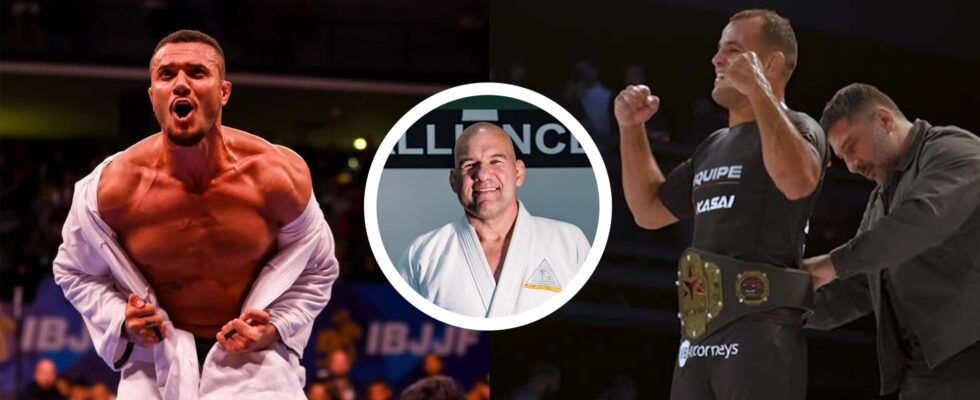
Fabio Gurgel has sparked an important conversation about the harsh economic realities facing jiu-jitsu as a competitive sport. Despite the romanticized notion of professional MMA stars living solely off tournament winnings, Gurgel presents a dreary mathematical analysis that challenges this dream.
When discussing the viability of jiu-jitsu as a professional sport, Gurgel breaks down the numbers with startling clarity.
“Jiu-jitsu isn’t a professional sport and maybe it never will be,”
he states. To illustrate his point, he calculates what would be needed for just minimal professionalization: ten black belt categories with six athletes each, earning a modest $5,000 monthly. This totals $3.6 million annually—money that simply doesn’t exist in the current jiu-jitsu economy.
Even champions like Nenego(Jansen Gomes), who Gurgel acknowledges as
“talented,”
face limited earning windows. While Nenego may have secured sponsorships and can
“live decently,”
Gurgel questions the sustainability:
“What more will his time spent living as an athlete, being exclusively an athlete, entail? Five more, six more years.”
After that competitive window closes, these stars must find alternative income sources, typically through teaching.
The root problem, according to Gurgel, lies in jiu-jitsu’s inability to capture mainstream audience attention.
“Jiu-jitsu is not a televised sport,”
he explains.
“It’s extremely uninteresting for the casual audience.”
Without broad viewership, there’s no sponsorship money. Without sponsorship, there’s no sustainable income for professional MMA stars.
“If you don’t have an audience, you don’t have sponsorship. If you don’t have sponsorship, you don’t have money.”
Gurgel warns that athletes are often
“misled”
by promises of professionalization through various events and organizations. While acknowledging exceptions like BJJ Stars, he notes that numerous promotions
“appear and disappear”
because
“they weren’t sustainable.”
This creates false hope for competitors who dedicate themselves entirely to competition, only to find themselves unprepared for life after their athletic prime.
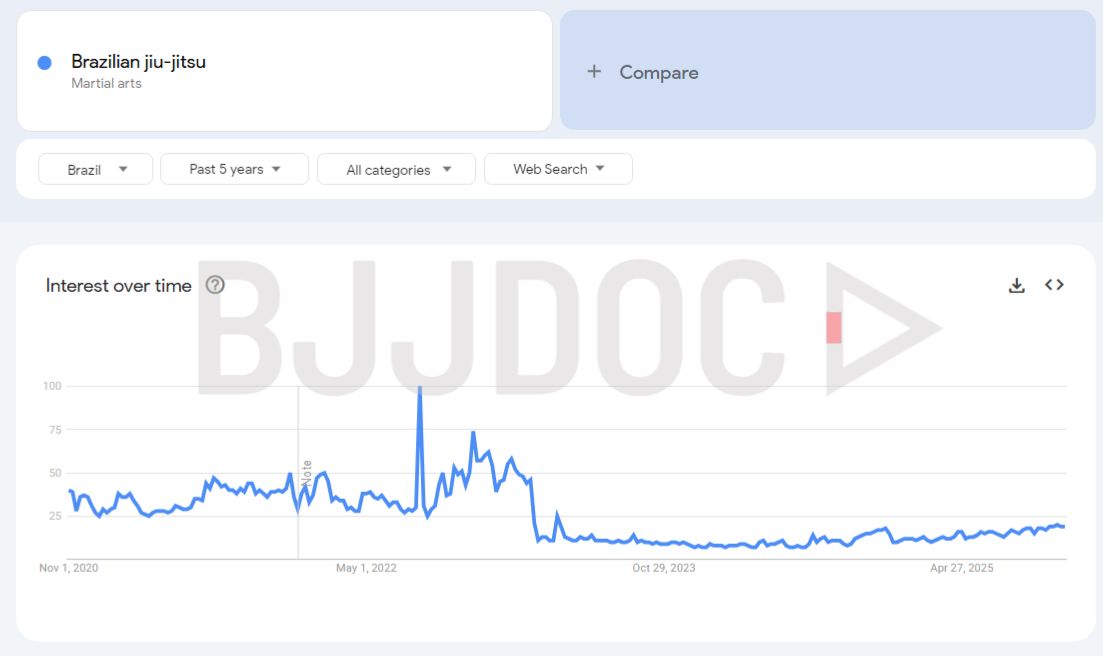
Google trends reveals an interesting data point. There’s been a rapid decline in interest for BJJ in Brazil in 2023.
This is in stark contrast to what’s been happening in the US as of late.
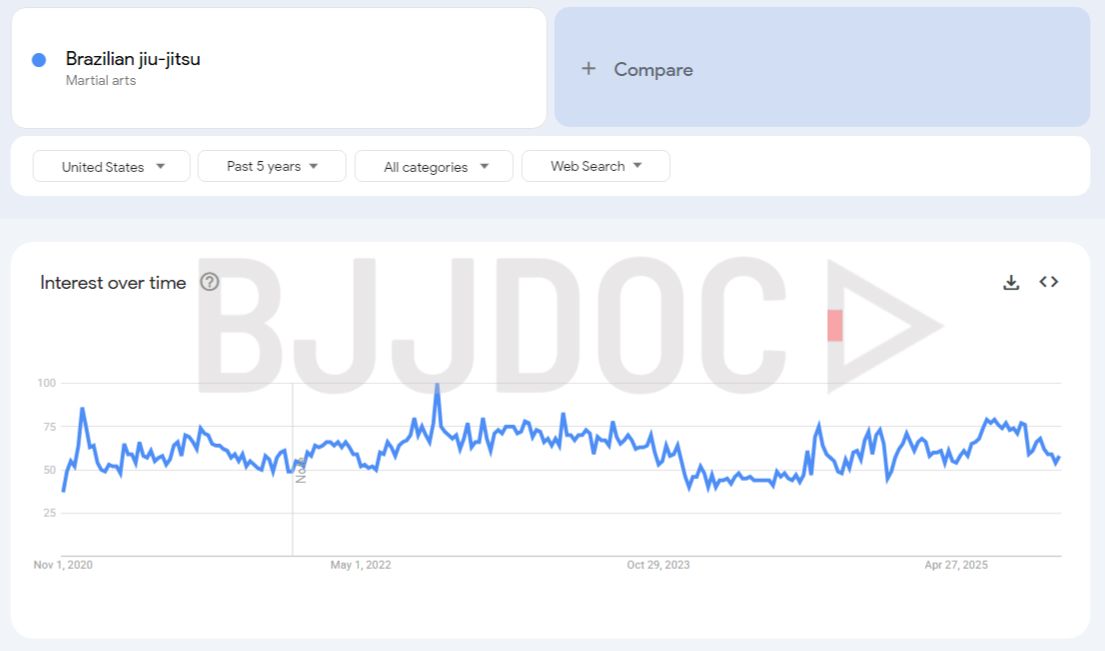
A plausible explanation could be a combination of market saturation, economic constraints, and shifting attention to other emerging sports or entertainment options. After the post-2020 spike in BJJ interest, many gyms may have reached capacity, and high participation costs could have discouraged new members. At the same time, the rapid rise of sports like women’s football, padel, and esports in Brazil has likely diverted public attention and online search activity. Media exposure may have also shifted — fewer viral tournaments, international competitors relocating abroad, and a lack of domestic promotional campaigns could have reduced public curiosity. The decline in interest also coincides with the untimely passing of Leandro Lo in August of 2022.
While Gurgel’s assessment may disappoint those dreaming of jiu-jitsu rivaling mainstream professional sports, his honest evaluation serves as crucial guidance for young athletes.
