
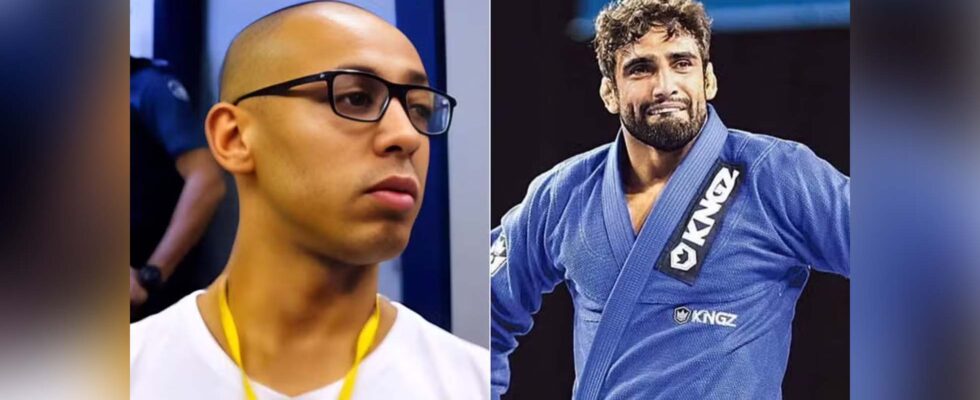
The halls of São Paulo’s Barra Funda Criminal Forum were filled with anticipation this week as justice approached for one of Brazilian Jiu-Jitsu’s most devastating losses. Three years after eight-time world champion Leandro Lo’s life ended at Club Sírio, military police lieutenant Henrique Otávio Oliveira Velozo faces a jury that will determine whether he spends the next two decades behind bars.
The case has captivated Brazil not just for the loss of a sporting icon but for the audacious defense strategy emerging during the trial. Velozo’s legal team, led by attorney Claudio Dalledone, constructed a narrative so divorced from witness accounts that it left observers questioning the bounds of legal advocacy.
The defense portrays the officer as being attacked first, immobilized and rendered unconscious by a RNC applied during the nightclub encounter. They argue that the 33-year-old martial artist, a competitor known for discipline and controlled combat, suddenly assaulted the officer, leaving deadly force as the only option. Computer-generated animations were introduced to depict Lo as the aggressor in multiple confrontations before Velozo discharged his weapon, which the defense characterizes as nearly accidental.
The prosecution, led by João Calsavara, presents a starkly different account supported by eyewitness testimony. Witness Bruno Nobete Miranda indicated that Velozo approached the athletes’ table provocatively, grabbed a bottle, and after a brief restraint by Lo, returned crouching and running, drew his weapon, and fired a single shot into Lo’s forehead at point-blank range. He then kicked the fallen champion before fleeing and hiding for hours.
The defense has attempted to suggest that Lo was prone to causing trouble in nightclubs and that Velozo acted in self-defense, but no substantiated evidence supports this claim. The trial, which began under Judge Fernanda Jacomini, will feature nine witnesses before seven jurors who will decide Velozo’s fate. Proceedings are expected to conclude within the week.
Among those testifying is police delegate João Eduardo da Silva, whose investigation laid the groundwork for the charges: aggravated homicide with three qualifying factors including base motives, creating common danger, and preventing the victim from defending himself.
The prosecution will also highlight Velozo’s prior convictions, including a Military Court sentence for contempt and violence against a subordinate, originally acquitted but later convicted on appeal. Administrative sanctions, including a three-day detention, indicate a pattern of behavior that undermines the self-defense claim.
Both sides have employed artificial intelligence-generated reconstructions and computer animations to visualize competing narratives. What remains undisputed is that a trained police officer brought a firearm to a social venue, engaged in a confrontation with an unarmed athlete, and fired a bullet into the man’s head before fleeing.
Velozo has been in preventive detention throughout the proceedings. In June 2024, the Military Court ruled he should lose his rank, though his attorney claims he continues receiving his salary while military proceedings remain pending.
For Lo’s family and the global jiu-jitsu community, the trial represents a long-awaited reckoning. The champion, who had just won his final world title months before his death, dedicated his life to a martial art valuing control, respect, and discipline.
If convicted, Velozo faces a minimum of 20 years in prison.
