

AJ Discianni, owner and instructor at New Asgard Martial Arts and a black belt under Paramount BJJ, made the controversial observation during a recent appearance on the Jits and Giggles podcast. His assessment pulls no punches:
“The level of jujitsu is so low and I think that’s like universal across the board.”
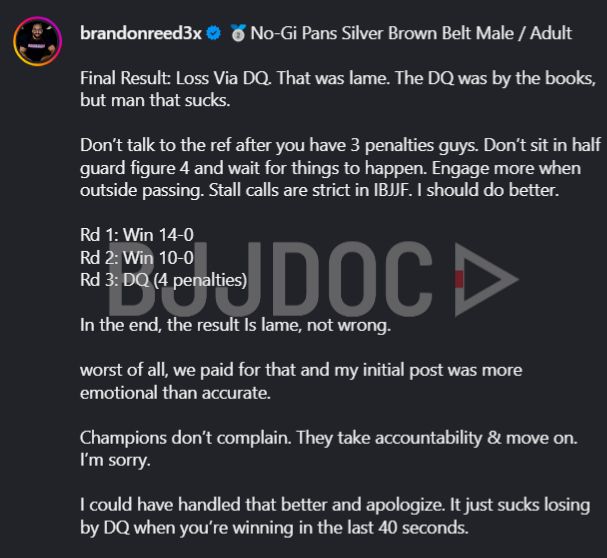
According to Discianni, the problem manifests in unexpected ways. He pointed to recent incidents at Pan American Championships where elite competitors demonstrated fundamental gaps in their understanding. Brandon Reed was among those mentioned.
“There was Brandon Reed was one of them and I forget who the other black belt was but two guys got DQ’d for multiple penalties and talking to the ref,”
Discianni explained.
“Like this is at the highest level this is happening—they don’t understand the rules.”
The instructor attributes the phenomenon partly to jiu-jitsu’s relative youth as a competitive sport but suggests the community has grown complacent about accepting mediocrity. His critique extends beyond rule comprehension to technical development itself where practitioners often mistake early success against weak competition for genuine mastery.
Discianni shared a personal example from his own journey through the colored belt ranks.
“My thing at blue belt and purple belt was like baseball bat choke and my coach was like hey like cool but name somebody at a black belt level winning worlds who’s hitting that and I couldn’t,”
he recalled.
“And I never baseball bat choked anybody again.”
This anecdote illustrates his broader philosophy about developing legitimate technique: study what actually works at the elite level rather than relying on moves that succeed only against less-skilled opponents.
“We try to take the data and look at the top guys see what they’re doing,”
Discianni explained, noting the difficulty of convincing students that their current success may not translate to higher levels of competition.
The black belt’s critique gained additional dimension when he discussed his own experience at Paramount where he dominated training partners in the room until facing competitors with more complete games.
“We didn’t have leg lockers so I was hitting everybody in the room I thought I was like hot sh*t and then I’m getting my leg blown apart by Damian Anderson in a match,”
he admitted.
“It’s like wow like I thought I was good but I’m not.”
When asked whether coaching quality bears responsibility for these systemic issues, Discianni offered a broader diagnosis.
“I think it’s the sport in general—it’s just a low culture,”
he stated. The technical deficiencies, in his view, represent not isolated coaching failures but a sport-wide acceptance of inadequate standards.
Despite eleven years of experience, Discianni continues encountering what he considers outdated teaching approaches.
“I’m still going to gyms they’re doing 15 minute warm-ups of jumping jacks push-ups sit-ups,”
he noted with evident frustration.
When pressed on his stance regarding traditional warm-up routines, Discianni didn’t hesitate:
“I love it—they pay me to do jujitsu not to do push-ups.”
He acknowledged this perspective might upset instructors who now face the challenge of filling class time with actual technical instruction rather than generic calisthenics.
Discianni’s assessment echoes broader discussions within the grappling community about jiu-jitsu’s growing pains as it transitions from niche martial art to global sport. While BJJ has achieved remarkable commercial success, particularly compared to traditional martial arts like judo which maintain more rigid performance standards, this accessibility may come at the cost of technical rigor.
The tension between inclusivity and excellence represents one of jiu-jitsu’s central challenges. The sport’s welcoming approach to adult beginners has fueled explosive growth and created sustainable careers for instructors worldwide. Yet as Discianni’s comments suggest, this same accessibility may contribute to an environment where substandard technique proliferates unchecked with practitioners advancing through ranks without developing the fundamentals that define elite performance.
