
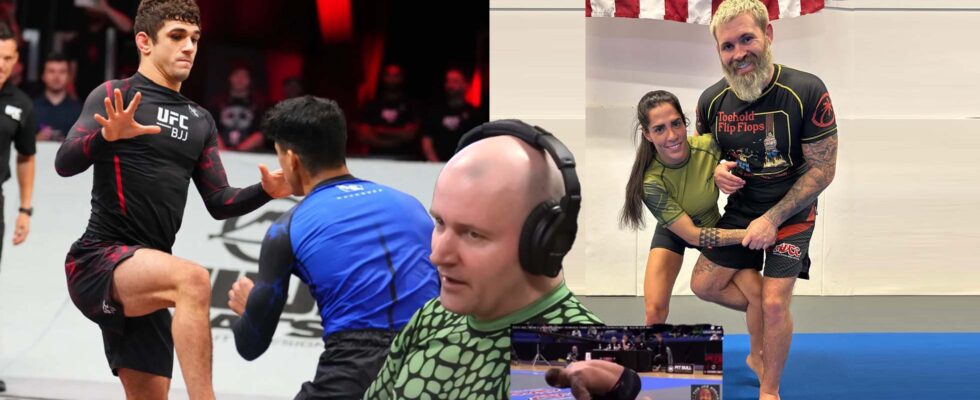
In a revealing conversation with Roger Gracie, renowned jiu-jitsu coach John Danaher didn’t mince words about one of Brazilian jiu-jitsu’s most glaring weaknesses: standing position and takedowns. According to Danaher, the current state of standing position in jiu-jitsu is “as bad as leg locking was in 2010,” and he believes the overwhelming majority of practitioners, even at elite levels, are simply incompetent when it comes to competing on their feet.
“The overwhelming majority of even expert jiu-jitsu players are simply incompetent in the standing position.”
Danaher’s critique stems from his observation that jiu-jitsu has historically excelled in ground-based positional control but has consistently struggled in two major areas: leg locks and standing position. While he’s confident that the leg lock revolution has largely addressed the first weakness, the standing game remains woefully underdeveloped.
The problem, as Danaher explains, is that jiu-jitsu practitioners have relied on a naive approach, attempting to import techniques directly from wrestling and judo without proper adaptation.
“Jiu-jitsu coaches and athletes have looked at other grappling styles that do have a strong emphasis in standing position and takedowns and use the very naive approach of just copy and pasting.”
This strategy fails because the rule sets and objectives of these sports differ radically from jiu-jitsu. Wrestling emphasizes amplitude with no concern for back exposure, while judo rewards big throws that would leave a jiu-jitsu competitor vulnerable to back takes.
“In jiu-jitsu, the smallest takedown scores the same as the biggest takedown, and once the throw is completed the match has just begun.”
This fundamental scoring difference creates a completely different strategic landscape. Danaher argues that jiu-jitsu needs its own autonomous approach to standing position, one that prioritizes control over amplitude.
“Wrestling and judo favor risk. The more risk you take, the more points you score. In jiu-jitsu, if you take a risk in exposing your back, you’re getting punished for taking the risk.”
Roger Gracie agreed with Danaher’s assessment, observing that most jiu-jitsu schools spend minimal time training standing techniques compared to ground work. This creates an undesirable situation where even elite competitors have no option but to pull guard.
“We can’t have situations where champions come scurrying out and just sitting down because they literally don’t know a single takedown.”
The solution, according to Danaher, requires jiu-jitsu to develop specialized standing programs tailored to its unique demands, with proper technique selection from judo and wrestling modified for a control-based philosophy.
“Jiu-jitsu is looking for takedowns that exhibit control rather than amplitude. Small, low amplitude takedowns which enable you to finish in a dominant position are much more appropriate for the jiu-jitsu athlete than big, high-amplitude risky takedowns.”
Danaher believes that with structured training over the next five to ten years, jiu-jitsu can overcome this weakness just as it did with leg locks, transforming incompetence into competence and eventually into strength.
