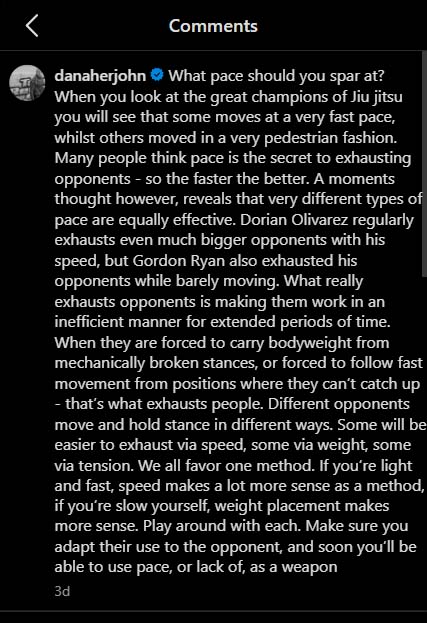
The prevailing wisdom in Brazilian Jiu-Jitsu often equates speed with dominance. Push the pace, the thinking goes, and your opponent will crumble under relentless tempo. But renowned coach John Danaher challenges this assumption with a counterintuitive insight: what truly breaks opponents isn’t necessarily how fast you move but how efficiently or inefficiently you make them work.
“When you look at the great champions of Jiu jitsu you will see that some moves at a very fast pace, whilst others moved in a very pedestrian fashion.”
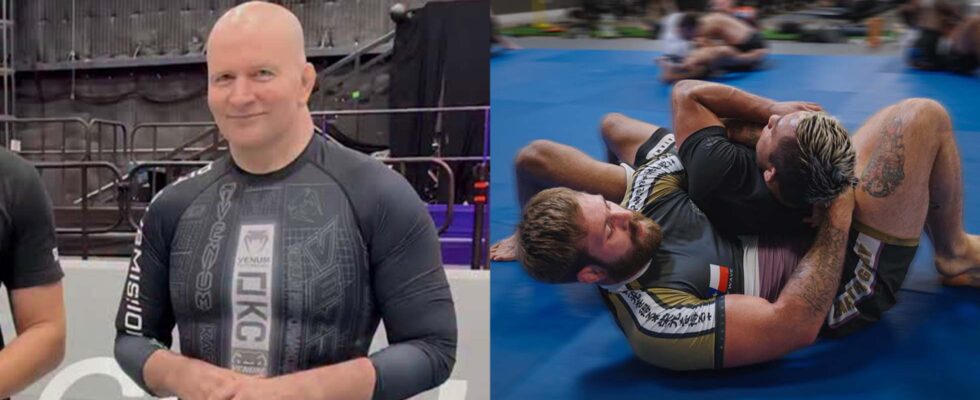
Danaher recently observed. The contrast is stark. Dorian Olivarez “regularly exhausts even much bigger opponents with his speed” while Gordon Ryan “also exhausted his opponents while barely moving.”
How can such opposite approaches yield identical results? The answer lies in understanding what fatigue actually is.
“What really exhausts opponents is making them work in an inefficient manner for extended periods of time. When they are forced to carry bodyweight from mechanically broken stances or forced to follow fast movement from positions where they can’t catch up – that’s what exhausts people.”
This reframes the entire concept of pace as a weapon. It’s not the metronome that matters but the structural inefficiency you impose. A heavyweight can drain an opponent through suffocating pressure that forces them to support weight from compromised positions. A lightweight can achieve the same through movement that keeps opponents perpetually chasing and adjusting from disadvantaged angles. Both create the same outcome: mechanical breakdown that accumulates into complete exhaustion.
The approach demands individualization. Danaher notes:
“Different opponents move and hold stance in different ways. Some will be easier to exhaust via speed, some via weight, some via tension.” The coach encourages practitioners to recognize their natural advantages: “If you’re light and fast, speed makes a lot more sense as a method, if you’re slow yourself, weight placement makes more sense.”
This philosophy extends beyond energy management. Danaher emphasizes that control always precedes submission.
“The lock is just the full stop at the end of a sentence it’s the sentence that counts and that sentence is control.”
The effectiveness of any finish depends entirely on the quality of dominance established beforehand.
The takeaway for practitioners is liberating: you don’t need to be fast to be effective. You need to understand how bodies break down under load, whether that load comes from speed, weight or tension. Master the ability to create structural inefficiency in your opponent, and pace becomes simply one tool among many not the defining characteristic of your game.
“Play around with each. Make sure you adapt their use to the opponent, and soon you’ll be able to use pace, or lack of, as a weapon.”