
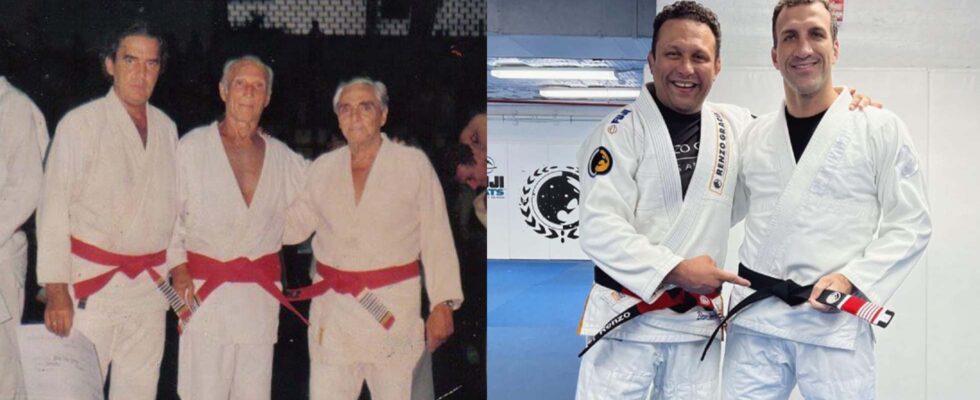
A member of Brazilian Jiu-Jitsu’s founding family has sparked fresh debate about one of the sport’s most celebrated alternative lineages. Igor Gracie recently shared what he sees as historical evidence suggesting that what many consider a non-Gracie branch of Jiu-Jitsu actually traces back to his family’s original academy.
The discussion centers on Oswaldo Fadda, a respected instructor who spread Jiu-Jitsu throughout Rio de Janeiro’s working-class neighborhoods in the mid-20th century. For years the Fadda lineage has been held up as proof that Brazilian Jiu-Jitsu evolved beyond the Gracie family’s influence with Fadda’s students eventually founding major teams like Nova União.
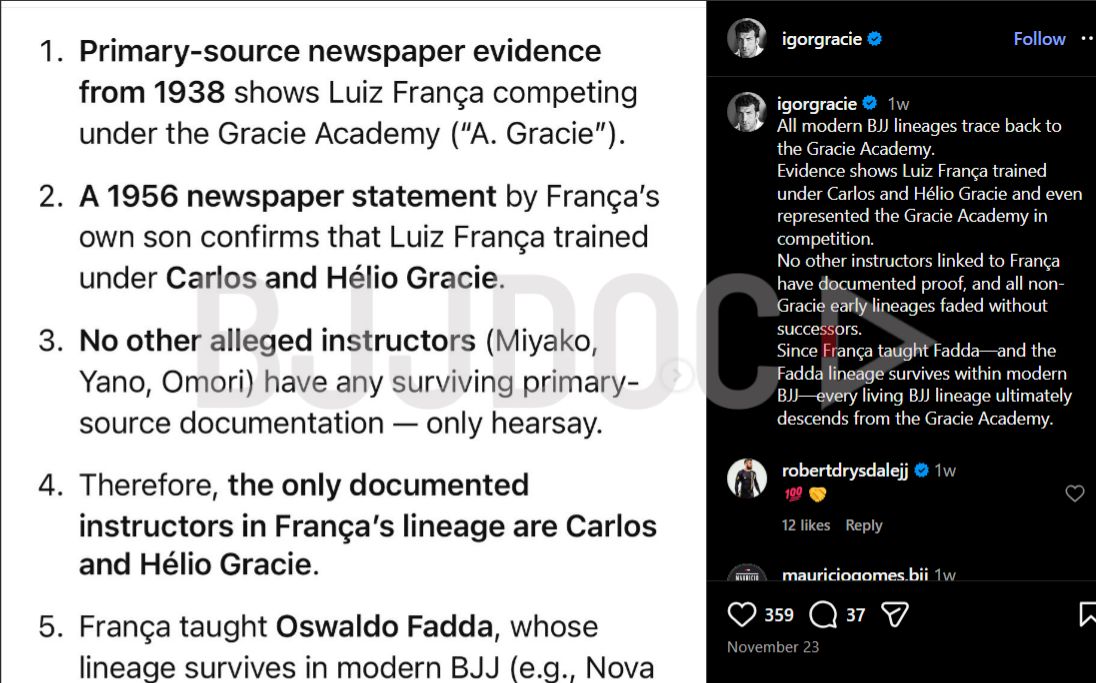
Igor Gracie‘s recent social media post challenges this narrative with a list of newspaper clippings. The materials include a 1938 competition record showing Luiz França, Fadda’s teacher, competing under the banner of “A. Gracie,” which indicates the Gracie Academy. Even more compelling is a 1956 newspaper statement from França’s son confirming that his father trained under Carlos Gracie and Hélio Gracie.
“All modern BJJ lineages trace back to the Gracie Academy”
Igor wrote as he argued that França’s documented connection to his family means
“every living BJJ lineage ultimately descends from the Gracie Academy.”
The claims find support in Robert Drysdale‘s work.
“The Fadda lineage, every piece of evidence we have points to it being the lineage of the Gracie family”
Drysdale stated in a 2020 interview and added that França’s connection to the Gracie Academy appears
“very clear.”
Drysdale noted that while França may have learned from other instructors the documentation does not support it.
“The only thing we have what connects [França] to a teacher is a Gracie academy”
he explained.
Drysdale emphasized that other Japanese instructors sometimes mentioned in França’s background, names like Miyako, Yano, and Omori, lack any surviving documentation. Igor Gracie made the same point and stated that these connections amount to “hearsay” without primary sources to verify them.
None of this diminishes Fadda’s historical importance. The instructor opened his academy in Bento Ribeiro, a northern Rio neighborhood far removed from the Gracie Academy’s wealthier districts. His approach to teaching made the martial art accessible to students who could never have afforded training at the original academy.
Drysdale’s research acknowledges this contribution and notes that Fadda taught
“the poor in Brazil and that had a huge impact on the evolution of the sport”
He added that
“Fadda’s role is underplayed”
in most historical accounts.
The geographical and class divide between the two schools meant they rarely competed for the same students according to Drysdale’s work. Yet Fadda’s academy provided the Gracies with credible opponents during an era when such competition was scarce.
This claim complicates a narrative that has existed for decades. When Rorion Gracie first told the story of Brazilian Jiu-Jitsu’s development to international audiences critics within the martial arts community pointed to the Fadda lineage as evidence that the art had multiple independent roots. The assumption was that if a respected non-Gracie lineage existed it would balance what some viewed as an overly Gracie focused version of history.
Many Jiu-Jitsu schools take pride in tracing their roots outside the Gracie sphere and view the Fadda lineage as representing a more democratic and accessible version of the art. Learning that this lineage connects back to the original academy does not erase Fadda’s achievements but it reshapes how we understand Jiu-Jitsu’s family tree.
Drysdale cautioned that new evidence could always emerge to revise current understanding.
“Unless something comes up tomorrow”
he said, the available documentation points consistently in one direction.
For now Igor Gracie‘s intervention ensures that one of Brazilian Jiu-Jitsu’s most cherished origin stories will face renewed scrutiny from historians and practitioners alike.
