
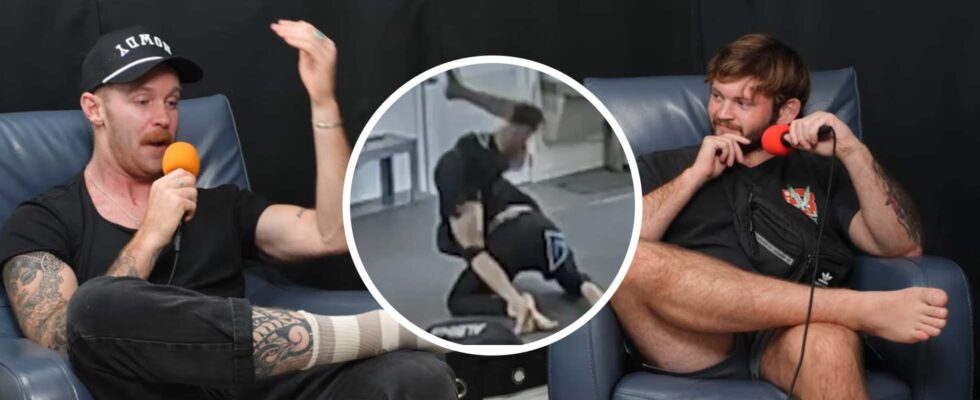
On January 7 2018 Jack Greener‘s life changed in an instant. A 23-year-old college senior with plans to become a professional surf guide in Costa Rica lay paralyzed on a jujitsu mat in San Diego while staring at a photo of Helio Gracie on the gym wall.
Seven years later after a long legal battle that resulted in one of the largest personal-injury settlements in combat sports history Greener now explains his story with a perspective many would not expect.
“Do I regret training? No. I still think it’s a cool sport.”
The Injury and Immediate Aftermath
The sound of Greener‘s C4 vertebra breaking is something he cannot forget. He compares it to watching someone chop wood where the final crack echoes through the forest. He remembers his body trying to spring up from the mat then nothing happened. A warm flushing sensation moved through him which marked the onset of instant paralysis.
Medical emergencies came one after another. Within 12 hours Greener was having strokes because blood clots from his damaged vertebral artery traveled to his brain. His nurse Justin who later became one of his closest friends had an intuition to stay within 10 feet of his room instead of returning to the nurses’ station. That choice saved his life. Surgeons operated for nine hours while his parents prepared for the worst in the waiting room.
The Settlement and Legal Process
The road to the $55 million settlement was complicated. Greener recalls how his legal team originally attempted to settle for $1 million years earlier and the request was ignored.
“We asked them to settle for a mill like 7 years ago and they’re like no.”
His attorney could not understand the rejection because video evidence medical documentation and clear liability were all present. The eventual explanation was simple and disturbing. The defendant’s lawyer committed malpractice by failing to notify his clients that a $1 million settlement was offered.
The case went to trial where a jury awarded $46 million. Interest increased that number to $55 million. Greener stresses that he never asked for that amount and notes that the jury independently decided the figure.
“I never asked for that number right so that number was originally awarded by a jury.”
The defendants used tactics that Greener describes as ruthless. They leaked the security-camera footage of the injury which rapidly circulated in the martial arts community.
“I got multiple death threats from Brazilians”
He explains that his past relationship was also targeted. His ex-girlfriend ended their relationship after expressing doubts about raising children with someone who was not able-bodied. Defense attorneys attempted to compel her to testify against him by contacting her repeatedly. She refused and sent screenshots to Greener.
Private investigators followed him for years. They hovered near him in court hallways trying to intimidate him. Yet at every legal stage civil court appellate court and the California Supreme Court the defendants lost.
“Bro you lost at the civil level the civil court level. You lost at the appellet court level… and you lost at the Supreme Court level. And as my attorneys would say scoreboard.”
Disability and Recovery
Greener‘s injury classification C4 incomplete quadriplegia means damage from his fourth cervical vertebra affects everything below. While he appears able-bodied sitting down the reality is far more complex.
“My connections are like this,” he explains demonstrating how his neural pathways function at a fraction of normal capacity.
The prognosis was grim. In his first meeting with medical professionals he recalls:
“Everyone sat around this table and I remember looking at them and being like, ‘Hey, like I’m going to walk out of here.’ And they go, ‘Listen, we want that for you.’ A lot of people say that we have to be realistic and say prepare you for a life in a chair.”
His response?
“No, no, no. Like, you don’t know who the [expletive] I am. I’m going to walk out of here.”
That defiance became his fuel. “From that, it was just a perpetual like, ‘F*** you,'” he says of his motivation. But he’s also realistic about the limitations:
“There’s no such thing as a full recovery with spinal cord injury and anyone that says there is is full of [ ] or trying to sell you something.”
The spinal cord, he explains, “is the only thing that doesn’t heal on the human body.”
When doctors initially suggested assisted end of life if his paralysis had been complete Greener admits:
“If they had given it to me, I would have taken it.”
But his incomplete injury left room for the unknown and ultimately hope. “I would give every dollar back to be able to go surf again,” he says, his voice carrying the weight of that permanent loss.
Medical Complications
The daily reality of spinal cord injury extends far beyond mobility. Greener deals with constant spasticity involuntary muscle spasms from sun-up to sun-down.
“Imagine that every single day,” he says of the cramping sensation that locks his limbs without warning.
Temperature sensation is gone from the nipples down. “I can just sit in the ice bath,” he says, describing his “party trick” of outlasting able-bodied friends.
Bowel and bladder function require daily management. “I can’t go number two on my own. Like I got to [] use a suppository every day,” he explains matter-of-factly. “I peed myself on the plane today.” The loss of dignity is constant but so is his determination to discuss it openly.
Perhaps most personally devastating for a young man:
“You lose the psychogenic component of getting an erection… you’re fully reliant on, you know, Viagra [and] Cialis, whatever for life.”
It’s another invisible burden of spinal cord injury that many don’t consider.
Dating and Personal Life
Dating as a disabled person presented unique challenges. “I had a girlfriend after being hurt… she was like, ‘Hey, like every time we’re intimate, I can’t foresee us having kids because you can’t be like an able-bodied dad,'” Greener recounts. While the breakup hurt he understood:
“We’re adults here. Like, that’s your choice.”
His approach to dating became one of radical honesty. “Nobody’s job to understand my disability. It’s nobody’s job to accommodate me. It’s my job to make that comfortable,” he explains. By leading with vulnerability he found people responded with openness.
Now in a relationship for a year with someone who was first a friend Greener has found acceptance. But the physical limitations remain. The loss of intimate function isn’t just about mechanics, it’s about the spontaneity and normalcy that many take for granted.
Jiu-Jitsu and the Instructor
The instructor who caused Greener‘s injury has shown no remorse.
“He had basically seven years to like own up to this,” Greener says. On the witness stand when asked if he regretted his actions the instructor replied:
“I did what I did. I’m not sorry.”
For years Greener remained silent. “I didn’t say anything for years. And I was like, the this is the one time I’m going to like say something,” he says of finally leaving a one-star review on the instructor’s gym in 2024.
The instructor’s response claimed Greener had lied in court, a claim contradicted by verdicts at three judicial levels.
Despite everything Greener harbors no resentment toward the sport itself. When a friend nervously admitted he was training at a prominent New York gym Greener‘s response was immediate:
“Dude, I’m so stoked that you’re training. Like, if I could still train, I probably would.”
He still follows competitors and appreciates the technical evolution of the sport.
Therapy and Mental Health
The psychological toll of paralysis required professional intervention. “I went to rehab in October of 24. rehab as in like depression and like PTSD rehab for a month straight,” Greener reveals. For years he avoided seeking help pushing through with sheer determination.
Ketamine therapy became part of his healing journey, first accidentally discovered recreationally then pursued therapeutically.
The therapeutic sessions three weeks ago were more intensive—five to six hours under medical supervision. “I was in like a black hole for who knows how long,” he says of the most challenging part. Yet other aspects of the journey affirmed his path forward. For those with PTSD or depression he’s become an advocate: ketamine, when legal and properly administered, can be transformative.
On His Attitude and Recovery Philosophy
Perhaps the greatest transformation wasn’t physical but emotional. “I didn’t have empathy before I got hurt. Like I just I was too brash and like egotistical,” Greener admits.
Rehab forced him to see beyond himself to connect with others facing their own catastrophic injuries.
That shift in perspective opened doors both literal and figurative. “It’s just nice to empathize and talk and be human with people,” he reflects.
His five-day ascent of Mount Whitney in 2021, chronicled in the film “Paralyzed to Peaks,” exemplified his philosophy: exceed expectations, defy limitations, prove doubters wrong. He became the first and only person with a spinal cord injury to summit that mountain.
Now, looking toward the future, Greener plans to establish a nonprofit bearing the same name. The goal: provide exceptional disabled athletes with gear and funding for ext reme trips.
“A lot of nonprofits wouldn’t just back me,” he explains of his Whitney expedition. He wants to eliminate those barriers for others.
His daily routine reflects the discipline that’s kept him mobile: waking at 4–5:30 a.m., immediate bathroom routine, then straight to the gym five to six days weekly. Stretching, weightlifting, and cycling—60 to 120 miles (97–193 km) per week—maintain the neural connections that allow him to walk with a cane instead of using a wheelchair.
Goals for the coming year include climbing El Capitan, big game hunting in Africa, and bike-packing 650 miles (1,046 km) through Iceland’s West Fjords. Each represents a middle finger to the prognosis that said he’d never leave a wheelchair.
Seven years after that catastrophic afternoon in a San Diego gym, Jack Greener continues defying expectations. The settlement money provides security and enables experiences but it’s a poor substitute for what was lost.
“Do I regret training? No. I still think it’s a cool sport.”
