

Polaris Professional Jiu Jitsu Invitational announced this week that for the first time in the promotion’s history it will run an open contenders tournament to determine who earns a chance at the 154 lbs (70 kg) title against Ethan Crelinsten. Framed publicly as an opportunity for emerging talent, the move reads more like a cost saving adjustment from a promotion struggling to stay relevant in an increasingly saturated BJJ market.
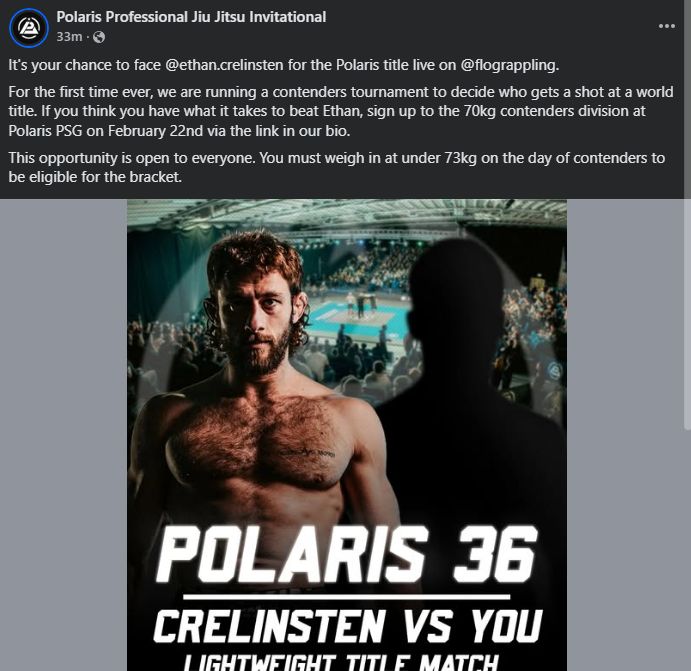
The qualifier is scheduled for Polaris PSG on February 22 with the sole requirement that competitors weigh in under 161 lbs (73 kg) on the day. Anyone willing to register can enter.
Polaris’s recent history suggests this decision is less about innovation and more about financial reality. After several years on UFC’s subscription service the promotion returned to FloGrappling. That move appears driven by necessity rather than preference. UFC has been distancing itself from third party promotions it does not own outright and recently ended its relationship with LFA under similar circumstances.
The timing also aligns with recent comments from FloGrappling General Manager Ben Kovacs on the White Monster Podcast. Kovacs acknowledged that grappling is not currently profitable for FloSports, describing it as almost like a labor of love and noted that the company would need to have hard conversations with athletes in 2026 about running events more economically than in the past.
Taken together, Polaris’s return to FloGrappling and the introduction of an open qualifier point to a promotion that can no longer afford to pay market rates for established contenders.
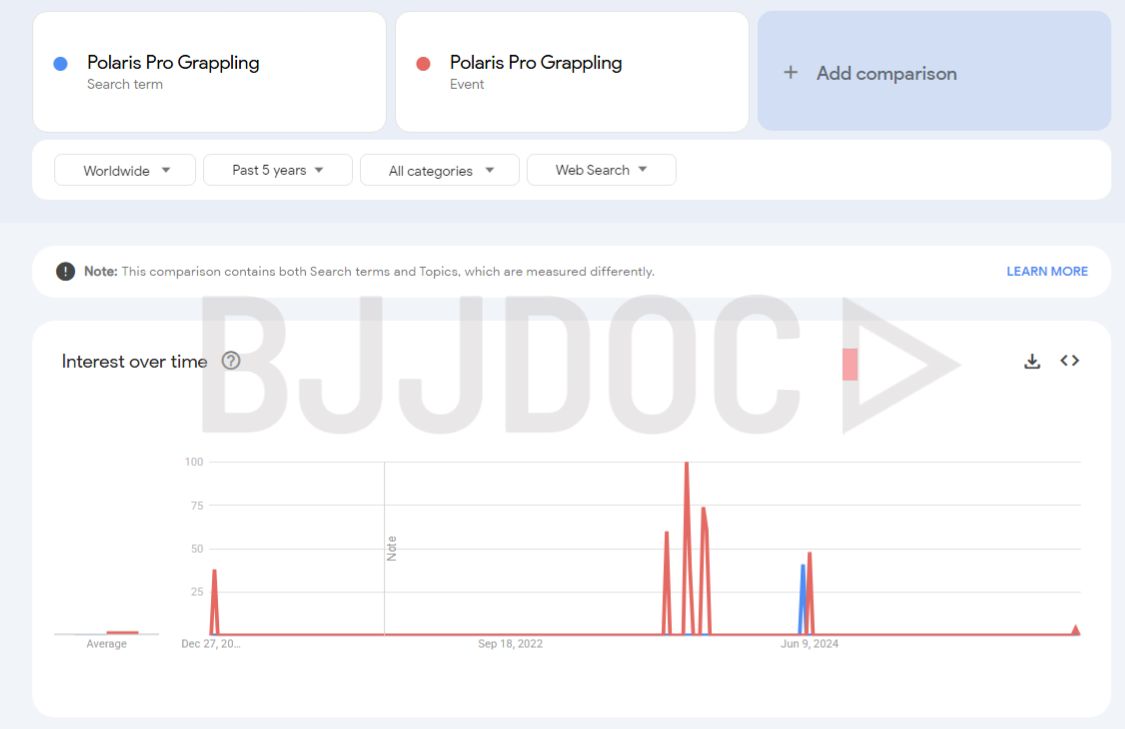
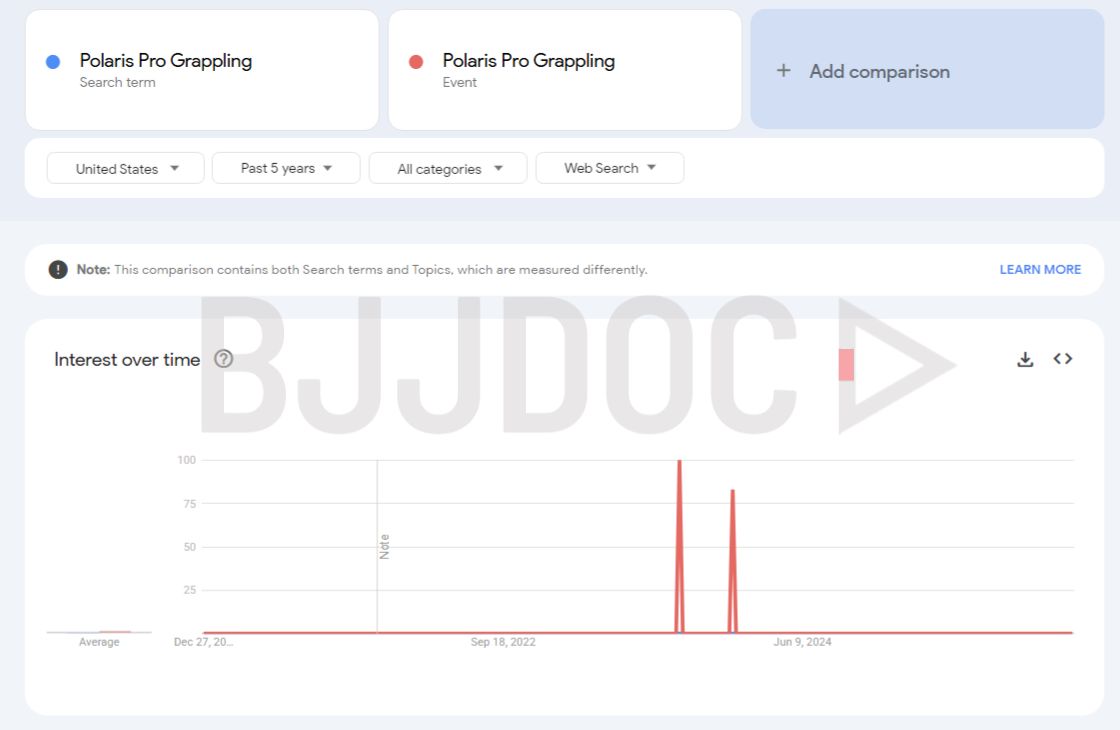
Public interest data reinforces that picture. Google Trends shows Polaris peaking in visibility around 2018 and 2019 followed by a steady decline. Recent events barely register compared to that earlier period.
The picture is especially damning when it comes to the US market.
As our recent assessment put it, when Helena Crevar, a member of John Danaher’s team, lost at Polaris earlier this year.
“Barely anyone in the community is aware of this and there’s no hype behind the girl who defeated her, because almost nobody is even aware this happened.”
When a loss involving a Danaher student goes largely unnoticed, it speaks directly to a promotion’s limited reach.
Polaris has also faced criticism over matchmaking. The promotion is co owned by individuals connected to the Scramble brand and some athletes have alleged preferential treatment for Scramble sponsored competitors in card placement. These claims are difficult to substantiate, but they have contributed to a perception that Polaris serves specific business interests as much as competitive merit. An open qualifier could address that perception or it could simply be a way to populate a card without paying appearance fees.
All of this is happening in a landscape where international promotions such as ACB, AIGA and ADXC, backed by significant external funding, offer prize money Western shows cannot match. At the same time, the UFC has launched its own BJJ venture with exclusive contracts reportedly paying $15,000 per win plus bonuses and Craig Jones’s CJI showed that independent events can still capture widespread attention if executed well.
FloGrappling has historically positioned itself as central to the sport by paying rights fees to organizations like the IBJJF, ADCC, Polaris and BJJ Stars or by providing production support. With Flo’s budget tightening and Polaris’s influence shrinking, this qualifier feels less like an opportunity and more like a signal of contraction.
For newer athletes, an open qualifier does offer a real chance to break through without sponsorships or personal connections. For established competitors, it sends a different message. If Polaris were able to pay for proven 154 lbs (70 kg) contenders, it would not need to crowdsource a title challenger.
Why would elite athletes accept whatever Polaris is offering when alternatives include lucrative purses or guaranteed paydays.
Polaris’s first contenders tournament is not a bold new direction. It is a response to shrinking leverage. Leaving UFC, relying again on a financially constrained FloGrappling and now using qualifiers to fill title matches all point in the same direction.
Google Trends reflects what much of the community already senses. Polaris is no longer a central player. An open qualifier may produce a worthy challenger for Ethan Crelinsten, but it does nothing to address the deeper issue of a promotion that no longer commands attention or resources.
