
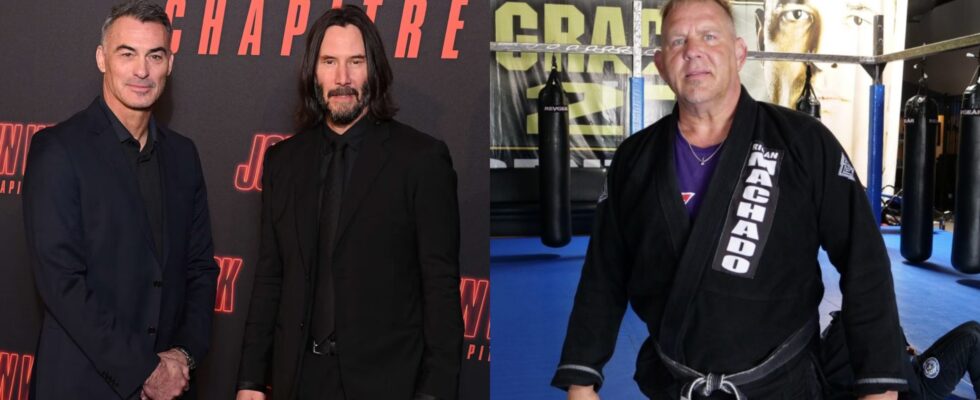
MMA and Brazilian Jiu-Jitsu legend Erik Paulson recently shared fascinating details about his combat career and training partnerships on a podcast. He also talked about his relationship with Chad Stahelski, the acclaimed director of the John Wick film franchise.
During the interview, Paulson reflected on his pioneering days as a mixed martial artist, competing primarily in Japan during an era when many of his bouts went unrecorded or untelevised. The combat sports veteran explained how he built his comprehensive skillset by seeking out the best instructors and training partners across Southern California.
“I really didn’t have a team to train with. I was training myself,” Paulson explained when discussing his early career. His solution was to become what he called “Leonard Nemoy” searching for the ultimate training partner, traveling throughout Los Angeles to work with elite practitioners in every martial art.
During the conversation, Paulson revealed his connection to the John Wick franchise through his collaborations with Chad Stahelski, the film’s director and fellow martial artist. He recounts how his training experiences have influenced action choreography in films. Paulson’s ability to train actors in realistic combat techniques has contributed to the authenticity of action scenes in the “John Wick” series.
“I had… Chad was my coach. Chad’s the director of John Wick. Chad and I and Dave Leech, we were training buddies,” Paulson revealed during the conversation.
The relationship between Paulson and Stahelski developed during a time when Paulson was assembling a network of specialists to round out his game. He trained with Rico Chipperelli for wrestling, multiple boxing coaches including Nikolai Sonia, Charlie Gergen, Marvin Cook, and Battalia, plus Muay Thai instruction from Rob, Lucy Aker, and Ajan Chai.
Paulson’s training philosophy centered on finding quality partners rather than collecting belt ranks. He famously remained a blue belt in Brazilian Jiu-Jitsu for nearly 17 years, even winning the Pan American Championships in 1996 at that rank.
“The belt doesn’t matter to me. What matters are the training partner. I just want good guys to roll with,” he stated.
His training schedule was demanding, with morning sessions at North Hollywood Muay Thai and the Inosanto Academy, followed by evening grappling at the Machado school or additional sparring at Boxing Works with Stahelski and other partners. Paulson invested $650 monthly seeking out the best instruction available.
Today, Paulson operates CSW (Combat Submission Wrestling) in Fullerton, California, with 150 affiliate schools worldwide. He recently came out of retirement to train MMA prospects Kade and Tye Ruotolo, who compete for ONE Championship in Asia.
Paulson’s relationship with Stahelski ultimately became a bridge between competitive martial arts and modern action cinema.
Speaking previously on the Joe Rogan Experience, Stahelski traced his own roots back to judo, which he practiced from ages 10 to 16, before transitioning into Kyokushin-style karate and Japanese Jiu-Jitsu.
Stahelski’s martial arts journey began early. “I was originally a judo first. I did a lot of Judo back when I was 10 to like 16. Then I started karate. It was like a Kyokushinkai Kokondo karate and Japanese Jiu-Jitsu,” he explained. His training continued through college at USC, where he discovered Filipino martial arts through instructor Bert Richardson, a student of Dan Inosanto.
“I met him and I was a big fan of Dan Inosanto from Black Belt Magazine, so he hooked me up and I got into the Inosanto academy and that’s where it went mental,” Stahelski recalled. The academy exposed him to diverse styles, including Kali and Silat, taught by Francis Fong and Paul Vunak.
For John Wick, Stahelski drew from multiple disciplines to create the film’s signature style. “We took Aikido, Aikijutsu, put it all the close quarter tactical s**t with some reloads,” he described. The approach was deliberately different from traditional action movies. “We’re gonna grab people, we’re just gonna make it all grappling. We’re gonna do all Aikido, Aikijutsu and Jiu-Jitsu. That’s it.”
The training regimen for Keanu Reeves was intensive. “We gave him like three to five weeks with some of the trainers we found to get into shape,” Stahelski said about the first film. The focus wasn’t on traditional martial arts drilling.
“Most of what we do is dance. They’re based on Dance drills, they’re not based on martial art drills… It’s mostly about memory because if a guy can punch and kick that’s great, but if you can’t remember five moves you’re not much good.”
“Athletes today, especially in martial arts, are just a whole another level,” He praised competitors like Israel Adesanya for their ability to switch stances constantly, creating multiple threats.
