
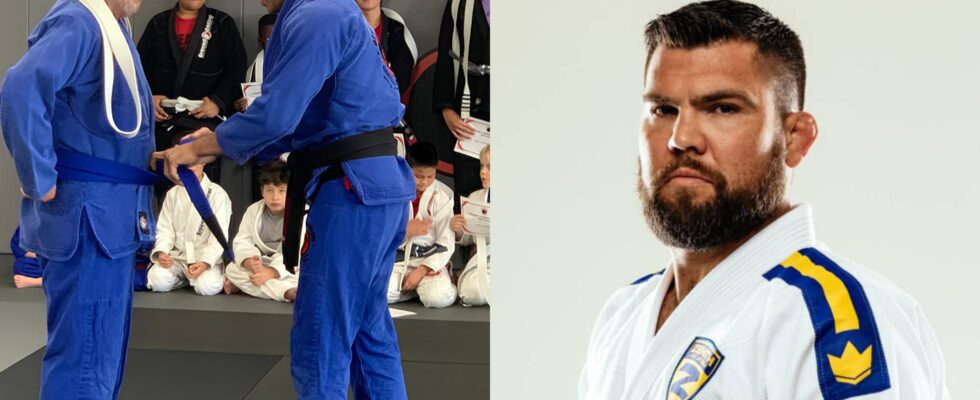
In a recent podcast episode, ADCC veteran and jiu-jitsu historian Robert Drysdale drew a contrast between what he describes as comfort-oriented self-defense training and the merit-based competition model pioneered by Carlson Gracie.
Drysdale addressed the blue belt standard directly while discussing the differences between the original Gracie Academy and Carlson Gracie’s gym model:
“In the self-defense format, these guys were getting their blue belts after 36 lessons. So you show up to the gym 36 times and you get a blue belt. In my gym, 36 times you get a stripe, and that’s most jiu-jitsu gyms in the world. 36 classes gets you nowhere.”
For Drysdale, this lowered standard connects directly to a financial model he believes has long prioritized the paying customer over genuine development.
“It’s telling the nerdy kid he doesn’t have to sweat and he’ll be able to defend himself. This is how all these traditional martial arts managed to enrich themselves, by lying to people and giving black belts to children, after taking tens of thousands of dollars from privates and enriching themselves, going, ‘You don’t have to sweat. You don’t have to work hard. I’m going to teach you a special technique here, a secret technique,’ and then they do these choreographed moves and they go home happy, erroneously believing that they know how to defend themselves. Any MMA athlete is going to look at this and say, ‘You’re a crook.’ And rightly so. And that’s what I think these people are. They’re crooks. They’re money-hungry crooks.”
On whether genuine learning can occur without genuine effort, Drysdale was direct:
“Anyone who knows anything about combat knows that if you’re not leaving the gym drenched in sweat, exhausted, you’re not really learning. Real learning takes place with sweat on your brow.”
He traced the root of the problem to the private lesson format itself, arguing that putting the paying customer in charge fundamentally changes what gets taught:
“If you walk into a private setting, the class is for you. Who’s really in charge? The coach or the paying customer? The paying customer, of course. If the paying customer goes, ‘I want it easier,’ how many people will have the courage to say, ‘I can’t do this?'”
Drysdale closed by separating his critique from any judgment of business success, framing it instead as a matter of historical record:
“As a historian, I would be incompetent if I didn’t acknowledge the difference. Carlson aimed at performance. That was it. You had to be good. You had to be a champion. You had to excel. You had to walk off those mats a little bit better every day. And if that means being very tired, well, that’s the price you pay.”
