
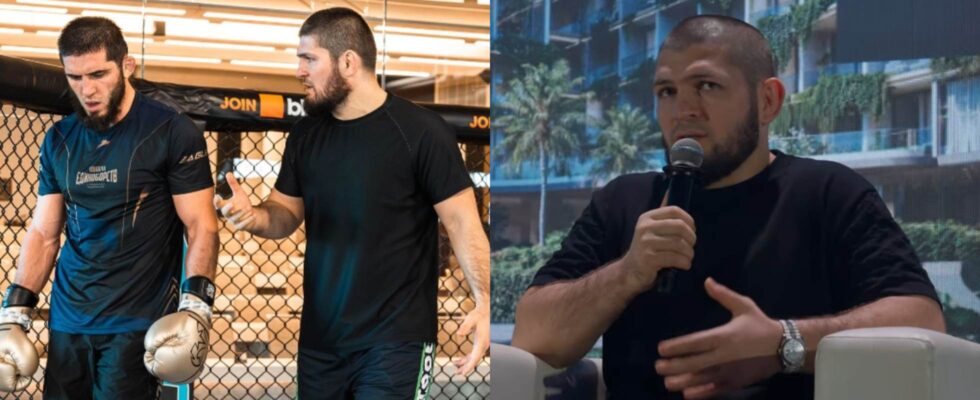
UFC legend Khabib Nurmagomedov recently appeared during an event in Phuket, Thailand, marking his official partnership with Sun Hills Development. During a session with the audience present, several attendees pressed him on the responsibilities that come with teaching martial arts to young people.
A father in the audience explained that his 15-year-old son trains at a gym and raised a concern about what that training actually produces in a young person.
“The power without kindness can be cruel. At the same time, kindness without power can be vulnerable,” he said.
Khabib immediately understood the concern and addressed the risks that come with teaching young people.
“If we speak in simple terms, the question is how to make sure a person who trains does not become socially dangerous,” he explained. “Someone who learns hand-to-hand combat, with both hands and legs, standing or on the ground, has the ability to harm others. To direct those skills in the right direction, he needs intelligence and proper guidance.”
He was clear that the responsibility cannot fall on the gym alone.
“It all starts at home,” Khabib said. “He comes to the gym, spends two hours there, and then leaves. After that, there must be education and guidance. But that work should be done by parents, at home.”
Khabib talked about the danger of developing physical strength without character.
“This is very dangerous when a person has no wisdom but too much strength,” he warned. “We have seen many situations where strength without understanding leads to harm.”
His advice to the father focused less on rules and more on values.
“My advice is simple,” he said. “If your child is strong, raise him to be noble. Strength should be used in competition, and in life it should be used only for self-defense and to protect the weak.”
He then turned the responsibility directly back to parents, stressing the importance of leading by example.
“Personal example has great meaning,” Khabib said. “I had that example at home. My father didn’t just tell me to train, he trained himself. He played football, he woke up early in the morning to exercise, and in the evening he trained again. I always had that example in front of me.”
He compared that with parents who give instructions but fail to model the behavior themselves. “It’s not enough to say, ‘Son, you have to do this,'” he explained. “You have to do it yourself and show it.”
Khabib then shared a saying that captured the idea perfectly.
“There is an expression,” he said. “When a father tells his son, ‘Watch who you spend time with and where you go.’ The son replies, ‘Father, you should watch how you live, because I am following your footsteps.'”
When the discussion shifted to whether coaches should be allowed to link academic performance to training privileges, Khabib said the priorities in his father’s gym were always clear.
“In the first place, there was education. In the second place, education. In the third place, only sports,” he said.
He recalled how his father would even pack books for him on training trips. “He didn’t just tell me to read them,” Khabib explained. “He made me rewrite them by hand.”
Khabib closed that part of the discussion with a warning about the people who influence children during the hours parents are not present.
“Sometimes there are teachers who are not mentally healthy,” he said. “And imagine, some unstable person is educating your child for five hours a day. You may not even know who he is, where he grew up, or what kind of values he has. But we send our children there because we are busy with our own responsibilities.”
Throughout the conversation, his message remained consistent and simple: “Communication is the key,” Khabib said. “There must always be communication.”
[Editor’s Note: Quotes have been translated and edited for clarity and readability.]
