
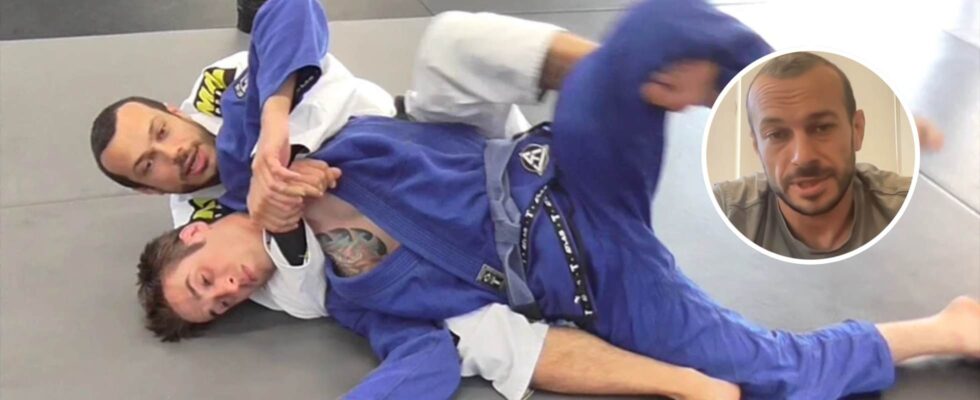
Brazilian grappling coach Lachlan Giles recently shared his concerns about how social media is shaping the way Brazilian Jiu-Jitsu practitioners learn the sport. Speaking on The Ageless Warrior Lab podcast with host Dave Meyer, Giles explained that while the overall quality of instruction has improved in recent years, the rise of algorithm-driven platforms has created a new problem: visibility doesn’t always equal effectiveness.
The discussion began when Meyer pointed out that students today have access to more instructional material than ever before, but often struggle to distinguish high-quality fundamentals from flashy techniques designed to grab attention.
Giles agreed, noting that social media tends to reward spectacle over important content.
“I think the hardest thing now is just, it’s like the same issue as with social media,” Giles said. “Well, it is social media, a lot of it.”
He explained that creators frequently share techniques on platforms like YouTube and Instagram, but the content that performs best is often the most sensational rather than the most practical.
“When you go on YouTube, or obviously I put stuff on my Instagram like techniques and stuff,” he said. “Which is obviously my best stuff’s on the paid platform, but I put stuff out on social media.”
Giles noted that visibility is often tied to novelty, controversy, or visual appeal rather than effectiveness.
“But I find like if you’ve got like a controversial take on something, or a wild wacky sort of thing, or like something that looks flashy,” he explained. “Like those are the ones that get viewed a lot.”
He contrasted that with more methodical instruction, which may be less entertaining but more valuable for long-term development.
“And sometimes I’m like, this is going to change the way you think about this position,” Giles said. “But it’s kind of a bit boring.”
According to him, that mismatch between usefulness and engagement creates a learning problem for practitioners who rely heavily on social media feeds.
“Those sort of things, they just don’t get any views,” he said. “And I’m like, well, I think that’s the issue people are going to run into these days.”
Giles warned that algorithms can unintentionally guide students toward techniques that look impressive but have a lower success rate in real competition.
“You’re going to be funneled into watching these sort of perhaps lower percentage moves,” he explained. “Just because they’re the ones that people are more likely to view, unfortunately.”
He then pointed to a specific example from his own social media feed that illustrated how strong opinions can drive engagement, even when the conclusion is misleading.
“Something came up recently on my feed,” Giles said. “It was like a video someone saying, ‘Never do this move. This move sucks.'”
Giles disagreed with that blanket criticism, arguing that a single failed attempt does not invalidate a technique.
“And I’m like, it doesn’t suck,” he said. “There’s a video of someone like trying the move and failing in a competition.”
He emphasized that context matters, and that many techniques work under the right conditions.
“But I’m like there’s plenty of examples of that also working,” Giles added.
In his view, the reason such content spreads widely is tied directly to the way social media rewards strong, confident opinions.
“Having like a strong opinion on something gets more shared,” he said. “Somehow that came across my feed because lots of people were watching this particular video.”
As the discussion continued, Giles outlined what he believes is a better approach to learning Brazilian Jiu-Jitsu: structured, system-based instruction rather than isolated techniques presented in short clips.
“Something that’s structured well can present a whole system as opposed to just an individual move,” he explained. “Like, this is a whole position, this is how I think about it.”
He stressed that effective instruction should connect techniques to underlying concepts and decision-making patterns.
“These are the main concepts you need to understand,” Giles said. “These are your options, this is what your opponent’s going to do.”
The goal, he noted, is to link all those elements into a coherent framework rather than treating moves as standalone tricks.
“Sort of trying to tie all that together,” he said. “I think that’s always going to be better.”
While that kind of learning requires more time and patience, Giles believes it ultimately produces stronger practitioners.
“It takes a bit longer to get through content like that than a YouTube video,” he said. “But it’s just going to set you up better to learn.”
