
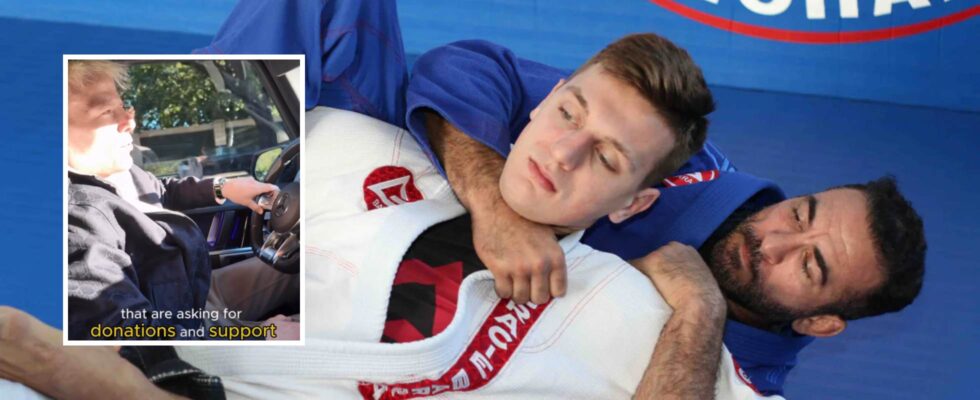
A Dutch jiu-jitsu competitor has set off a surprisingly charged debate across social media after posting a video questioning why members of the BJJ community ask strangers to fund their training, competitions, and travel through platforms like GoFundMe.
Jordy Sanders, a three-time Dutch champion, posted the video with a caption that asked: “Why should strangers fund someone else’s hobby?”

In the video, Sanders didn’t hold back. “Lately, I’ve seen a lot of posts of these jiu-jitsu athletes that are asking for donations and support for their competitions, their training and their traveling,” he said. “And my question is to these people, why would anybody donate money to you to do your hobby? If you can do this hobby, you’re capable to work as well and make your own money. And why would anybody give money rather to you than a dog shelter?”
He concluded the video by talking about those seeking help with medical bills after injuries sustained in training: “For the athletes that are asking for donations for their surgeries, maybe you guys should tap on time when you’re broke.”
Across discussion threads, the prevailing sentiment leaned strongly in Sanders’ favor. A large portion of the community appeared to agree with his underlying argument that athletes should take personal responsibility for funding their participation in what is ultimately a voluntary sport.
The idea that hobbies, even demanding ones like competitive jiu-jitsu, should be financially self-sustained resonated with many practitioners who balance training with full-time jobs.
Some commenters talked about how crowdfunding has become an easy fallback rather than a last resort. In their view, athletes should either work to support their ambitions, develop a level of skill that attracts sponsorships, or reconsider the scale of their competitive goals.
At the same time, the discussion was not entirely one-sided. Some pointed out that the path to sponsorship often requires competing in tournaments, which can be prohibitively expensive without initial financial backing. From that perspective, limited fundraising can serve as a stepping stone rather than a permanent solution.
The debate also touched on the rising cost of participation in Brazilian jiu-jitsu. Membership fees, competition registration, travel expenses, and the inherent risk of injury have made the sport increasingly expensive, leading some to argue that financial barriers are pricing out talented athletes before they have a chance to prove themselves.
