
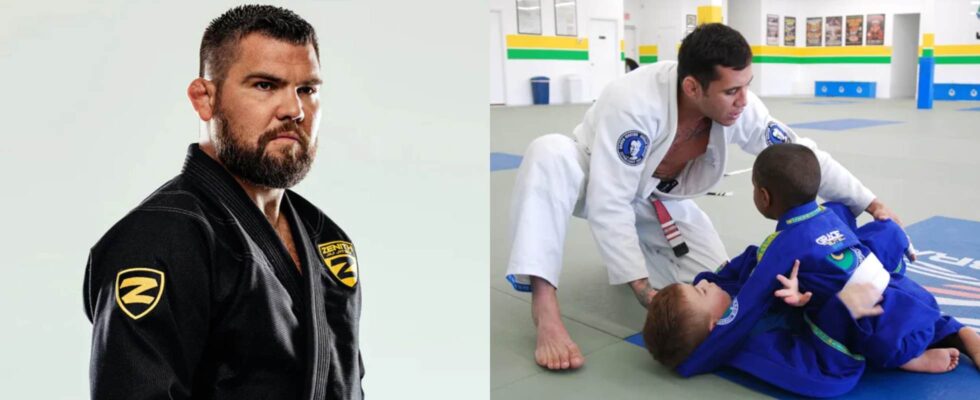
ADCC veteran, jiu-jitsu world champion, and former MMA athlete Robert Drysdale appeared in an interview to discuss the historical evolution of Brazilian jiu-jitsu. During the conversation, Drysdale made an observation about how shifts in culture, specifically the rise of political correctness, changed how children were raised and how it reshaped the direction of jiu-jitsu’s development.
Drawing from his upbringing in Brazil, Drysdale described a childhood environment where physical confrontation between kids was common and largely accepted as part of growing up.
“When I was a kid, we’d get into figh ts every week. Every week there was one,” he recalled. “There was a little circle, like a mini octagon. The kids would close it off. They’d give you time to take your watch off because the watch was like a big deal. You couldn’t break your watch.”
He continued by painting a picture of how structured those confrontations felt, even among children.
“You take your wallet, put your backpack down, and you scrap, and then no one would interfere until someone quit,” he said.
Drysdale compared that environment with what he sees as a very different cultural climate today, one where the boundaries around acceptable behavior have shifted significantly.
“The political correctness has had a massive impact on how children are raised,” he said. Now everything is bullying. It’s almost too much. You can’t say anything. I can’t even make fun of people. They go, ‘You’re bullying me.'”
Looking back on earlier decades, he argued that social norms were far less restrictive.
“The ’90s was a lot less politically correct,” he added.”The ’80s even less so.”
According to Drysdale, those cultural changes didn’t just affect childhood behavior, they also shaped the identity and evolution of Brazilian jiu-jitsu itself.
“That change right there impacted the evolution of jiu-jitsu,” he explained. “All of a sudden, it stopped being a warrior, Spartan practice, for lack of a better term. It became something more for everyone, more democratized.”
However, he was careful to clarify that this shift toward accessibility differed from how earlier figures in the sport had envisioned growth.
“Not in the way that Carlson would have democratized,” he said.”But in a way that it was for everyone who wants to train, not whether you can survive the hot waters of high-level competition or intense training.”
Despite some nostalgia for the older, tougher culture, Drysdale acknowledged that the transition has brought meaningful benefits to a wider range of people.
“The change is positive in the sense that it brought goodness into the lives of so many people,” he said. “Is that not better? Is that not superior to having half a dozen people, however brilliant they may be in the cage and ring?”
“Which one has a more positive impact in the world?” he asked. “A martial art that reaches all demographics, even if it is less combat ready?”
Drysdale admitted that he still feels an internal tension when weighing authenticity against accessibility.
“My heart says, ‘No, Rob. Like you’re supposed to be real. Otherwise, what’s the point?'” he said. “But on the other hand, I go to a jiu-jitsu class and I see all these grandmas walking around competing. And who am I to say that she shouldn’t be in practice because she can’t hang with Buchecha?”
Ultimately, Drysdale leaned toward recognizing the social value of a more inclusive version of jiu-jitsu, one that prioritizes community as much as combat readiness.
“It gives people community. It gives them a place to belong,” he said. “So what if what they’re practicing wouldn’t work in a fig ht?”
Over time, he explained, his perspective has shifted toward appreciating the emotional and social role the sport plays in people’s lives.
“Over time I’ve come to see the other side clearer,” he said. “And I think there’s a very valid point to be made about people just wanting to be in jiu-jitsu because it’s where they’re happy. It’s like a second home to them. And how do you argue with that?”
