
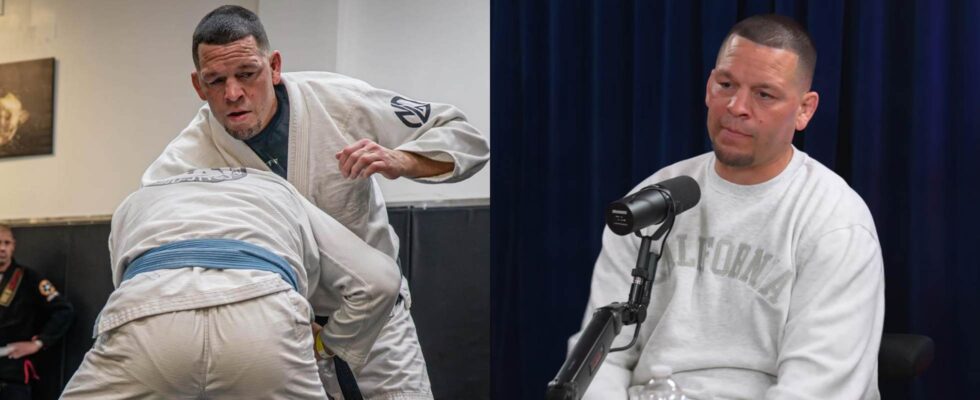
UFC icon Nate Diaz recently sat down with comedian Theo Von on This Past Weekend podcast alongside fellow athlete Chris Avila. During the conversation, Diaz made a compelling case for why jiu-jitsu should be taught in every school across the country.
When Von asked whether figh ting should be taught in schools, Diaz did not hesitate. “I think jiu-jitsu should be,” he said.
Chris Avila then named law enforcement, to which Nate replied: “But if they did it in school, then by the time they get to law enforcement, they would know. And then if you’re going to do law enforcement, you be like, ‘Well, I better step up my game,’ because you would be conscious and aware of it because you learned it in school.”
For Diaz, the argument goes beyond self-defense. It is about awareness. “Just for self-defense in general, I think people should know how to defend themselves a little, how they be a little more stable walking around,” he said. “I think it helps with everything, you know, kind of like common sense type of thing. Like I think people get hurt less and think a little more about what they do.”
He drew a straightforward comparison to one of the most universally accepted life skills taught to children. He stated, “Jiu-jitsu, I think is necessary for everybody. It’s like learning how to swim. Like I think everybody should learn how to swim. What if you fall in some water? So that’s what I think about, too.”
Diaz also pointed to a false sense of confidence that many people carry. “People don’t even think about it or consider it though. ‘Oh, I could defend.’ When’s the last fig ht you got in? You don’t even know that you can’t fig ht. And I know that you don’t know that. And people aren’t even conscious or aware of that. So I think that’s a scary situation,” he noted.
Beyond physical protection, Diaz spoke about the social benefits jiu-jitsu gave him as a teenager. Training alongside people of all ages, from police officers to bakers to doctors, helped him break out of his shell.
“I learned how to talk to people and understand people and communicate. So it helps with just falling into the social pipeline,” he said.
He noted that the confidence built on the mat translated directly into everyday life. “Especially after training, you’re getting endorphins, you’re high, and they’re asking you something you know about. So you explain, you go here, you pass a guard like this, and then they’re going, ‘Hey, what do you do in the daytime?’ Now you got a friend,” he stated.
His position on the matter was inclusive from the start. “Girls, kids, everybody,” he said. “Why wouldn’t they want to learn jiu-jitsu?”
