
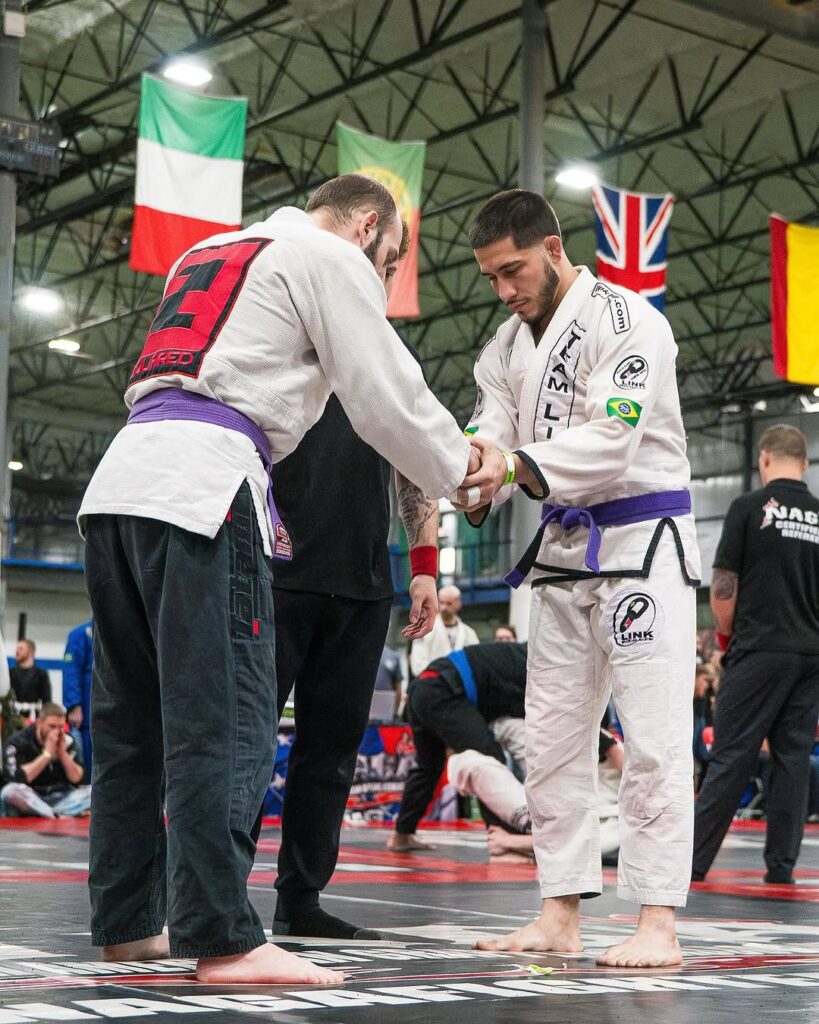
Before Cesar Alvan ever stepped onto a wrestling mat at Columbia University, his life was already rooted in martial arts. Growing up in Leominster, Massachusetts, he spent his childhood inside his father’s gym, surrounded by Brazilian jiu-jitsu and judo.
Reflecting on those early years in a recent interview, Alvan explained that combat sports were part of his life from the very beginning. “I grew up with a BJJ and judo background,” he said. “That’s what I first got into since I was very young, like literally two years old.”
For him, the gym was home. He recalled learning basic life skills on the mats long before he ever thought about competition.
“I learned how to walk and crawl on the mats,” he said. “That’s where I lived my everyday life. My dad is a BJJ instructor from Brazil, and he came over here and opened up his own martial arts gym. So I grew up doing that. That was always what my life was based around.”
Wrestling didn’t enter the picture until third grade, and when it did, the transition wasn’t entirely smooth. A group of kids from a local youth club had joined his father’s gym, and after Alvan handled them comfortably during training, they encouraged him to try wrestling. He accepted the challenge, but quickly realized that his instincts from jiu-jitsu didn’t always translate to the new rule set.
“It was very interesting at first,” he said. “As a young kid who grew up doing Brazilian jiu-jitsu, I didn’t quite get the rule changes.”
Those habits showed up immediately during competition. Techniques that worked perfectly in jiu-jitsu often put him in trouble on the wrestling mat.
“I was always locking hands on top,” he explained. “There were a lot of matches where I’m pulling guard off my feet and going to my back. My coach is like, ‘No, no, you can’t do that.'”
Despite the early learning curve, that jiu-jitsu background never truly left him. In fact, it became a decisive advantage years later on one of the biggest stages in college wrestling.
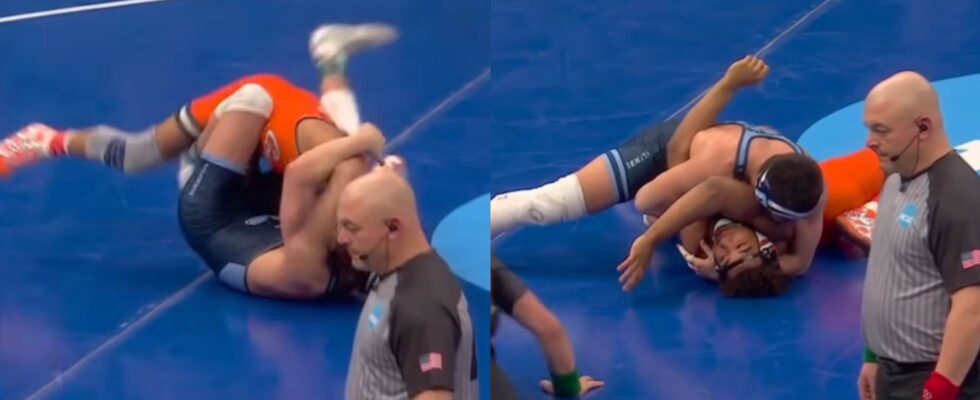
During the NCAA tournament, Alvan found himself in overtime against D’Lockett in what became one of the most talked-about moments of the event. When he was forced onto his back, which is a dangerous position in wrestling, he instinctively relied on the techniques he had practiced since childhood.
“As I was going to my back, I’m like, I’m going to go for the sweep,” he said. “That’s something I’ve done a few times in matches and in training, just because of my BJJ background.”
The move worked perfectly. Alvan executed the sweep, reversed the position, and pinned D’Lockett, turning a defensive moment into a highlight.
Looking ahead, Alvan believes his martial arts roots will continue to shape his future long after his wrestling career ends. Returning to his family’s gym is one possibility, but his ambitions stretch even further.
“My dad owns a martial arts gym back home,” he said. “So I’d love to either go back home and help him grow that.”
At the same time, he hasn’t let go of the dream that first took hold when he was a child watching athletes pass through his father’s gym. “While doing that, maybe train some MMA and hopefully go to the UFC and become a UFC champion one day,” he said. “That’s been my ultimate dream since I was young.”
That aspiration isn’t coming from nowhere. His father has long-standing ties to the sport, coaching athletes at the highest level. “My dad has been in and out of the MMA scene,” Alvan said. “He’s coached many MMA athletes. He’s coached in 86 UFC matches himself. So that’s been my life since I was a kid.”
