
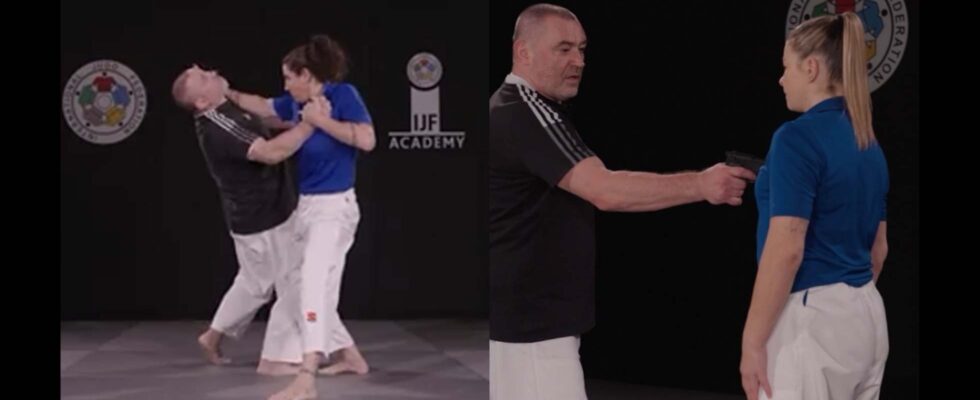
The International Judo Federation is making a move that has the martial arts world raising eyebrows. Through its IJF Academy platform, the governing body of Olympic judo has announced a new course titled “Judo for Self-Defence Instructor” (JSDI), and the promotional trailer for it looks remarkably familiar to anyone who has spent time around Brazilian Jiu-Jitsu’s Gracie self-defense curriculum.
The trailer opens with a polished pitch:
“The International Judo Federation Academy presents a powerful new way to stay safe and stay fit. Built on the principles of judo, this self-defense program blends tradition with modern techniques. It’s designed for everyone because confidence and safety are universal needs.”
The language is smooth, the production values are high and the message is clearly aimed at a broad civilian audience rather than competitive athletes. That alone marks a notable departure from how judo’s traditional institutions have historically operated.
For generations, the Kodokan, judo’s founding organization in Tokyo, steered clear of teaching practical self-defense as a core part of its curriculum outside of formal kata. The kata that do exist within the Kodokan system are widely regarded as rarely practiced to any realistic standard of self-defense application.
The trailer promises the course was “created by world-class experts” and is “practical, accessible and empowering for all ages,” but offers little specifics about the methodology behind it. What the trailer does show, in terms of technique and framing, draws immediate comparisons to the Gracie self-defense system, a structured civilian self-defense program built by the Gracie family that has become one of the most recognized self-defense curricula in the world.
Judo has been grappling with a serious image problem in Western markets for years and nowhere is that more apparent than in the United States. Renowned judo black belt Shintaro Higashi has been one of the more vocal voices on the subject.
“When you go to Japan and you say judo, people think, ‘Oh, little kids.'”
“You say judo [in the USA] they think judo chop, hey buddy, are you doing that karate thing right.”
The perception gap goes beyond casual misunderstanding. Higashi points out that even experienced grapplers tend to view judo negatively, though for entirely different reasons than the general public.
“You say that to a jiu-jitsu guy, they immediately think, uh, knee injury, shoulder injury, getting slammed, not fun.”
That is a significant problem given the landscape of grappling in the United States, where Brazilian Jiu-Jitsu has built a dramatically larger base of practitioners.
“Jiu-jitsu is very accessible.”
“It’s not the same with judo.”
Higashi‘s proposed remedy is straightforward in concept if not in execution.
“We have to make judo easy and then work on the marketing side of judo.”
He called for dojo operators to lower the barrier to entry while the broader judo community works to reshape public perception. He noted that the IJF has already been quietly managing optics at competitions, with camera operators instructed to look away when injuries occur, a contrast to combat sports that tend to amplify such moments.
The new JSDI course could be read as one response to exactly that kind of thinking. A self-defense program stripped of judo’s most intimidating competitive elements, packaged for everyday people worried about personal safety rather than tournament medals, addresses a real gap in the market. Whether it addresses that gap effectively is a different question entirely.
Access to the course is not open to the general public. Enrollment requires that candidates already hold the Undergraduate Certificate as Judo Instructor (UCJI) and be formally nominated by a supervisor within their National Judo Federation. In other words, the course is aimed at creating certified instructors who can then teach the material downstream, not at putting civilians directly through a program.
That structure has its logic, but it also means the IJF is entering the self-defense market through the same institutional channels that have historically kept judo at arm’s length from the kind of practical, accessible instruction that made Gracie Jiu-Jitsu a household name in martial arts circles. Whether the organization has genuinely rethought its approach to self-defense training or is simply repackaging existing material with a modern coat of marketing remains to be seen.
“Judo has a branding problem and I think we can all do our very best to work on it.”
The IJF appears to agree. Now comes the harder part, proving the content lives up to the pitch.
