
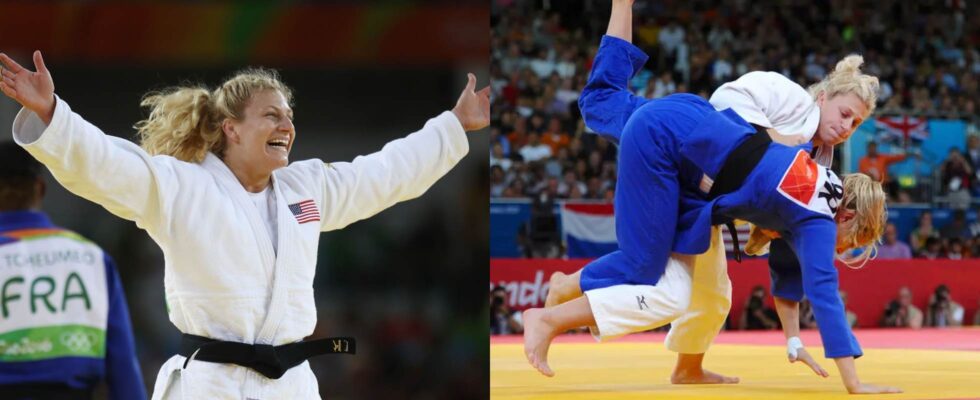
Two-time Olympic gold medalist Kayla Harrison recently sat down with Jorge Masvidal on his latest podcast episode. During the conversation, she talked about modern judo, its politics, and the rule changes that reshaped the sport.
One of Harrison’s biggest frustrations centered on the decision to ban leg grabs in competitive judo, a move she believes contradicts the sport’s own history.
“You can’t grab legs, even though it’s literally a throw,” she explained, pointing to the original teachings of judo’s founder. “There’s a book that the founder of judo wrote, and there are 67 main throws of judo, and a double leg is one of them. But they banned it. I’m like, how are you going to ban an original throw? It doesn’t even make sense. It’s political.”
According to Harrison, those rule changes also altered the overall style of competition, particularly in traditional powerhouses like Japan.
“It’s probably why they banned it because now Japan is very, very traditional, and from my perspective, kind of boring,” she said. “You’re not really allowed to grip fig ht anymore. A lot of stuff has been taken out.”
Harrison noted that the rule shift had ripple effects across national programs, specifically mentioning Cuba’s historically dominant women’s team.
“When they got rid of leg grabs, it did kind of mess up Cuba,” she said. “But for a long time, especially women’s judo in Cuba, they were scary.”
She also tied judo politics to the delayed legalization of mixed martial arts in France, arguing that traditionalists worked to keep MMA out of the country.
“That’s why MMA was banned in France for so long,” Harrison said. “Because the judo people didn’t want the riffraff MMA, and they had an in with all the politicians.”
Despite becoming one of the most decorated athletes in the sport, Harrison revealed that the financial opportunities available after her Olympic success were surprisingly modest.
After winning her second gold medal, the International Judo Federation approached her with a job offer that she found underwhelming.
“That was what the International Judo Federation wanted me to do, but they offered me like $25,000 a year,” she said.
When Masvidal expressed disbelief at the figure, Harrison acknowledged the emotional conflict between passion and compensation. “I mean, I didn’t do it for money, but like, I did,” she said.
Masvidal supported her and said, “You should get compensated. You brought those medals from America.”
Harrison also highlighted the difference in competition frequency between judo and MMA, explaining how constant tournament exposure helped her manage nerves and develop resilience.
“In judo, there’s a tournament every weekend,” she said. “So it’s like, okay, you lose, big deal. On to the next. We’re growing.”
During the conversation, Harrison also reflected on the grueling training camps in Japan that shaped her career.
“Every year we would go to Japan for the national training camp,” she recalled. “We’re talking like there’s 500 girls on the mat. You’re eight girls deep in every weight class, just absolute killers. The best of the best.”
The workload was dramatically different from what she experienced in the United States.
“In America, we might have 15 people on the mat across all weight classes, and maybe do 10 rounds of sparring,” she said. “We go to Japan and we’re doing 30 rounds twice a day.”
After years of being outmatched, Harrison eventually reached a turning point,one she says she will never forget.
“In 2016, I was the reigning Olympic champion, and you see yourself getting better,” she said. “I’ll never forget this for as long as I live. There were 500 girls, and I’m standing in the middle of the mat with my hand raised because no one would go with me. I made Japan my b**ch. All the coaches were yelling at them, ‘You’ve got to go with her.’ No one wanted to go with me. But it took a decade. It took a decade of me getting my a*s whooped.”
