
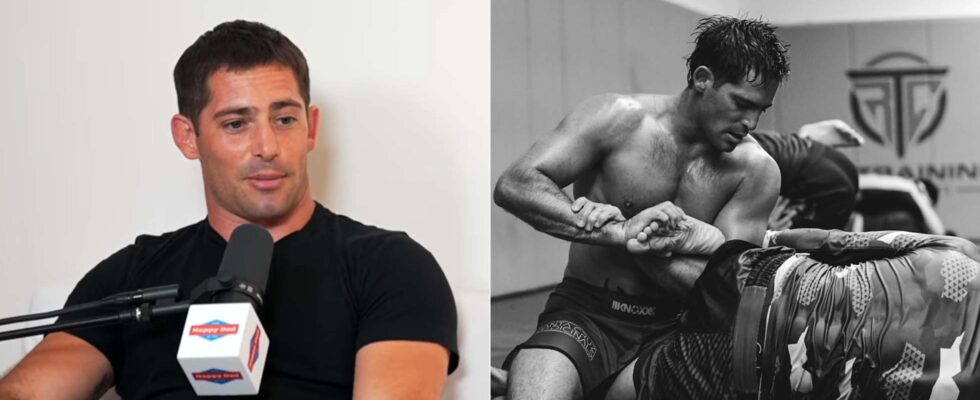
Brendon Ruh, the founder of Santa Cruz Medicinals, appeared on the Full Send Podcast and spent a fair amount of time talking about his Brazilian jiu-jitsu training, the injuries that come with it and why he considers it the best martial art for most people.
Ruh laid out a weekly routine built around weights three times a week and jiu-jitsu twice a week with surfing, mountain biking and free diving rounding things out.
“My training regimen is I do weights like hard like three times a week. And then I try to go to jiu-jitsu like twice a week. And then I surf.”
He also acknowledged that overtraining had previously affected his hormone levels, noting that going hard with “surf, jiu-jitsu, weights” had done some unusual things with his testosterone panel.
Ruh was straightforward about the appeal.
“I love it, man.”
he said, adding that his entire crew shares the enthusiasm.
He connected the sport to the caloric demands of serious training.
“People in jiu-jitsu, 1,000 calorie days. Like it’s hard work.”
He was candid about the physical toll, particularly around the leg lock game.
“I’m in the leg lock game now. Like my stuff’s always tweaked, dude. Like I always have a little tweak.”
He pointed to persistent knee issues from heel hooks as an ongoing reality of training hard.
That said, he offered some reassurance for newer practitioners.
“You get less injured once you reach like this sort of level. Like maybe like blue belt and above.”
He added:
“You’ll start to know what’s good.”
For managing those lingering issues, Ruh has incorporated BPC-157 into his recovery approach.
“You know, jiu-jitsu, you get little injuries and stuff. I got a couple BPC sho ts in my ankles.”
Ruh described showing up to train with UFC welterweight Michael Morales despite a swollen ankle.
“I was like, ‘Forget it, I’m just going to train with my ankle swollen.’ So it got worse.”
He used the experience to highlight what separates grappling from striking.
“The cool thing about jiu-jitsu is I’ll go train with Michael Morales, and it’s like I’m going to get messed up, but I’m going to be fine.”
By contrast, he noted that sparring left him feeling noticeably different afterward.
Ruh was direct on this point.
“I do think jiu-jitsu and wrestling are better than striking martial arts,”
he said, framing it partly as a conversation starter but also as a genuine view.
His argument was less about the quality of boxing or Muay Thai and more about where recreational training naturally leads.
“You go to a boxing class. You love it. It’s fun. You hit the pads. Now you want to get good at this thing that you just started. Now you’re sparring. And the only way to actually get better at that sport is spar hard. You’re going to get hit in the head.”
For the average person focused on health and self-defense, his conclusion was simple.
“For just like the normal person who wants to do martial arts defending themselves, I think jiu-jitsu is the best.”
