
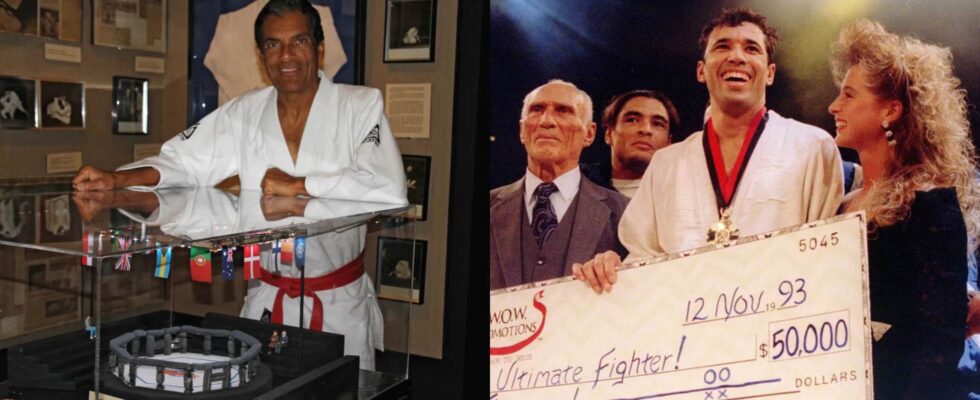
Former MMA star and ADCC veteran Robert Drysdale recently appeared on the Jiu-Jitsu Revolution podcast to discuss the history of Brazilian jiu-jitsu and its relationship with the UFC. Among the more pointed observations he made was his belief that Rorion Gracie never truly viewed MMA as a sport worth holding onto long term.
Drysdale traced Rorion’s arrival in the United States to the late 1970s, noting that he spent over a decade in California without ever moving toward staging an MMA event.
“Rorion Gracie, the founder of the UFC, he moved to California, can never remember if it’s ’78 or ’79. But late ’70s he moved to the United States and he doesn’t start the UFC until 1993, so he had been there for 14, 15 years and he had not pulled the trigger on MMA. He was trying to promote jiu-jitsu through other means, dojo storming, you know, Hollywood movies. An MMA event like the UFC was not something on his radar.”
According to Drysdale, it was the success of jiu-jitsu challenges broadcast on national television in Brazil in 1991 that shifted Rorion’s thinking.
“I think Rorion got the inspiration from that. Okay, if it’s working in Brazil, imagine what we would do in California or in the United States.”
Drysdale also pointed to what he saw as a clear inspiration for the format.
“I think they were watching these things. This is how we got to sell it to the world. We’re going to create a real life blood sport and we’re going to call it the UFC.”
He added that Rorion’s decision to plant his flag in California was no accident.
“He didn’t go to Nebraska. He didn’t go to Paraguay. He didn’t go to Colombia. He went to California. It’s intentional. If you want to sell something to the world, you go to California. The world will buy it. If Californians buy it, the world will eventually buy it.”
Drysdale then talked about Rorion’s long-term commitment to what he had built.
“I don’t think Rorion ever fully believed in MMA as a sport in itself, because the first opportunity he had, he sold the UFC for a million dollars.”
When his host noted the scale of what that sale represented in hindsight, Drysdale did not hold back.
“It’s like a multi-billion dollar business. They sold it for a million bucks. Because if you’re selling that for a million bucks, what you’re doing is, I’m good, I don’t want nothing to do with this. If you’re in love, like Dana loves what he does, so he’s good at it. He loves what he does. So he’ll pass away as CEO of the UFC. He’s not going anywhere.”
For Drysdale, the sale was the clearest signal of what the UFC actually meant to its founder: a vehicle to promote jiu-jitsu, not a sport to be built and sustained.
