
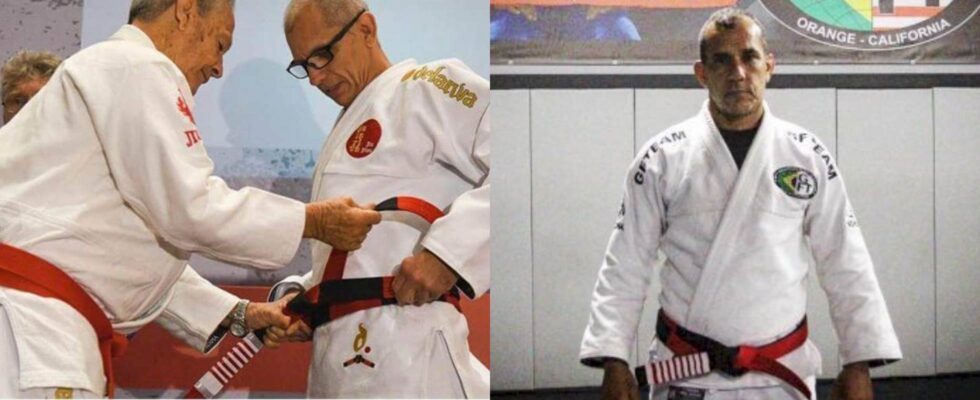
In a recent podcast interview, BJJ world champion and historian Robert Drysdale revealed little-known details about the coral belt from the 1967 Brazilian Jiu-Jitsu federation manual. What he described was a belt system far more meritocratic and conditional than anything practiced today.
Drysdale began by walking through the belt structure of the era, explaining that when a practitioner received a black belt, it came with a white bar.
“When you became an intern,” he said, “you were given a red bar on your black belt. No white tape anywhere, no stripes, just a red bar, nothing else.” Once the internship was complete, the white stripe was added to the red bar, which is the format most recognize today.
“What’s really interesting about this is that the next belt is the red belt,” Drysdale said. “There’s no coral belt.”
He continued: “The coral belt, there was only a black and red coral belt. There’s no white and red at that time. They had a black and red and it was an honorary belt. This is really interesting. The honorary belt, and this is in their words, is to be given to the people who are willing to defend the honor and glory of jiu-jitsu inside the rings.”
The conditions attached to wearing it were strict. “It was an honorary belt that you would wear in case you were willing to defend jiu-jitsu inside a ring,” he explained. “And this is even more interesting. If you did not perform well, it was presumably taken away from you because the federation reserves itself the right to take away the belt.”
Drysdale used a contemporary example to drive the point home. “If you’re Buchecha and you’re winning everything, you get to wear a coral belt wherever you go. You could teach class and wear it. But if you stop doing well, you’re no longer being the alpha, the representative of jiu-jitsu, the coral belt could be taken away from you by the federation.”
He was clear that this policy never made it off the page. “This was never implemented. They never implemented this, but it’s in the manual of the federation. It’s there.”
Despite it remaining theoretical, Drysdale explained the intent behind it: “You want to be the man? You got to be the man inside the ring. You don’t get to talk your way up. You want to wear this belt? You get in the ring.”
He added: “I think this meritocratic environment they were trying to create is something I admire.”
