
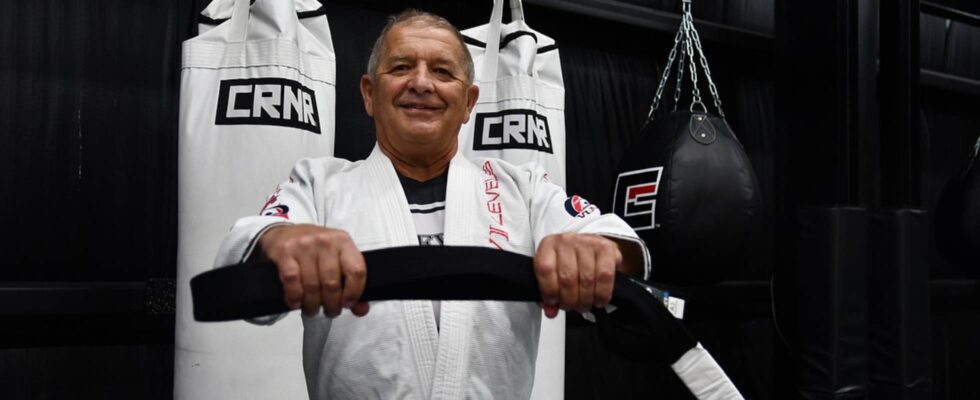
When Paul Laniosz stepped onto the mat for the first time at 6 Levels Orlando, he was 65 years old, freshly retired, and carrying a two-decade-old dream. On Saturday, February 7, that dream became reality when the Winter Garden resident earned his black belt in Gracie jiu-jitsu, just weeks before celebrating his 77th birthday on March 18.
“I’m really proud of it,” Laniosz said. “It’s mine. When I got the belt, I was kind of surprised and wasn’t thinking it was going to be as organized and accomplished. I got it, and I think I went home and I put the belt on two times, three times. I’d take it off and put it back on. My wife said, ‘Just don’t go to sleep with it on.'”
According to sources, Laniosz spent his working years in Chicago, where he built two businesses, traded in the futures markets, and eventually ran an asphalt contracting company.
He married his wife 50 years ago, raised two daughters, helped put them through college, bought them new cars, and watched them both walk down the aisle. By most measures, success had been a constant companion. But something was missing. He had always wanted an accomplishment that was entirely his own.
That desire first took shape in the early 2000s, when Laniosz watched UFC events with friends and coworkers and became captivated by the technical precision of the competitors on screen. He briefly tried two martial arts gyms in Chicago, but the demands of a full day of construction work made it impossible to sustain. The idea stayed with him, though.
When he and his wife relocated to Florida upon retirement, Laniosz went on a walk through his new neighborhood and struck up a conversation with a woman. She happened to be the wife of John Burke, who was in the process of opening a mixed martial arts training center. That chance encounter changed everything.
Laniosz wandered over to the gym, which was being relocated from Ocoee to Winter Garden at the time, and offered to lend a hand with construction. He also told Burke he was interested in training, but worried he was too old to start. Burke told him plainly there was no such thing.
“Think about how easy it would be for him to say, ‘I’m 70-something; what are the odds?'” Burke said. “He didn’t. He dived into the pool head-first, and he didn’t even check to see if it was filled with water.”
What followed was 12 years of consistent, dedicated practice. Laniosz trains at 6 Levels every Monday and Wednesday, with occasional Friday sessions mixed in. He is the oldest student at the gym, surrounded by training partners who are sometimes 30 or 40 years his junior. There were moments of genuine doubt. He walked out the door ten times, telling himself he was finished, that he was too old.
Every time, he came back the following day.
Burke, now 51 and with 34 years of training behind him, was present during the foundational years of Gracie jiu-jitsu instruction in California, which gave him deep roots in the discipline. Laniosz recognized that background early on.
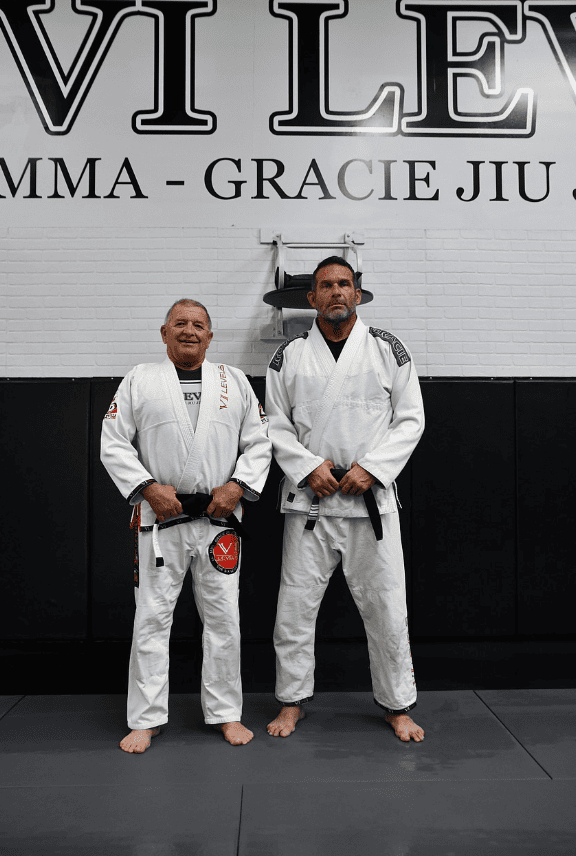
“John is unique,” Laniosz said. “He was there at the beginning with the Gracies in California. He was trained by the top people in jiu-jitsu, he was part of the group, so he had a unique ability of knowing everything correctly.”
The Gracie family is credited with developing and popularizing what became known worldwide as Brazilian jiu-jitsu, a grappling art built on leverage, positioning, and technique rather than size or raw power.
Those principles proved especially valuable as Laniosz aged through his training. Burke adapted his teaching to match his student’s physical realities, working on strategy over athleticism.
One of the earliest and most persistent challenges for Laniosz was breathing. In the middle of a roll, pinned beneath a younger and larger training partner, he would hold his breath and try to muscle his way out of a position.
“I’m holding my breath and trying to use some strength to get out,” he said. “I want to get out, and I can’t. That’s where John says, ‘You got to let loose and relax and think of where you’re at and what you were taught.'”
Adaptation became a recurring theme throughout his journey. Just two weeks before his promotion, Laniosz was working on a lockdown technique and could not execute it. His body would not cooperate, regardless of how many repetitions he attempted. Rather than forcing a movement that did not suit his frame, Burke taught him a different way through the same position. Laniosz had it resolved shortly after.
“I’m older than all the young people in this class,” he said. “I didn’t like being in class being told that I have to improve this or I have to improve that and I’m getting lazy. Then I got motivated to start pushing it better and better, and you don’t notice you’re improving in jiu-jitsu until someone tells you.”
Burke often reflects on what made Laniosz such a rewarding student to coach. It was never about physical gifts. It was about desire.
“Paul wanted to get it so badly that it made him such a pleasure to have on the mat,” Burke said. “He couldn’t have had really any more desire to get it.”
Burke also makes a point that tends to surprise people unfamiliar with the discipline. The most difficult belt in jiu-jitsu is not the black belt. It is the white belt. Taking that first step and committing to return is what stops most people before they ever find their footing on the mat. Laniosz cleared that hurdle at 65, and never looked back.
Laniosz is quick to say the real lesson from his journey is not about age. It is about process.
“It tells people that there’s no magic,” he said. “There’s no secret. You don’t come in here and learn a secret way and then you’re a tough fig hter. There’s no such thing. You have to put in the time and the effort. You’re going to get frustrated. You’re going to walk out that door.”
