
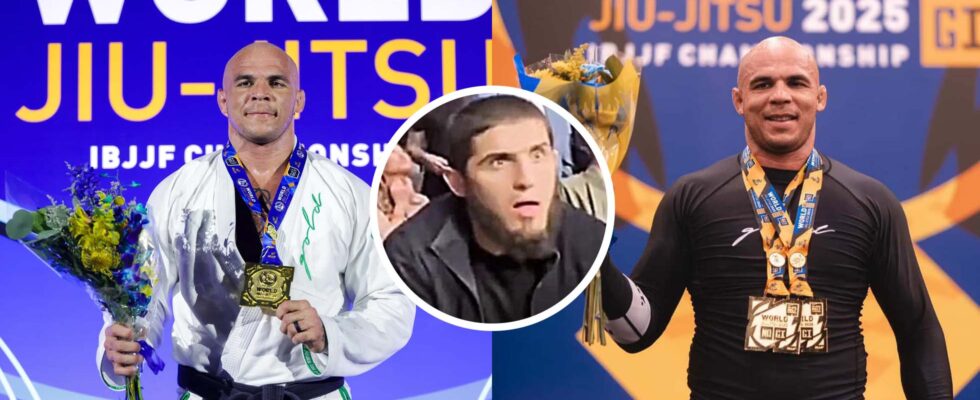
Roosevelt De Sousa has accepted a three-year suspension from the USADA after testing positive for meldonium, the same compound that led to Islam Makhachev‘s suspension nearly a decade ago.
The USADA announced that De Sousa, 33, of Miami, Florida, tested positive following an in-competition test at the 2025 World International Brazilian Jiu-Jitsu Federation Championship on December 13, 2025. His suspension began January 13, 2026, and all competitive results from December 13, 2025 onward have been disqualified, including the forfeiture of any medals, points and prizes.
Meldonium, classified as a Hormone and Metabolic Modulator, has been prohibited under the WADA Code since January 1, 2016. It’s designed to treat ischemia and commonly used by diabetes patients, is thought to improve stamina and endurance, making it attractive to athletes seeking a competitive edge.
De Sousa’s case mirrors that of Islam Makhachev, who tested positive for meldonium in April 2016, just months after it was added to the banned list. However, the circumstances surrounding their violations differ significantly.
Makhachev, then 24 years old, had used meldonium as part of a legitimate medical treatment plan. After undergoing a radiofrequency ablation procedure for frequent ventricular arrhythmia in December 2014, his physician recommended meldonium in November 2015 as a preventative measure. Crucially, Makhachev discontinued use before January 1, 2016, aware of the impending ban. The USADA confirmed his cessation of use, and he received a relatively short suspension as the compound was detected in trace amounts consistent with prior legitimate use.
De Sousa originally faced a four-year ban for his violation. However, under Article 10.8.1 of the WADA Code, he qualified for a one-year reduction by admitting and accepting the sanction within 20 days of notification. This cooperation reduced his suspension to three years.
When meldonium was banned in 2016, it triggered a wave of positive tests, particularly among Russian athletes.
The most high-profile case was tennis star Maria Sharapova, who failed a test at the 2016 Australian Open. Sharapova stated she had been taking meldonium since 2006 for health reasons and was unaware of the ban. Other notable Russian athletes who tested positive included four-time world champion Yuliya Efimova.
De Sousa’s three-year suspension represents one of the lengthier bans for meldonium violations, reflecting both the seriousness and the fact that his positive test occurred nearly a decade after the ban.
