
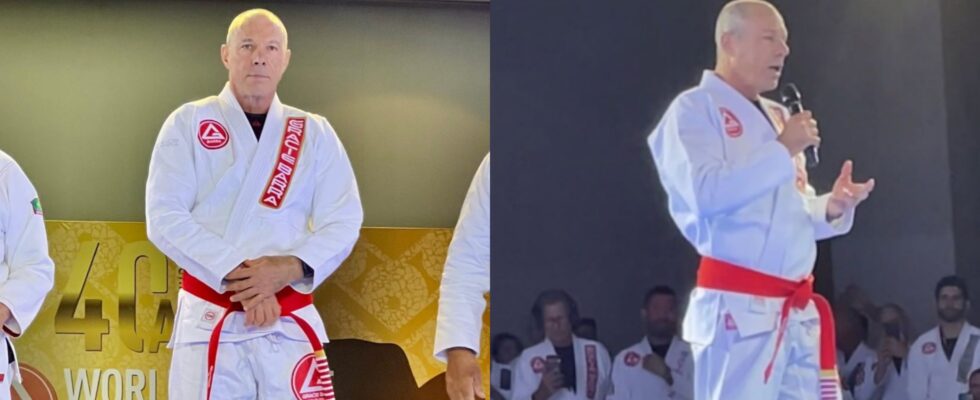
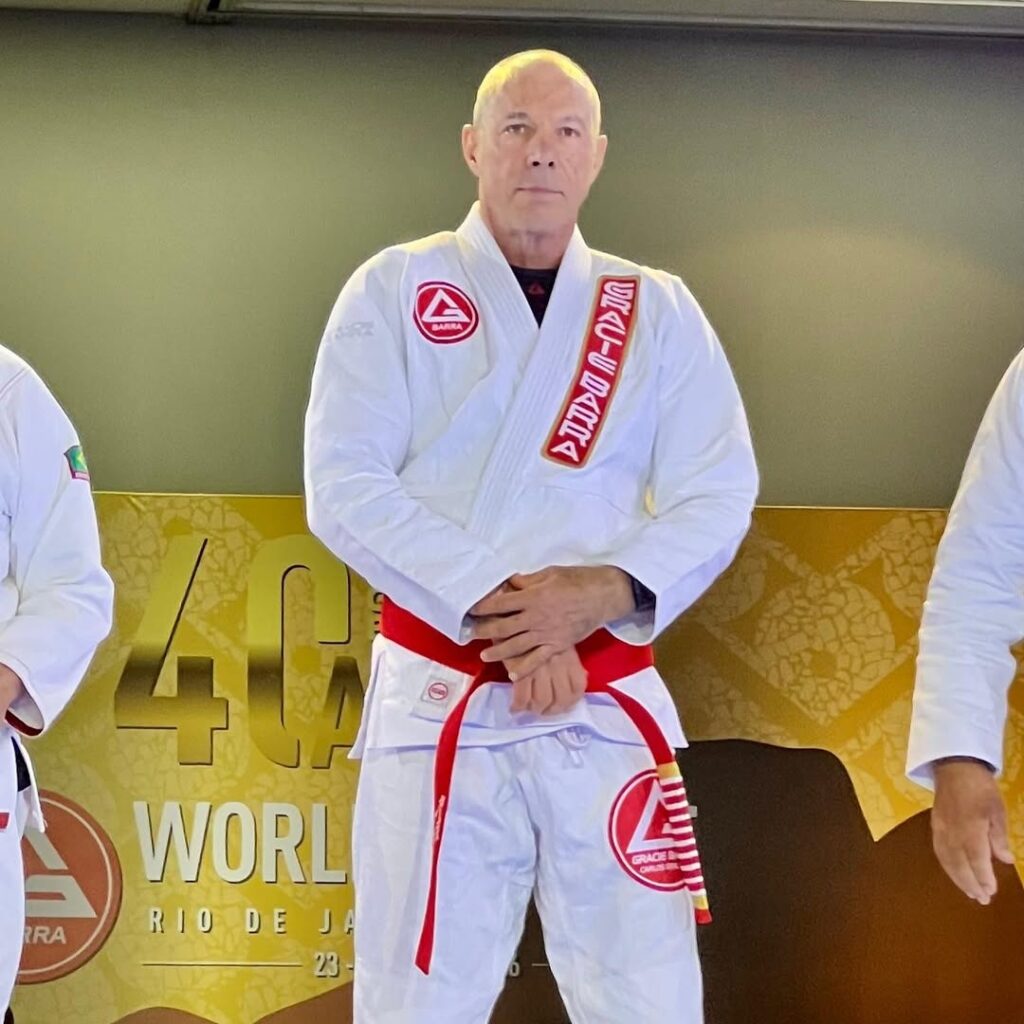
Carlos Gracie Jr., the founder and president of the International Brazilian Jiu-Jitsu Federation (IBJJF), has been promoted to red belt.
The announcement was made via the IBJJF’s official social media channels, accompanied by a tribute acknowledging Gracie Jr.’s lifetime of commitment, leadership, and passion for the sport.
“After more than 50 years dedicated to the art, this milestone is a true reflection of a lifetime of commitment, leadership, and passion for Brazilian Jiu-Jitsu,” the IBJJF stated in their announcement.
The timing of Gracie Jr.’s promotion carries significance as just one week earlier, Rigan Machado received his red belt in a ceremony. The incident generated controversy about promotion standards and family politics within Brazilian jiu-jitsu’s founding lineages.
Machado, 59 and approaching 60 this July, originally received his black belt from Carlos Gracie Jr. himself in the early 1980s. The Machado family, first cousins to the Gracies, relocated to the United States in the late 1980s and early 1990s, becoming instrumental in establishing jiu-jitsu across California and Texas.
However, Machado’s red belt promotion was not administered by Carlos Gracie Jr., but rather by Rorion Gracie.He is the eldest son of Helio Gracie and a figure representing a different branch of the Gracie family tree.
According to IBJJF guidelines, developed collaboratively within the jiu-jitsu community under Carlos Gracie Jr.’s leadership, the minimum age for a red belt promotion, assuming someone received their black belt at 19, would place them at no younger than 67. Machado is still nearly a decade short of that threshold.
More significantly, Rigan Machado received his red belt before the very man who promoted him to black belt and who helped establish the framework for such promotions. Carlos Gracie Jr., who has met the age and time requirements to the letter, received his red belt a week after his former student.
The certificate presented at Machado’s ceremony, held at Eric Paulson‘s school in Southern California, came from the FJJO (Federação de Jiu-Jitsu Olímpico do Estado do Rio de Janeiro). The organization’s name raises questions, as no Olympic jiu-jitsu currently exists, and the federation appears largely dormant. It bears similarities to the CBJJO, a rival federation that briefly operated in the early 2000s before fading into irrelevance as the IBJJF consolidated its authority.
This isn’t the first time Rorion Gracie has moved outside conventional promotion protocols. In 2017, he attempted to promote Rickson Gracie to ninth-degree red belt at a seminar in Las Vegas. Rickson was initially very resistant.
Carlos Gracie Jr. founded the IBJJF in the 1990s, transforming Brazilian jiu-jitsu from a martial art practiced primarily within the Gracie family and their students into a regulated international sport. BJJ historian Robert Drysdale has called the founding of the IBJJF “the most significant moment in BJJ history,” noting that it influenced the start of actual sport jiu-jitsu as we know it today.
Under Gracie Jr.’s leadership, the IBJJF established standardized rules, weight classes, and promotion protocols that have been adopted by tournaments worldwide. The organization’s flagship events, including the World Championships and Pan American Championships, have become the gold standard in competitive jiu-jitsu.
The red belt, also known as the ninth degree, represents the pinnacle of achievement in Brazilian jiu-jitsu. According to traditional protocols that Gracie Jr. himself helped establish through the IBJJF, the rank typically requires a minimum of 48 years after receiving a black belt, along with significant contributions to the art.
