
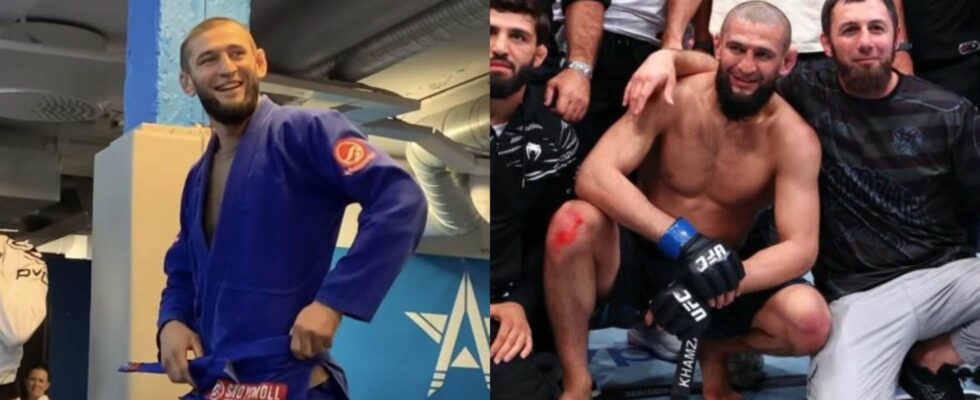
During a recent appearance at a major Abu Dhabi jiu-jitsu event, MMA star Khamzat Chimaev opened up about the role jiu-jitsu has played in shaping elite competition and why he views it as an essential piece of any serious athlete’s development.
“It let me feel back when I was a child competing in wrestling,” Chimaev said, reflecting on the atmosphere at the event.
Chimaev also talked about a movement happening across combat sports. “The last couple of years, not only jiu-jitsu, all the sports we’re working on, like wrestling, jiu-jitsu, MMA, everything is growing so fast here because they support sports here,” he said.
He gave particular credit to the Abu Dhabi ecosystem for nurturing that growth, noting that financial incentives and organizational support have created genuine motivation for young athletes.
He stated, “Everyone who starts to speak about jiu-jitsu, they start to speak about Abu Dhabi because here it’s a big event. They support a lot and, of course, they get paid good as well. That’s why it’s a big motivation for the kids to be here and compete.”
The strategic logic behind his appreciation for jiu-jitsu became apparent when he addressed how it translates directly into competitive success inside the cage. “If you have a good grappling jiu-jitsu, you control the match. It’s one of the aspects you need to use there,” he said.
He also spoke about the local talent pool at the event, expressing genuine optimism about where Abu Dhabi’s jiu-jitsu scene is headed. “We have a lot of good jiu-jitsu guys here as well, a lot of black belts. There are a lot of young kids, there are new kids, but they’re good level, good level,” he observed. “For sure, they’re going to be a lot of champs.”
His advice to young practitioners who might be eyeing a future in MMA was straightforward and rooted in patience.
“First of all, just to stay focused on his job. If you like jiu-jitsu, do that. Just compete there, train hard,” he said. “And to move to MMA, you have the time whenever you want. So if you’re a good jiu-jitsu and move to MMA, it will be more easy for you.”
Gordon Ryan, widely regarded as the most decorated submission grappler of his generation, recently laid out a detailed case for why athletes like Chimaev and Khabib Nurmagomedov, despite being dominant in the octagon, would face a steep learning curve in pure submission grappling environments.
Ryan argued that their approach, which he described as submission grappling tailored specifically for MMA, is designed around maintaining top position while landing ground strikes rather than pursuing submissions in open exchanges.
“Their whole thing is that they take their hands nice and high behind your arms, they go into rear chest locks, and they put your hands back on the ground. So every time you try to get up, your hands go to the floor, and you’re carrying their body weight. They can hit you, but you can’t touch them,” Ryan explained.
He went further, suggesting that Chimaev and Khabib would be “beat pretty easily” at an event like ADCC, where the ruleset removes the threat of ground strikes and demands a broader technical vocabulary.
Ryan did, however, acknowledge the legitimate value of what these athletes do. “What they’re doing is submission grappling for MMA. They have the ability to take people down. They can follow them through transitions, make them carry body weight, keep them on the floor, or return them to the floor when they try to get up, and then do significant damage with punches or submit them from top position.”
In Ryan’s view, that style of jiu-jitsu is the most critical kind an athlete can develop. “So that kind of jiu-jitsu, the submission wrestling kind where a guy can put people down and then do damage from top position after keeping them down, is the most important kind of jiu-jitsu,” he said.
Chimaev was not impressed. When a social media account tagged him and asked him to weigh in on Ryan’s analysis, the response was brief and pointed. Chimaev replied with laughing emojis and, in a separate comment, wrote simply: “Big bulls***.”
Meanwhile, questions about Chimaev’s activity level continue to swirl in the wider MMA community. Following his title loss to Sean Strickland at UFC 328, podcasters and analysts including Joe Rogan and Brendan Schaub debated whether Chimaev should pursue RAF wrestling appearances, similar to the move that elevated Arman Tsarukyan’s profile.
Schaub argued the case for keeping “Borz” visible and physically sharp. “He competes once a year, which is not good, dude. Let’s do RAF. Let’s get this rolling. Keeps your weight down. Keeps you active. Also keeps you in the limelight. Like Arman has blown up, dude,” Schaub said.
Rogan was more cautious, pointing to the physical toll Chimaev’s weight cut reportedly took on his body before the Strickland bout, with his brother reportedly stating publicly that they feared Chimaev’s body might give out during the cut process.
“You’re not healthy if you almost passed away a day ago,” Rogan said, raising the question of whether returning to high-level competition of any kind too soon would be responsible.
