
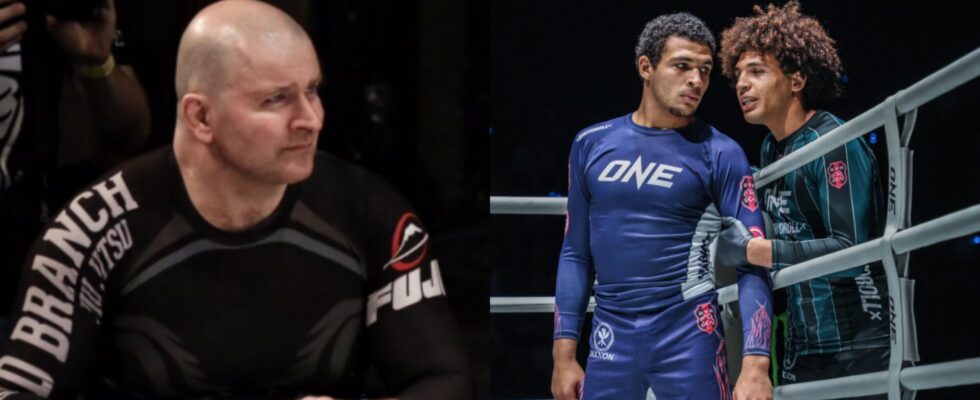
Long before Kade and Tye Ruotolo became two of the most exciting grapplers in the sport, John Danaher saw traits that separated them from nearly everyone else in their generation. Speaking in a recent interview, the legendary coach explained how the brothers combined early experience, physical gifts and a rare willingness to fix weaknesses into a style that now makes them elite at the highest level of jiu-jitsu.
Danaher first pointed to the age at which the Ruotolos began training, explaining that their mat experience gave them a major advantage over most competitors.
“They started the sport very, very young,” Danaher said. “They’re probably the first example in American grappling of American students who started at age four or five.”
He contrasted that with the way earlier generations entered the sport.
“Most people when I began jiu-jitsu started as adults,” he said. “I was 28 years old when I had my first lesson as a white belt.”
Because of that, the Ruotolos accumulated years of experience before most athletes ever step onto the mats.
“What counts is not your age, but your mat age,” Danaher explained. “They were very young in years, but they were very old in mat age.”
Still, Danaher stressed that starting young was only part of the equation.
“There’s a lot more to it than that,” he said. “What really makes them stand out is that they’ve mastered this idea of covering up and improving initial weaknesses while building upon strengths.”
He then recalled the first time the Ruotolos faced his students as teenagers, when a major flaw in their game became obvious.
“When the Ruotolos first faced my students at around 16 or 17 years old, they were relatively easy to leg lock because none of their training experience had prepared them for that,” Danaher said. “They both got heel hooked by my youngsters, Nicky Ryan and Ethan Crelinsten.”
Rather than avoid the issue, the brothers adapted quickly.
“You could clearly see that they identified their current weakness and made prodigious steps to improve upon it to a point now where they’re winning championships with their own leg locks,” he said.
Danaher said what impressed him most was the maturity they showed at such a young age.
“I love the fact that even as teenagers, they had the maturity to say, ‘Okay, here’s an obvious weakness. Let’s get around this. Let’s turn it into a strength,'” he said.
Their physical attributes also helped shape the kind of game they developed.
“Both of the brothers have extraordinary reach for their height,” Danaher explained. “They both have extraordinarily long arms for their height.”
That advantage naturally opened up certain submissions.
“That means that variations of kata-gatame, in particular D’arces and Anacondas, are going to be much easier for them in their weight division than for most people,” he said.
According to Danaher, the brothers built an entire tactical approach around those strengths.
“They adapted a game based around movement which forces opponents, not with physical pressure, but with tactical pressure, into positions which expose them to those specialized strangleholds,” he said.
Danaher also addressed how the brothers improved what was once considered a weaker part of their game.
“When we looked at the Ruotolos when they were young, we saw that there was a disparity between their top game and their bottom game,” he said. “They were generally much better on top position than they were in bottom position.”
Their answer was developing the buggy choke into a legitimate offensive weapon.
“They solved that with the buggy strangle,” Danaher said, describing it as “a variation of kata-gatame using their legs done from disadvantageous positions on bottom.”
That adjustment completely changed how dangerous they became from inferior positions.
“Their bottom game is now part of their offense,” he said.
Danaher also praised the chaos and athleticism the brothers bring during transitions and scrambles.
“Ty and Kade are two of the best scramblers in the sport of jiu-jitsu. Whenever you go to sh0ot on the legs with them, there’s a danger of running straight into a D’Arce stranglehold,” Danaher said.
Even after completing takedowns, opponents still struggle to control them.
“It’s also very hard to control them after a takedown,” he added. “They do a very good job of springing back up to the feet.”
Danaher closed with strong praise for both brothers and their future in the sport.
“I deeply admire what they’ve done,” he said. “Those two young men have a huge future ahead of them.”
