
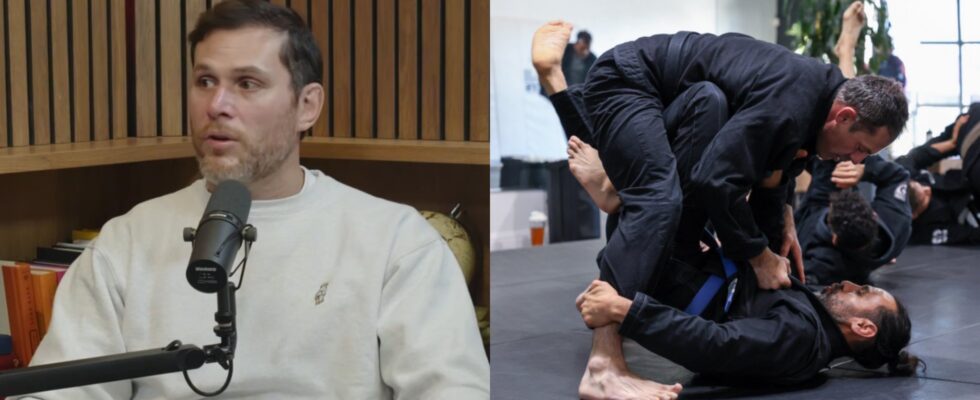
During his appearance on a recent podcast, Roger Gracie shared a clear and uncompromising view on whether jiu-jitsu should ever become an Olympic sport. His answer was direct: he hopes it never happens.
The discussion began around how modern competition rules are increasingly shaped by the need to make matches more appealing to spectators. Gracie argued that this shift comes at a cost, changing the essence of the sport itself.
“Because now they are thinking how they can make it more entertaining for people watching,” he said. “Then it changes the dynamic. Now you are accommodating for the expectation of the spectators, not for the athletes.”
Building on that idea, he referenced a previous interview with Men’s Health, where he was asked specifically about jiu-jitsu’s potential inclusion in the Olympic Games. His response reflected a concern that institutionalizing the sport at that level would fundamentally reshape it.
“I hope it will never grow, because you’ll be purely entertaining,” he said. “There will be zero about jiu-jitsu and all about the spectator sport. You will just end the martial arts.”
To support his argument, Gracie pointed to how other combat sports have evolved under Olympic rules, using them as cautionary examples.
“Look at karate, look at taekwondo,” he said. “I mean, it’s a joke.”
He elaborated on what he sees as a dilution of combat effectiveness under Olympic scoring systems:
“When you see the Olympics, you cannot even hit the person hard. You can just touch, it’s a touch point. It’s not a martial art. It’s a kid’s game, if I touch you or score a point.”
The interviewer then brought up judo as a comparison, noting that it already exists within the Olympic framework. Gracie acknowledged that Olympic inclusion can be personally beneficial for athletes, but distinguished sharply between individual opportunity and the health of the art itself.
“Of course it would have been an amazing thing to be there competing for that event,” he said. “That grandeur, it’ll be awesome. But not for the jiu-jitsu.”
He continued by outlining the trade-off between financial and career benefits for athletes versus the impact on the discipline.
“For the athlete, for the individual athlete, for sponsorships, you’ll get a lot of money. For the athletes, for your career, financially there is a lot of positive. Being an Olympic gold medalist. But for the jiu-jitsu, no.”
Gracie also linked this concern to the rising popularity of no-gi jiu-jitsu, suggesting that its growth follows a similar pattern of adapting the sport for easier consumption by viewers.
“I think that’s one of the reasons that no-gi is so popular nowadays,” he said, “because it’s more for the spectators. It’s more dynamic. Gi is a slower fig ht. You cannot move much. So for people watching it is way less entertaining because there is way less movement. No-gi is just a lot of scrambles. It’s way more entertaining to watch.”
