
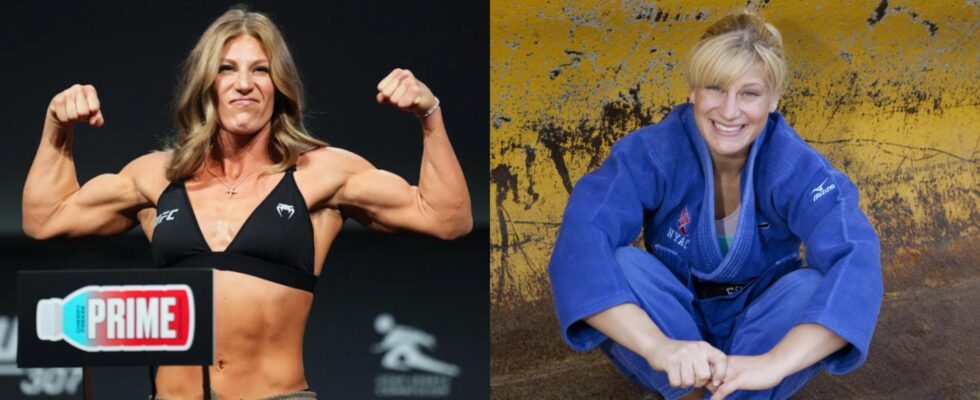
In a recent podcast episode, UFC bantamweight champion and two-time Olympic gold medalist Kayla Harrison opened up about the childhood s3xual abuse she endured at the hands of her judo coach and the culture that often enables predators to operate without accountability.
Harrison explained that the abuse began when she was just eight years old. Looking back, she described how her coach gradually became one of the most important people in her life before ultimately exploiting that trust.
Reflecting on why she was vulnerable to grooming, Harrison said, “No one talked to you about what you should do if someone close to you tried to take advantage of you.”
She continued by explaining how children from difficult family situations are often targeted.
“I was a prime target and I think unfortunately kids who come from broken homes are big targets,” Harrison said. “It’s not anyone’s fault, but obviously parents who work full-time and are not as present, this is the breeding ground for childhood s3xual abuse.”
Harrison also recalled the confusion she felt as a child when the abuse first became physical. At the time, she had no understanding of grooming or abuse and trusted the adult who was hurting her.
“I’ll never forget the first time something really physical happened and the shame and the fear and the dirtiness I felt and I didn’t know that it wasn’t okay,” she said.
Because her coach occupied a position of authority and trust, she struggled to recognize what was happening.
“Because he was in a position of power,” Harrison explained. “I was like, oh, this is love. That’s what I thought.”
Looking back as an adult, she now understands what she couldn’t comprehend at the time.
“Looking back now as an 8-year-old I didn’t understand what grooming was,” she said. “I didn’t understand what was happening.”
As the abuse continued, Harrison said it dramatically changed her personality and mental health, even as her athletic success continued to grow.
“By the time I was 12, I wore sweatpants every day and I didn’t look people in the eye,” she recalled.
The emotional toll became overwhelming.
“I started cutting myself. I was extremely s*icidal. And I was getting better. I was winning tournaments. I qualified for the Olympic trials when I was 14,” Harrison said. “It was h3ll.”
For years, she never considered telling anyone about the abuse.
“It had never occurred to me to say something,” Harrison admitted. “It just never occurred to me that I could just break this cage I was in by saying something.”
When she eventually confided in a teammate, events moved quickly. Her mother contacted law enforcement, the FBI became involved, and her coach ultimately pleaded guilty and served ten years in federal prison.
Before that happened, however, Harrison said he attempted to intimidate her.
“He told me that one of us wasn’t going to make it out of this alive.”
Harrison also criticized the tendency of institutions and communities to protect influential figures rather than support vic tims. Drawing a comparison to the Jerry Sandusky scandal at Penn State, she expressed frustration with how public attention was directed.
“My peers were rioting and flipping over cars because a football coach lost his job,” she said. “But nobody was saying anything about the countless vic tims whose lives had been changed forever by this man.”
Ahead of the 2012 London Olympics, Harrison made the decision to publicly share her story, hoping to use her platform to raise awareness about child sexual abuse.
“It happens everywhere,” she said. “It doesn’t care how much money you have in your bank account. It doesn’t care what color your skin is. It doesn’t care what side of the street you live on. Child s3xual abuse can happen to anyone.”
Today, Harrison says her experience has given her a sense of purpose and a mission to help others.
“I have this story for a reason and it is to help people and it is to give people hope,” she said.
She added that her ultimate goal is to see the prevalence of child s3xual abuse dramatically reduced.
“I don’t want this statistic to be one in four girls and one in six boys,” Harrison said. “I want that statistic to go away.”
