

On the evening of Thursday, June 18, a ceremony inside a modest academy on Rua Elmano Ferreira Veloso in São José dos Campos, Brazil, became one of the most significant nights in the history of Brazilian Jiu-Jitsu in the Paraíba Valley.
Luiz Carlos Dagmar, known throughout the BJJ world as Mestre Careca, received the red belt, 9th degree. It is the highest honor the sport can bestow.
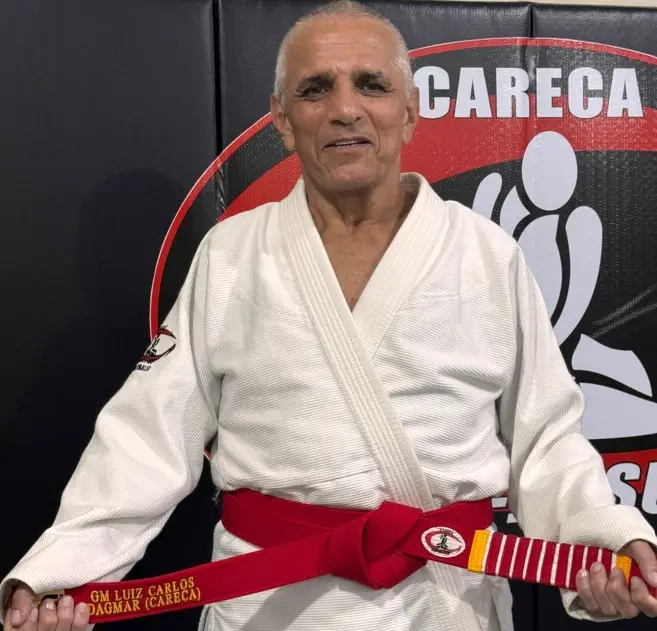
The distinction places Careca in a group so small it can barely be called a group at all. In a region where he has spent nearly three decades building athletes and shaping lives, he now stands as the only 9th-degree red belt.
The belt was presented by two of his oldest companions in the art: Mestre Edmilson Alves, a coral belt 8th degree, and Mestre Sérgio Lisboa, also a coral belt, both pioneers of jiu-jitsu in the Paraíba Valley.

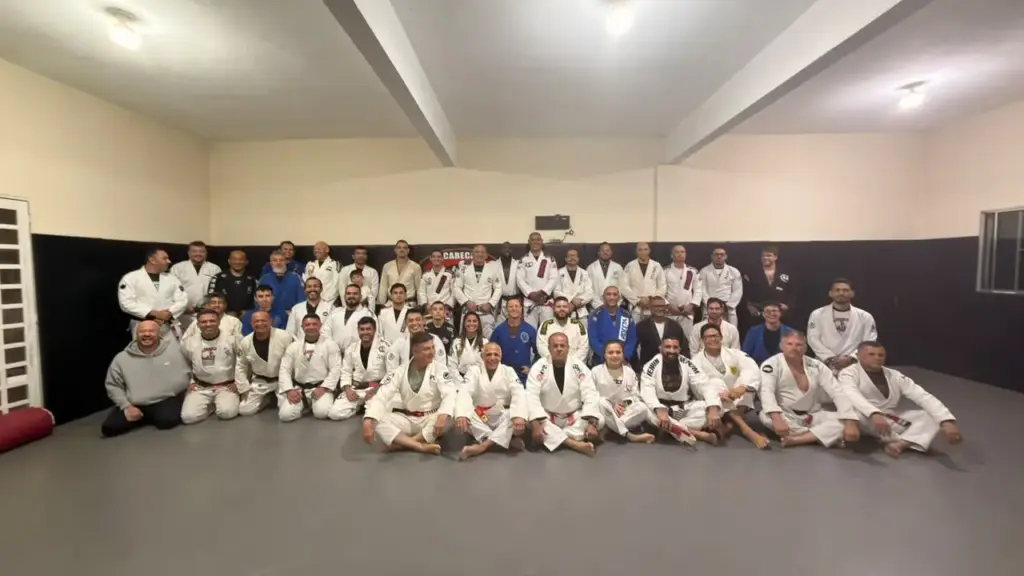
The room was filled with students, former students, friends, and family, everyone who had watched his journey and wanted to be present for its crowning moment. Standing alongside his wife, Anizia, and his daughters Luiza and Simone Dagmar, Careca received an outpouring of love from a community he helped create.
The story behind the belt begins long before that Thursday evening. Born on August 31, 1956, in Rio de Janeiro, Careca stepped onto a mat for the first time in 1975. He trained under Mestre Maurição in Copacabana before earning his black belt from the legendary Grand Master Osvaldo Alves, one of the most respected names in the history of the gentle art.
For years, he balanced a career at the now-defunct Banerj bank with his training and teaching obligations, but the pull of jiu-jitsu proved stronger than any profession. In 1989, when a transfer took him to Saquarema, he opened his first academy and began the chapter that would define his life.
By 1998, Careca had relocated to São José dos Campos and started teaching there. Few could have predicted that the professor arriving from Rio would permanently alter the trajectory of jiu-jitsu in the region.
From those early classes grew the Equipe Careca Jiu-Jitsu, a program that became a nationally and internationally recognized institution, producing champions while quietly transforming the lives of thousands of ordinary people who simply came to learn.
The most celebrated name to emerge from his instruction is André Galvão. Galvão began training under Careca at 15 years old.

Careca recognized his ability early, pushed him toward more demanding environments to accelerate his growth, and ultimately awarded him his black belt in 2005. Galvão went on to become one of the most decorated competitors in the history of the sport.
But Galvão is only the most visible thread in a much larger tapestry. Pablo Deziro, Giovani Deziro, Pedro Bessa, Flávio Oliveira, Soró Lemos, Ronaldo Cândido, Carlos Galvão, Gustavo Galvão, Taú Freire, and Álvaro Borges all came through Careca’s academy and carried his teachings outward into the world.
What makes this particular moment even more exciting is something Careca’s daughter Luiza chose to share publicly for the first time in the days surrounding the ceremony.
Two years ago, the family received a diagnosis. Careca is living with frontotemporal dementia. Luiza, who was abroad when she learned the news, described the moment as the greatest shock of her life.
“Two years ago, we discovered that my father has frontotemporal dementia,” she wrote. “It was the biggest surprise of my life. I received this news on the other side of the world, unable to do anything, and for a long time I asked myself: why him? Why, God? Such an active, cheerful, healthy person, always taking care of his body and mind. It seemed impossible to understand.”
She went on to describe the weight of watching her father navigate the condition, and what it meant to witness this achievement beside him.
“Over time, I learned that there are questions to which we will not have answers. And seeing my father facing all this hurts in a way that words cannot explain. But today I want to talk about something bigger than the pain. About his great achievement. 54 years dedicated to Jiu-Jitsu. More than half a life built on the mat. Jiu-Jitsu was never just a sport for you; it was your mission, your passion, your way of life. You always gave your all, body and soul.”
She reflected on what the red belt represents against that backdrop.
“Being by your side to witness this moment, to see you earn your red belt after so many years of dedication, warms my heart. Amidst everything we’re going through, this achievement becomes even more special. Your legacy goes far beyond graduations, titles, or medals.”
“It’s in every student you’ve trained, in every life you’ve transformed, and in everything you’ve built along this journey. Congratulations, Dad. This red belt is much more than a graduation. It’s the reflection of a lifetime dedicated to Jiu-Jitsu.”
Fifty-one years after stepping onto a mat in Copacabana, Luiz Carlos Dagmar stood in his own academy, surrounded by the people his life’s work produced, and received the recognition that only a handful of people in the world have ever earned.
