
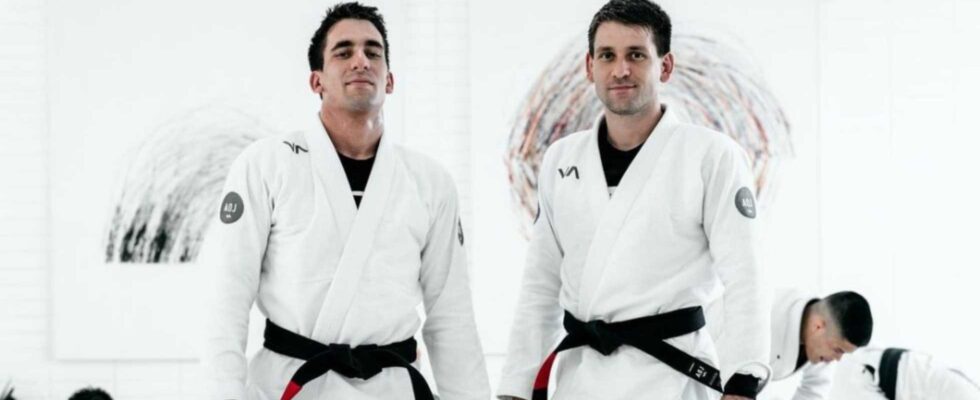
If you have ever wondered what it costs to get on the mat with two of the most decorated grapplers in Brazilian jiu-jitsu history, the answer coming out of Art of Jiu-Jitsu (AOJ) in Costa Mesa, California is generating controversy.
According to a pricing sheet circulating online, the Mendes Brothers are listing their private lessons at $500 per hour, placing them at the very top of the academy’s tiered instruction model.
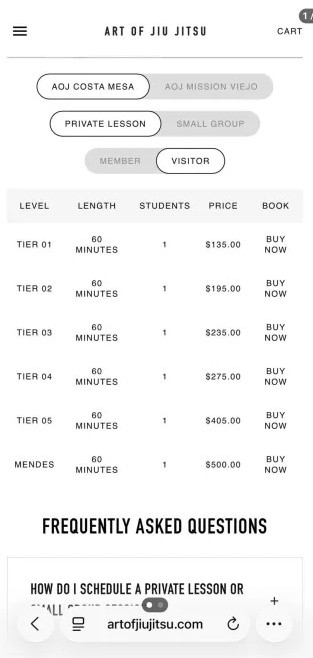
To put that figure in context, AOJ structures its private lesson rates across five tiers before reaching the brothers themselves. Tier 1 starts at $135 per hour, with rates climbing through Tier 2 at $195, Tier 3 at $235, Tier 4 at $275, and Tier 5 at $405.
Rafael and Guilherme Mendes sit above all of it at $500.
The pricing has sparked a lively debate within the grappling community, with opinions splitting largely along the lines of who is asking and what they are hoping to get out of it. Those who train recreationally or come from a judo background have been particularly candid.
One commenter on a popular forum put it bluntly: “As hilarious and expensive as it would be to pay $500 per hour for a Mendes brother to tell me that I look awkward and scared when trying to execute a berimbolo, I could get that feedback for free here on Reddit.”
The sentiment reflected a recurring thread in the discussion: that for most practitioners, especially those not competing at a high level, the return on a world-champion private may not justify the investment.
As one user noted, the high price tag may also serve a filtering function, ensuring that only those with a genuine and serious purpose actually book the time.
The Mendes Brothers are not alone in commanding premium rates for their time. Gordon Ryan, widely regarded as the most dominant submission grappling competitor of his generation, recently opened his own facility, King’s Way, and announced private lesson pricing between $1,000 and $1,200 for a one-hour session for up to four people.
Ryan noted he plans to offer two daily blocks, one on weekdays from 11 AM to 12 PM and another on weekends from 12:30 to 1:30 PM. “I will begin teaching privates at King’s Way soon,” Ryan stated. “If you’re interested in this, keep an eye out for updates or ask me in person.”


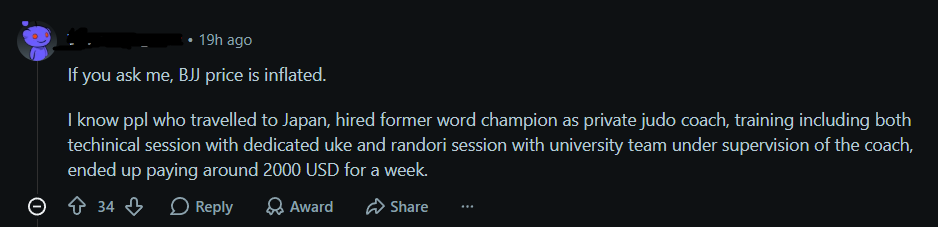
The comparison between BJJ private pricing and other martial arts has not been lost on critics. Several commenters pointed to the judo world, where, as one noted, travelers to Japan have reportedly paid around $2,000 for an entire week of sessions with a former world champion, including dedicated training partners and supervised randori.
From Brazil, the disparity looks even starker. One practitioner noted that in the country where the sport was born, private lessons at gyms with world champions often run around $40 to $50, and monthly memberships at top-level academies rarely exceed $100.
Defenders of the pricing argue the economics are more complex than simple comparisons suggest. One forum contributor pointed out that unlike Japanese judo athletes, who often receive company salaries, government stipends, and institutional support, many BJJ competitors rely on private lessons as a primary source of income.
“For a lot of BJJ competitors it’s literally their main source of income,” they wrote.
The Mendes Brothers, for their part, have a case to make for their rate. Rafael and Guilherme are multiple-time IBJJF World Champions and have built a coaching program at AOJ that has developed a remarkable number of elite competitors.
“These guys could easily be compared to Cael Sanderson or David Taylor for the continued success in coaching,” one commenter observed. “I imagine they charge a lot simply because they don’t have time.”
For those unwilling to commit to the full hourly rate, alternatives do exist. AOJ offers a subscription-based instructional platform, and other online resources like Submeta provide detailed technique breakdowns at a fraction of the cost.
One black belt in the discussion suggested that for most practitioners, those resources, combined with consistent mat time and quality coaching from someone who knows their game, will deliver more practical improvement than a single high-ticket session.
