
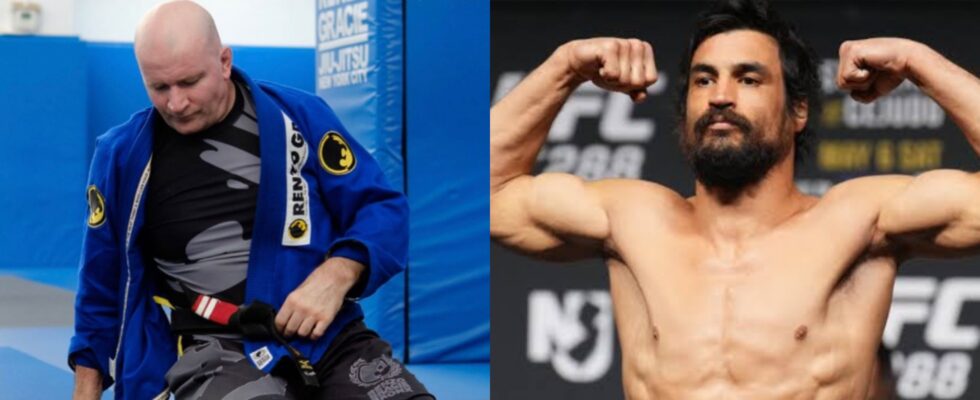
Over the past few weeks, Kron Gracie has directed his skepticism at one of the sport’s most celebrated figures: John Danaher.
In a recent post, Gracie shared a clip from Danaher’s appearance on the Lex Fridman podcast, where the New Zealand-born coach delivered one of his deep dives into human psychology and competitive decision-making.
In the clip, Danaher explained the psychological bias that causes competitors to fear loss more than they value an equivalent gain, using the example of a hundred-dollar bill to illustrate how loss aversion shapes behavior in high-level matches.
“If you have $100 in your wallet, you’re more worried about the idea of losing $100 that you have now, then you will be excited by the prospect of gaining $100 that I could potentially offer you,” Danaher said in the clip.
Gracie was not impressed.
His commentary alongside the post was blunt: “I cannot believe people fall for this guy’s bull**it. All he did was put everyone who won at black belt through an AI database before AI was big and created the super figh ter. He can explain but he can’t do s**t.”

It was not a one-off comment. A few weeks earlier, Gracie had shared another Danaher clip, this one focused on the triangle choke and its philosophical importance to jiu-jitsu as a whole. In it,
Danaher argued that the triangle represents the very soul of the art, specifically the principle of using the legs to neutralize an opponent’s upper body strength.
“If I wrestle my upper body versus your upper body, it’s just a battle of strengths. The stronger man wins. But if I can use my legs to fig ht your upper body, that’s when weaker people start beating stronger people,” Danaher said.
Gracie’s response cut straight to the point.
He wrote, “I never do triangle?!? Why do people listen to this AI bot, because he sounds smart?!? I don’t get it.”

The criticism raises questions that the jiu-jitsu community has wrestled with for years, even as Danaher’s commercial and reputational influence has grown to remarkable proportions.
By any measurable standard, his output as an instructor is extraordinary. He has released 54 instructional titles totaling more than 461 hours of content, organized across nearly 4,000 chapters. His catalog alone accounts for eight percent of all instructional runtime on BJJ Fanatics, despite the platform hosting over 1,200 instructors.
His average release runs more than eleven hours in length, and he has consistently produced six to nine new titles every year since 2018. His flagship bundle clocks in at over 82 hours.
Danaher never competed at a serious level himself, and the lineage of his most famous student, Gordon Ryan, traces back to purple belt at another academy before Ryan joined his team.
Still, the two have turned that association into a highly profitable enterprise, with Ryan widely reported to have generated over nine million dollars in instructional revenue over the course of his career.
Gracie occupies a very different position in the landscape. After years competing in the UFC, a stint living in Montana, and ongoing questions about his direction as a professional, he recently announced plans to return to Los Angeles and reopen his gym.
His tenure in mixed martial arts drew criticism from multiple directions. When he leaned on his grappling roots, the results were sometimes not enough at that level. When he tried to develop his striking, he drew pushback from within his own family, including from his father Rickson Gracie.
Throughout it all, Gracie competed under USADA oversight and, by most accounts, his physical profile and performance reflected exactly that. His vocal opposition to PEDs previously put him at odds with Ryan, who has addressed his own relationship with that topic on multiple occasions.
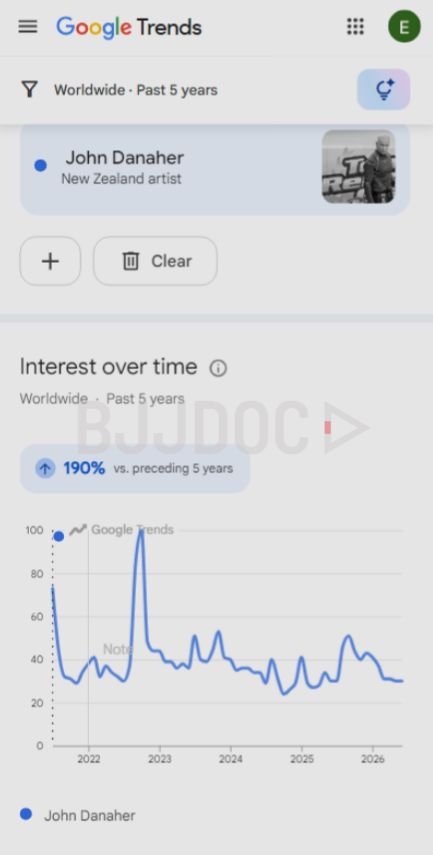
Danaher’s appeal has always been rooted in his ability to articulate the invisible logic of jiu-jitsu in a way that feels almost academic. His popularity peaked around 2022 according to search trend data, though his profile in the community was already significant as far back as 2016.
For many practitioners, listening to him is genuinely illuminating. For Gracie, that same quality is precisely what makes him skeptical.
