

A Brazilian Jiu-Jitsu gym in Linden, New Jersey has drawn significant criticism after turning away a female athlete who attempted to drop in for a training session. The gym’s policy explicitly prohibits women from training alongside men, a stance that surprised many in the martial arts community.
The confrontation occurred when a woman, invited by a regular member, attempted to join the gym’s popular competition class. Despite the gym’s active social media presence promoting open drop-in sessions, she was turned away solely on the basis of her gender.
The woman shared her experience on r/BJJWomen, a subreddit dedicated to discussing Brazilian Jiu-Jitsu from a woman’s perspective in the traditionally male-dominated sport.
“I didn’t think there would be a gym that doesn’t allow women to train with men in the US in 2026,” the visitor wrote. “I’m baffled.”
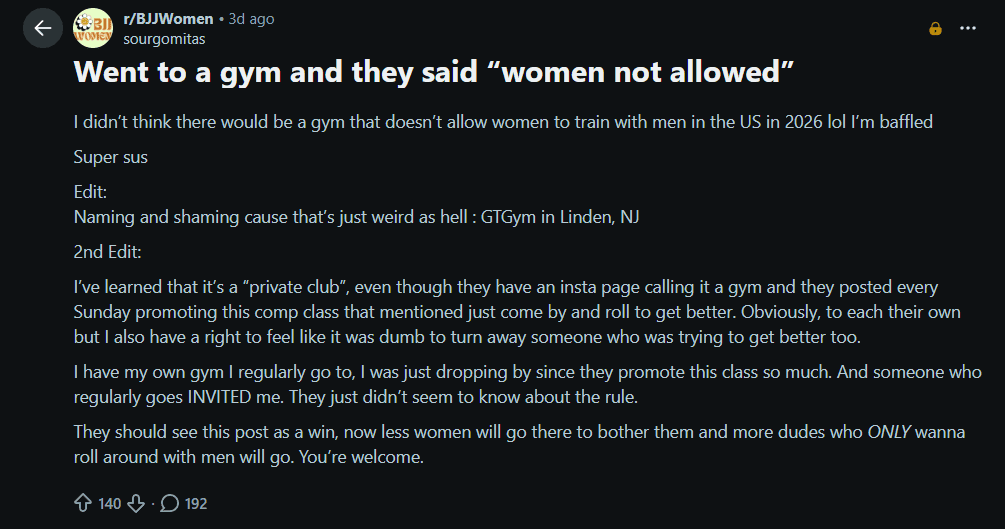
When questioned about the policy, the gym’s management cited their status as a “private club” rather than a public gym, suggesting this exempts them from standard anti-discrimination requirements.
However, this characterization contradicts the gym’s public-facing social media strategy, which actively promotes classes and encourages new participants to “just come by and roll to get better.”
The distinction between a private club and a public business carries significant legal weight. While some jurisdictions allow private clubs more flexibility in membership policies, the gym’s extensive public advertising and invitations blur that distinction in the eyes of many observers.
Several members of the BJJ community raised concerns about whether the gym’s policy violates anti-discrimination laws. New Jersey has relatively strict anti-discrimination statutes, though the state has carved out provisions allowing gender-specific fitness facilities.
The legality of the gym’s policy remains ambiguous, falling into a gray area between private club privileges and public business obligations.
One commenter with legal knowledge noted that operating under a business license may obligate the facility to comply with anti-discrimination laws, regardless of private club claims. Another suggested reporting the gym to county authorities rather than pursuing individual legal action.
