
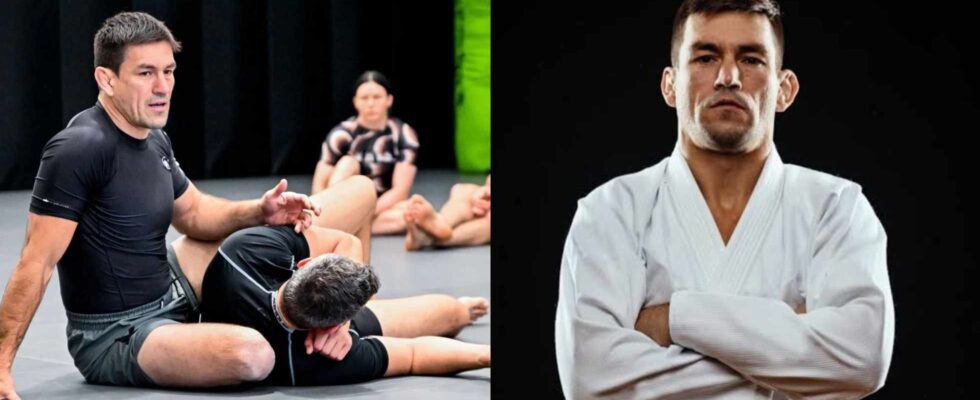
Demian Maia believes the rapid growth of competitive Brazilian Jiu-Jitsu has created a gap between sport-focused training and the art’s original purpose as a martial art.
During an interview with BJJ Fanatics, the sixth-degree black belt, ADCC champion, multiple-time world champion, and longtime UFC competitor explained that some practitioners are developing advanced competition skills before learning essential defensive concepts.
“What I see nowadays on some people, especially if you too much focus on a sport jiu-jitsu, you lack a lot of fundamental,” Maia said.
For Maia, those fundamentals include controlling the mount, escaping dominant positions, maintaining the closed guard, defending headlocks, and understanding how to respond when strikes are involved. He argued that these skills should form the foundation of every student’s education, even when the student’s primary goal is tournament success.
“Because it is based on the martial arts,” Maia explained. “So it’s not just defense, submissions or position, but also defending striking.”
Maia does not believe sport Jiu-Jitsu and martial arts training must be separated completely. Instead, he sees them as connected paths. Learning how to defend punches, establish a takedown, and control positions in a combat context can strengthen a competitor’s overall understanding without limiting their progress under sport rules.
“If you learn the fundamentals of this, the martial art, and learn like how to control the mount position or the side mount or to escape from back, it’s much more important than learn a lot of stuff at the beginning,” he said.
He also emphasized that students should have the opportunity to learn the broader principles of Jiu-Jitsu before specializing. A practitioner may eventually choose to focus on modern guard systems, lapel techniques, or other competitive strategies, but Maia believes that choice should come after a solid grounding in positional control and self-defense.
His own fundamentals course reflects that philosophy. Maia described it as a 45-class program centered on the basic skills a person would need to defend themselves, while still supporting development in sport Jiu-Jitsu.
“If you have one year of your life to train, at least you know how to defend yourself,” Maia said.
For Maia, preserving these fundamentals is not about rejecting innovation. It is about ensuring that the evolution of competition does not erase the principles that gave Brazilian Jiu-Jitsu its identity.
