
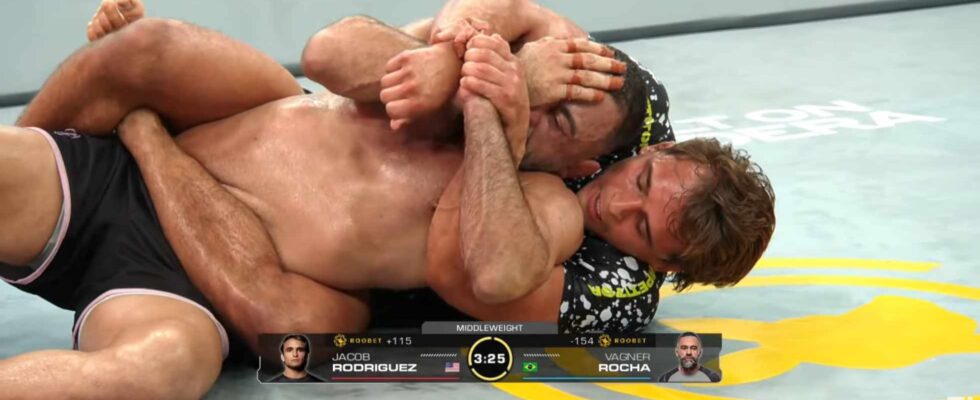
When Jacob “Jay Rod” Rodriguez stepped into the Karate Combat pit, he carried more than a game plan. He carried the weight of a career put on hold, a reputation under intense scrutiny, and months spent on the outside of the sport he had worked years to reach.
None of that showed when it counted. Facing veteran Vagner Rocha in a 10-minute middleweight grappling contest, Rodriguez took the scorecards decision, controlling nearly the entire round against one of the most seasoned submission specialists in the game.
It was a composed, patient performance from a competitor who, not long ago, wasn’t certain he would have a professional mat to stand on again.
A Fall From Grace
In May 2025, Rodriguez was removed from B Team, the Austin-based jiu-jitsu powerhouse, after co-founders Craig Jones and Seth Belisle discovered he had been keeping screenshots of female teammates’ public Instagram profiles alongside adult content on his phone.
The response from leadership was immediate. Rodriguez received the news in a 1 AM phone call from Jones with little opportunity to explain his perspective at the time.
The months that followed were largely quiet. Rodriguez acknowledged his conduct as “invasive, inappropriate and unhealthy,” while clarifying that rumors involving AI-generated content or hidden cameras were false.
He disclosed that he had begun therapy and was leaning on his faith as part of a broader process of personal growth, following what he described as struggles with impulsive behavior. The controversy involved at least two female members of the team, including competitor Ally Wolski, both of whom praised the gym’s leadership for acting quickly to prioritize member safety.
What followed was a near-complete severance from the sport. In an August 2025 appearance on the Jits and Giggles podcast, Rodriguez spoke openly about how far the consequences had extended.
“I can’t train in Austin specifically… anywhere worth going to,” he said, noting that reputable gyms had been hesitant to accept him, something he said he understood from a business perspective. For a stretch of two to three months, he was not on the mats at all.
The Long Road Back
The B Team he had once called home has since become something different. Jones departed the organization in July 2025, citing the difficulty of managing operations from abroad.
“I’ve been the absent father, you know,” he said in an August interview. “Obviously there’s a lot of dramas that just naturally unfold at any gym and I really don’t want to be the one from afar to have to manage those things.”
Belisle left alongside him to help manage CJI and its charitable foundation. Leadership of the rebranded Simple Man Martial Arts passed to Nicky Ryan and Damien Anderson, who have placed an emphasis on accessibility and a more family-oriented atmosphere.
Inside the Pit
Rocha arrived as one of the most experienced names on the card, a 44-year-old veteran from Rio de Janeiro with a 14-4 MMA record and 11 professional finishes, backed by decades of grappling history. Oddsmakers gave him a slight edge heading in, listing Rodriguez as a +115 underdog.
The matchup also carried personal stakes. Rocha had previously submitted Rodriguez’s older brother, Nicky Rod, via choke at the UFC Fig ht Pass Invitational 4 in June 2023.
Rodriguez, 24, from Philadelphia, entered with serious credentials of his own: a first-place finish at the 2022 ADCC West Coast Trials and a silver medal at the 2024 ADCC, where he had cemented a reputation as one of the most dangerous grapplers in his weight class. A known buggy choke specialist, he stepped into the pit with a point to prove despite the extended time away from high-level competition.
From the first exchange, Rocha worked his signature game: sustained positional pressure, using his body weight and grip strength to wear down his younger opponent. The commentary table described it as “dad strength,” the kind of accumulated physical attrition that Rocha has relied on throughout a lengthy career.
Rodriguez kept his composure, tested a couple of low entries without finding the opening he needed, and eventually worked his way onto Rocha’s back.
Once there, he settled in and went to work. Rodriguez established a body lock with contralateral control, one arm threatening the neck while the other kept his opponent’s body anchored. He returned to the face repeatedly, leveraging the pit’s concrete surface to apply pressure toward the artery on the side of Rocha’s neck.
Rocha was not passive from the bottom. He worked systematically for exits, looking for moments to reestablish his base and get back to his feet, but Rodriguez closed off each attempt before Rocha could develop any real momentum. With 90 seconds left on the clock, the picture had not changed in any meaningful way.
In the final 40 seconds, Rocha created a moment. He rolled, attacked the knee, elevated Rodriguez off the mat, and disrupted the control that had defined the round. It was a lively sequence, but time expired before he could take it further.
The decision went to Rodriguez by scorecards. For a competitor who had spent the better part of a year on the margins of the sport wondering whether a return at this level was even possible, the answer arrived in a controlled performance against a formidable and experienced opponent.
