
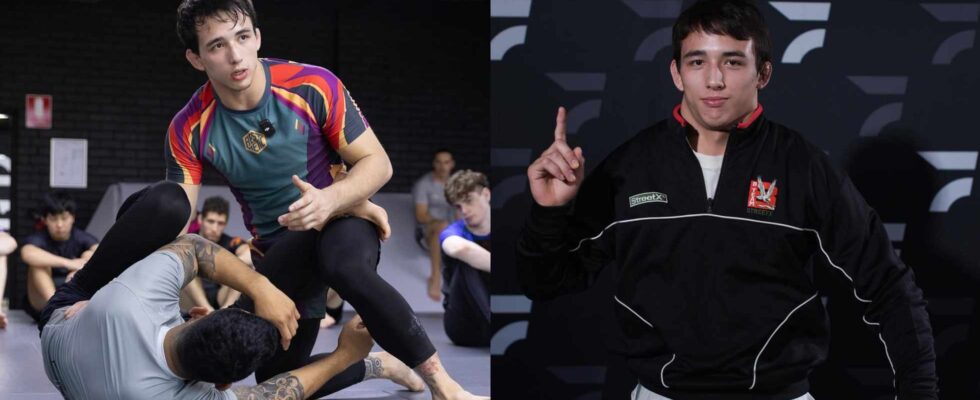
Jozef Chen’s rise through Brazilian jiu-jitsu has been remarkably fast. At 19, he became the youngest ADCC European Trials champion and established himself as one of the sport’s most promising young competitors. Yet Chen’s development was not built around simply attending class, repeating techniques, and rolling without direction. His approach centers on deliberate learning, focused practice, and a willingness to investigate problems for himself.
Chen began training in Nanjing after moving through several cities across Asia. Before jiu-jitsu, he had no major athletic background and did not consider himself especially talented in sports. What made jiu-jitsu different was the way it was presented to him. He viewed it as a game that combined physical skill with problem-solving.
“Jiu-Jitsu was the first time that I really wanted to get good at something,” Chen explained.
That curiosity became even more important during the COVID-19 pandemic, when he had fewer academic commitments and more time to immerse himself in the sport. He spent hours watching instructionals, studying competition footage, listening to podcasts, and searching for ideas beyond what was taught at his local academy.
However, Chen believes many practitioners make the mistake of consuming instructional content without ever testing it.
“What I find is sometimes like if I were to derive something directly from instruction I don’t have the firsthand experience that really makes it stick per se. Whereas if I have something from training and I’ve experienced it and it feels like there’s something there, and that can often come from me watching an instructional, then I write it down.”
Rather than filling notebooks with techniques straight from a video, Chen only records ideas after they’ve been tested in live training.
“I’m not going to watch an instructional and just write it down without having experienced it per se, because I find that there’s too much disconnect there for me to actually be able to use any of it.”
His coach also introduced him to conceptual learning through positional games instead of relying exclusively on traditional sparring. One example involved beginning in side control while preventing the top player from using chest-to-chest pressure as the bottom player attempted to turtle.
By removing familiar tools, both athletes were forced to think more deeply about frames, wedges, levers, and body positioning.
Chen believes these constrained games expose weaknesses that often remain hidden during unrestricted rolling. In his view, many grapplers unintentionally build games that allow them to avoid fixing fundamental problems.
“I find a lot of people, they almost disguise their weakness in guard retention with guard offense.”
He added that competitors often become comfortable only within their preferred positions.
“Sometimes people have weaknesses the moment you get them outside of their guard of choice.”
According to Chen, training games deliberately force athletes into uncomfortable situations that demand genuine problem-solving.
“I find that it enables, it almost forces people to think a little bit more about problems in which you might not have thought of in an open round where everything is allowed and so on.”
Although Chen values entering each session with a clear objective, he also believes athletes shouldn’t become so rigid that they lose their curiosity. Having direction is important, but leaving room for experimentation often leads to unexpected discoveries.
“Sometimes I find that if I’m too rigorous with my intent, sometimes I get a little bored. I’m like, okay, I want to explore other things.”
That same analytical mindset also shapes how he approaches both gi and no-gi grappling. While many practitioners view them as nearly identical sports, Chen argues that each develops different habits that don’t always transfer well.
“I find that a lot of the issue usually is making the transition from one to the other.”
He believes gi specialists often become too reliant on securing one dominant grip, while no-gi competitors can underestimate the importance of establishing control early in an exchange.
“A lot of my no-gi friends who I’ll just make in the gi because they’re not worried about their initial grips, and vice versa where a lot of my gi friends, they focus too much on having one strong grip, but they’re not really used to chaining grips.”
For Chen, the common thread is that improvement comes from investigation rather than repetition. By testing ideas in live situations, identifying weaknesses instead of hiding them, and remaining open to exploration, he believes athletes can make far more meaningful progress than simply accumulating hours on the mat.
