
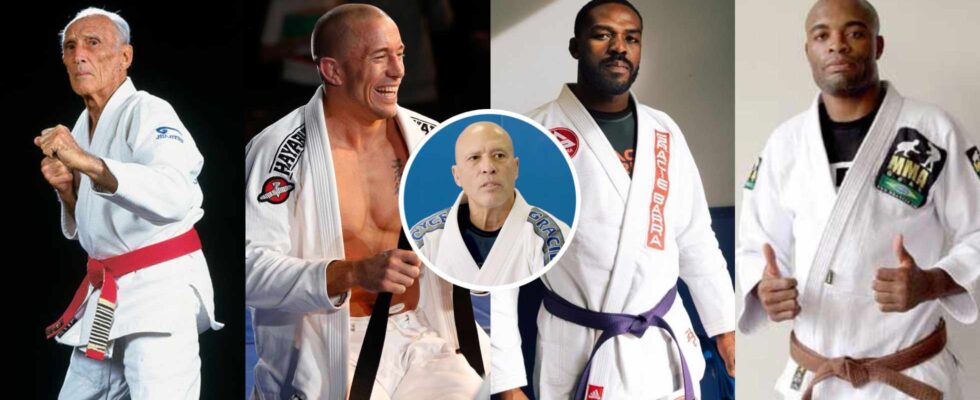
When Georges St-Pierre sat down with Royce Gracie at the UFC pioneer’s academy, the conversation covered decades of martial arts history before arriving at one of the most compelling questions in combat sports: who belongs on the Mount Rushmore of MMA?
Gracie, the man who introduced the world to Brazilian jiu-jitsu on the biggest stage imaginable when he won the first UFC tournament in 1993, did not hesitate when GSP posed the question.
“I’ll definitely have to put my father in there,” Gracie said. “He’s the one that developed the defensive style, the whole how to defend yourself. He had leverage from the techniques. He’s the one that developed the whole MMA and challenge everybody and went for it.”
Gracie took a moment to clarify the distinction between his uncle and his father, noting that while his uncle was first to learn the art of jiu-jitsu, it was his father who shaped the philosophy and methodology that the entire Gracie family would carry into challenge matches and eventually into the UFC.
That legacy of testing the style against all comers, from boxers to wrestlers to karate practitioners, laid the groundwork for everything modern mixed martial arts has become.
From there, Gracie turned to the present era. His second selection was the man sitting across from him.
“You would be there,” he told GSP.
The compliment carried genuine weight coming from the man whose VHS tape first inspired a teenage St-Pierre to dedicate his life to martial arts.
For his third and fourth picks, Gracie looked to two of the most decorated champions the UFC has ever produced.
“I would put Anderson Silva,” he said. “And I’ll definitely put Jon Jones in there. That would be my four guys that I would choose today.”
Throughout the conversation, he emphasized technique over brute force, the ability to adapt and control an opponent rather than simply overpower them, and the kind of fig ht IQ that separates legends from contenders.
Gracie did offer one name outside of his official four, adding that he enjoys watching Charles Oliveira.
“I like the kid’s attitude,” he said. “The way he represents, the way he competes.”
When pressed further on the question of who the best pound-for-pound athlete is today, Gracie was reluctant to settle on a single answer, arguing that the current ruleset complicates any definitive verdict.
His view remains that removing time limits would change the conversation entirely, a perspective shaped by his own experience competing in a tournament format where he competed against multiple opponents in a single night with no rounds and no breaks.
