

Days after FloSports announced the launch of a new free channel on Amazon Prime Video, promising over 300 premium live events and more than 1,000 hours of live programming, Flograppling’s General Manager surfaced on Reddit to explain why the platform’s flagship WNO series has effectively gone dark.
Many in the jiu-jitsu community initially assumed the Prime Video deal was tied to Flograppling’s recently announced partnership with ONE Championship, but the arrangement appears to be a broader corporate play that extends well beyond any single deal.
Ben Kovacs, who runs Flograppling and also founded the Guardian Jiu-Jitsu nonprofit, stepped into the r/bjj community under his handle DaddyGrapple to respond to a thread that had been gaining traction.
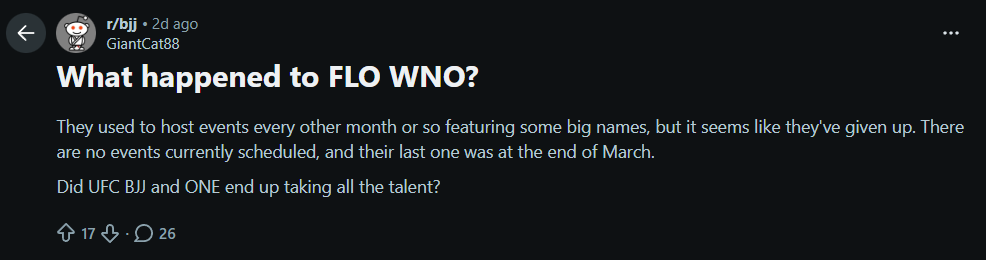
The post, titled “What happened to FLO WNO?”, pointed out that the promotion had not scheduled a single event since its last card at the end of March, and questioned whether UFC BJJ and ONE had absorbed all available talent.
Kovacs acknowledged the community’s concerns, citing the calendar as a primary factor.
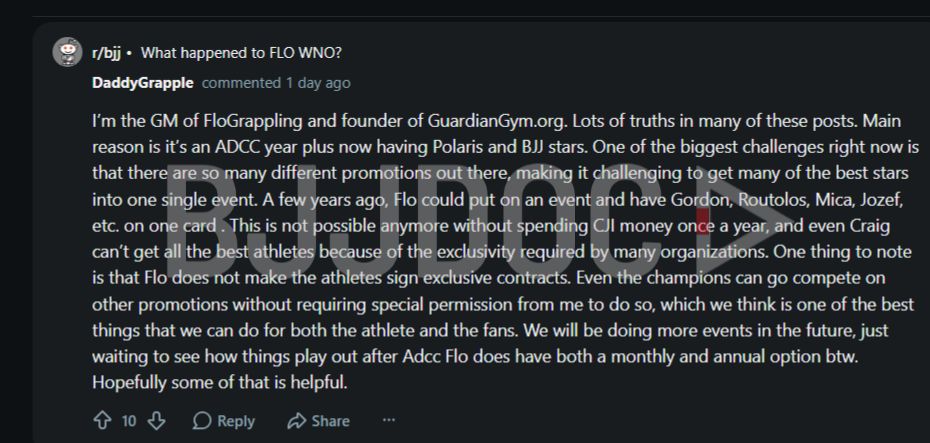
“Main reason is it’s an ADCC year plus now having Polaris and BJJ Stars,” he wrote. “One of the biggest challenges right now is that there are so many different promotions out there, making it challenging to get many of the best stars into one single event.”
“A few years ago, Flo could put on an event and have Gordon, Routolos, Mica, Jozef, etc. on one card. This is not possible anymore without spending CJI money once a year, and even Craig can’t get all the best athletes because of the exclusivity required by many organizations.”
But Kovacs went further than pointing to scheduling conflicts and exclusivity clauses. In a follow-up comment, he argued that the motivational landscape for elite grapplers has fundamentally shifted.
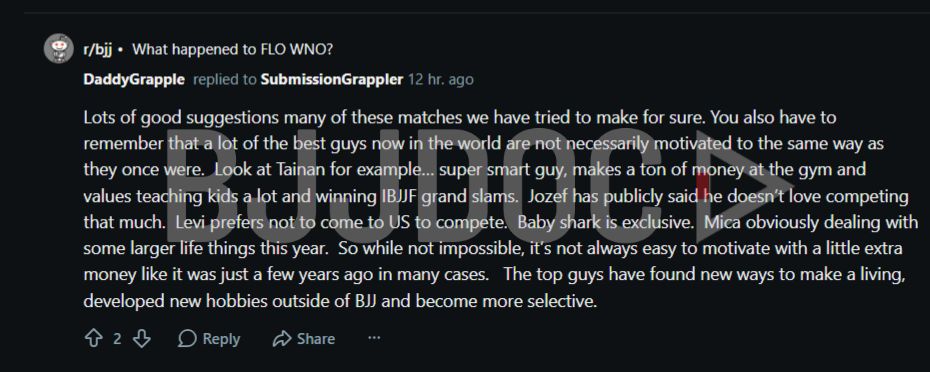
“A lot of the best guys now in the world are not necessarily motivated the same way as they once were,” he explained. “Look at Tainan for example… super smart guy, makes a ton of money at the gym and values teaching kids a lot and winning IBJJF grand slams.”
“Jozef has publicly said he doesn’t love competing that much. Levi prefers not to come to US to compete. Baby Shark is exclusive. Mica obviously dealing with some larger life things this year. So while not impossible, it’s not always easy to motivate with a little extra money like it was just a few years ago in many cases. The top guys have found new ways to make a living, developed new hobbies outside of BJJ and become more selective.”
Rather than placing blame solely on competing promotions or budget constraints, Kovacs is essentially arguing that the athletes themselves have outgrown the competitive circuit as their primary livelihood. The era when a WNO paycheck represented the most attractive option for the sport’s biggest names appears to be closing.
This candor stands in contrast to the far bolder positions Kovacs staked out on the White Monster Podcast, where he described Flograppling as the financial engine behind the entire BJJ competitive ecosystem.
“What a lot of people don’t understand is that by having a Flo membership you’re creating a lot of this ecosystem to happen,” Kovacs stated. “Flo is paying IBJJF and ADCC and you know all these different partners rights fees. You know Polaris, BJJ Stars. The only reason these events exist, or a main reason they exist, is because Flo is either doing the production for them or Flo is actually writing them a check in order to have the rights to put on Flo.”
That portrayal has drawn skepticism from observers across the community. IBJJF and ADCC both predate Flograppling by years and operate as independent organizations. Polaris recently returned to Flograppling’s platform after a stint on UFC Fig ht Pass, a move driven by necessity rather than loyalty. BJJ Stars remains a thriving independent Brazilian promotion, drawing roughly 8,000 subscribers per event and fielding approaches from UFC, none of which have materialized into a deal. None of this fits neatly into the narrative of a platform that holds the ecosystem together.
On the same podcast, Kovacs addressed the financial pressures that have been quietly reshaping WNO’s viability. Oil-funded international promotions have recalibrated athlete expectations at the very top of the sport, and Flograppling cannot match their prize pools.
Events such as ADXC from Dubai, ACB’s resumed BJJ cards, and AIGA’s growing presence in Kazakhstan are backed by sovereign wealth and private fortunes that operate outside the conventional logic of subscription revenue and broadcast rights fees. None of those promotions carry content on Flograppling, yet all continue to attract elite talent.
“People are like, ‘Oh, I made $182,000 to go compete for four minutes on this event over in wherever it was across the world. So that’s my new market price for grappling,'” Kovacs said. “And you’re like, ‘Well, not quite how it works.'”
Athlete perception of FloSports’ finances adds another layer of difficulty to negotiations.
“I think a lot of the athletes see that and they think, ‘Oh, Flo’s got money.’ Or they’ll see like, ‘Oh, Flo raised $10 million in their last financing round or whatever,’ and they’ll say, ‘Oh, Flo can pay me.’ And they don’t actually want to be partners. So they’re just trying to sort of squeeze out what they can from their match. They’re not trying to give back.”
FloSports has raised over $100 million in total funding across four rounds, with its most recent Series D led by Dream Sports, the Indian technology company behind Dream11, the world’s largest fantasy sports platform. The trajectory of that investment appears to point toward fantasy sports integration rather than escalating event production budgets.
For WNO specifically, the internal framing has shifted considerably.
“The conversations about things like WNO are more like, ‘Hey, like can we put these events on? Can they be fun? Can they help move the sport forward? And can we just not lose so much money on them?'”
Looking ahead to 2026, the language Kovacs used on the podcast suggests a recalibration rather than a resurgence.
“I think, you know, 2026, we probably have to have some hard conversations with some athletes and just say, ‘Hey, we’d love to have you on the card, but you know, we have to do it a little bit more economically than we’ve done it in the past, or we have to change up the format a little bit to be more exciting for the fans.'”
He also framed WNO’s position within the broader company in unusually direct terms.
“This isn’t a money-making endeavor for Flosports right now, to be honest. You know there are other verticals in Flo I would say that do better than grappling. Grappling is almost like a labor of love for Flosports.”
On Reddit, Kovacs pointed to a Polaris partnership as part of Flograppling’s response to the changed landscape. Flograppling has secured a deal covering six Polaris events in 2026 and eight in 2027, with the aim of expanding into the European market, where a generation of exciting grapplers has developed largely outside the spotlight of American audiences. He also reiterated that Flograppling does not require exclusive contracts from its athletes.
“Even the champions can go compete on other promotions without requiring special permission from me to do so, which we think is one of the best things that we can do for both the athlete and the fans.”
Whether that flexibility is a genuine competitive advantage or a quiet acknowledgment that Flograppling lacks the leverage to demand exclusivity in the current market is a question the community has been sitting with for months.
Gordon Ryan’s prolonged inactivity has not helped. For years, Ryan was widely regarded as the one name who could elevate a WNO card beyond a routine matchup, and his absence has exposed just how thin the top of the sport’s drawing power actually runs.
For now, Kovacs’ answer to all of it is to wait out the ADCC season, lean on the Polaris pipeline, and hope that after the year’s biggest event, the sport’s elite competitors find their way back to the table.
