
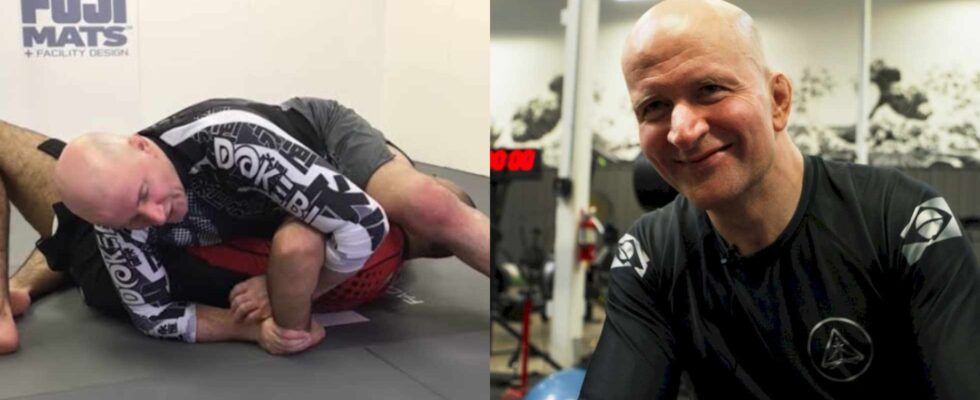
On the Lex Fridman Podcast, John Danaher, widely regarded as one of the greatest minds in martial arts, laid out his philosophy on tapping in competition, drawing a sharp distinction between training and competition, and between early-round matches and championship finals.
For Danaher, the rule in the gym is unambiguous.
“In training, you should be tapping very early,” he said. “You’re getting paid to compete on stage, so be a professional in the gym. Tap early, tap fast. That way you’ll last a lot longer.”
The reasoning is straightforward: there is no upside in taking damage during practice, and the gym is not the place to prove toughness.
The picture changes in competition, but context is everything. In the early rounds of a major tournament like ADCC, Danaher expects his athletes to tap.
“If you get your leg broken or your arm broken in the first round, you still got three more matches before you get to the final.”
Sacrificing your body for a first-round win that you then cannot build on is, in his view, a poor trade.
He also drew a distinction between limb locks and strangleholds. With a strangle, the math is simple: “I don’t see any heroism in just letting yourself pass out.”
Resisting a choke to the point of unconsciousness accomplishes nothing that tapping early would not, and it removes the athlete’s ability to make any decision at all. Danaher also referenced George Patton’s principle of competing smart rather than absorbing unnecessary damage, framing the approach to competition around outcomes rather than pride.
In a championship final, however, Danaher steps back from prescription entirely.
“If you’re in a final and you’re hit on points… most people at that point are going to be willing to let something break in order to win a gold medal. At that point I leave it up to the student. It’s a deeply personal decision.”
He was equally clear that he would never issue that directive himself: “I would never say to a student I expect you to let your body break in order to win a gold medal.”
His stance on reckless toughness is firm.
“I would be angry if they let their bodies break in a meaningless fashion in some random tournament or in a first round match where there’s no way you could go on to the second, third and fourth matches with a broken limb.”
The framework is less about bravery than calculation.
“Winning ADCC is, for a grappler at least, life-changing. You’re a world champion forever and no one can ever take that moment away from you.”
That context, he argues, can justify a different threshold in a gold medal match than anywhere else on the mat. The principle underneath all of it is the same one that runs through everything Danaher teaches: protect your ability to train, compete, and improve, because without that, there is nothing left to compete for.
