
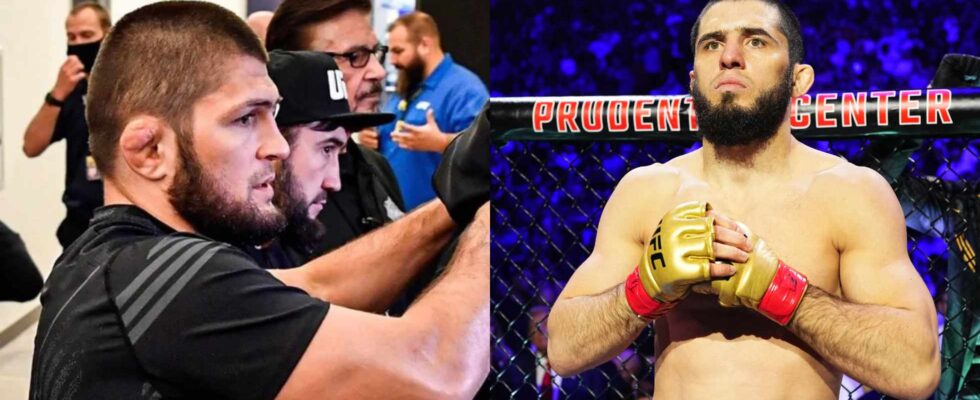
For most combat sports athletes, cauliflower ear is earned over years of grinding on the mat, a physical mark that tells its own story without a single word. But for UFC star Islam Makhachev, the revelation that some people seek out that look without ever having trained a day in their lives left him genuinely puzzled.
Growing up in Dagestan, Russia, one of the world’s most respected wrestling cultures, Makhachev developed a sharp eye for the real thing. The deformed ear, caused by repeated blunt trauma to the outer ear cartilage, has long been a symbol of time spent on the wrestling mat or the grappling room floor.
So when Makhachev began noticing individuals around him with the telltale swollen ears who clearly had no background in combat sports, he couldn’t quite make sense of it.
“There are people too, which I look at, and I know he has never done sports in his life and his ears are broken,” Makhachev said in a video.
The practice he was reacting to is more widespread than many outside the grappling world might expect. Makhachev expressed disbelief upon learning that clinics exist, run by medical professionals, where individuals can pay to have their ears intentionally altered to replicate the look.
What began as an unavoidable byproduct of hard training has, in some corners, become an aesthetic choice available to anyone willing to pay for it.
Makhachev is far from alone in his perspective. Joe Rogan, longtime UFC commentator and recreational jiu-jitsu practitioner, has spoken candidly about his own relationship with the condition. Unlike many grapplers who wear it with pride, Rogan has been straightforward about wanting no part of it.
“Ears like yours get calcified. You’re definitely going to change what things sound like. It’s the price to pay to be dangerous,” Rogan noted, while making clear that the trade-off was not one he was personally willing to make.
“I’m just a comedian. So for me, it’s like I got to mitigate what gets f**ked up, right?” he added, explaining why he opts for protective ear guards during training, even when some in the grappling community view the choice skeptically.
Rogan also acknowledged the very phenomenon that appeared to catch Makhachev off guard, noting that some athletes go out of their way to develop the condition rather than prevent it.
“Some people don’t even train with ear guards. They’ll break their ears and they’ll do things to their ears on purpose so they can purposely get it,” Rogan said.
On the other end of the spectrum sits Bo Nickal, the highly regarded UFC middleweight prospect who made his feelings about cauliflower ear known at an unusually young age. At just 8 years old, Nickal walked up to his parents and told them he wanted cauliflower ears, already viewing the condition as a mark of commitment rather than a consequence to be avoided.
That mindset carried him through a decorated wrestling career at Penn State and into the UFC, where he holds a perfect professional record with all wins coming by stoppage. Nickal’s path in the sport has been shaped by a genuine love of the craft rather than appearances, which perhaps makes his childhood wish all the more telling.
“I did a bunch of sports growing up. I played football, baseball, ran track,” Nickal recalled. “My father actually made me take breaks periodically from wrestling. Up until I was 16 years old, there were a lot of other sports and things that I was doing.”
Even with that athletic background, the allure of cauliflower ear as a symbol of belonging to the grappling world never faded for Nickal.
What Makhachev found so difficult to accept is the distance between the symbol and the result. In the world he comes from, and the world Nickal grew up chasing, the ears are a result, not a goal in themselves. The idea that someone might seek out the look without putting in the work behind it cuts against everything those marks are supposed to represent.
