

A congratulatory letter circulating on Reddit has sparked a debate inside the Brazilian jiu-jitsu community, with practitioners from white belts to black belts weighing in on whether the document represents a legitimate business model or a textbook case of a “McDojo.”
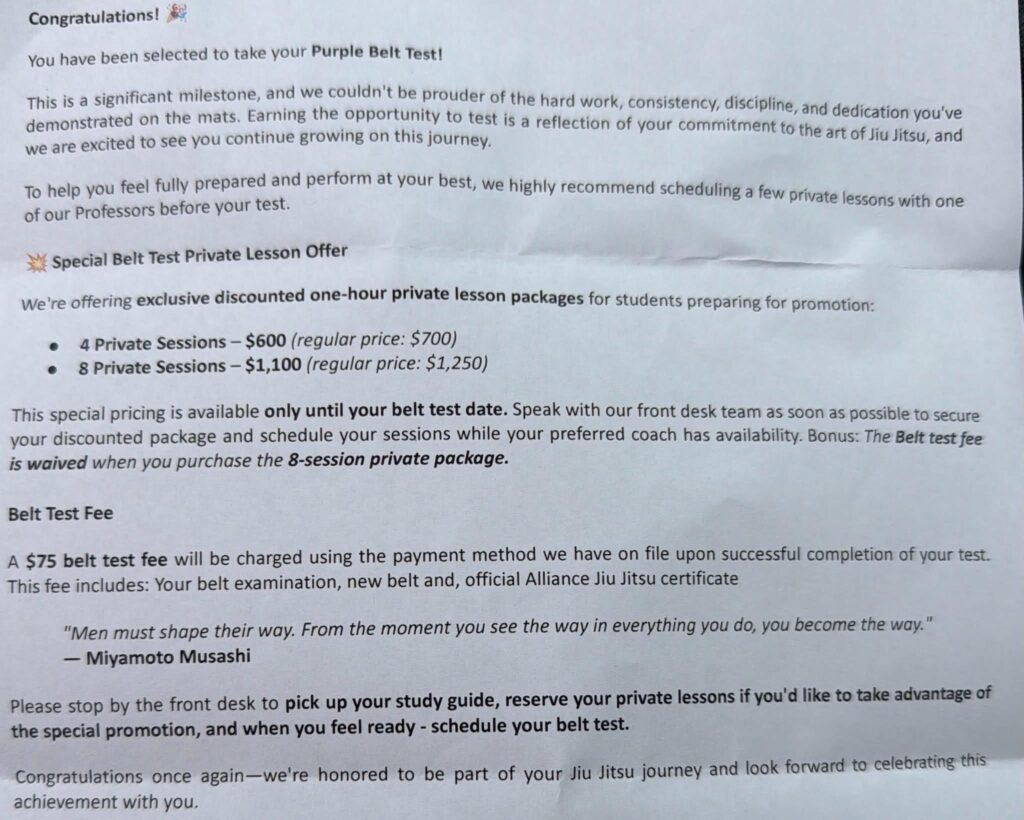
The letter was posted with the question “Would you say this BJJ school is a McDojo?”, reads at first glance like a genuine celebration. It congratulates a student on being selected to test for their purple belt, praising their “hard work, consistency, discipline, and dedication” on the mat.
But as readers scroll further, the tone shifts.
Before the student can step onto the mat for their test, the letter presents a “special belt test private lesson offer.”
Discounted one-hour private sessions are available in two packages: four sessions for $600 (regular price: $700), or eight sessions for $1,100 (regular price: $1,250). The pricing is described as available only until the student’s test date.
And for those who commit to the eight-session package, one incentive is added: the $75 belt test fee is waived entirely.
That $75 fee drew the most sustained reaction.
That testing fee quickly became one of the biggest points of discussion. Many practitioners questioned the idea of charging separately for belt promotions, arguing that advancement in Brazilian jiu-jitsu should be based on an instructor’s assessment over time rather than a paid examination.
Others felt that combining the testing fee with a limited-time private lesson promotion created unnecessary financial pressure.
The detail that caught the most attention, however, was not the fees themselves. It was the closing line. After laying out the financial obligations in full, the letter signs off with a quote from legendary Japanese swordsman Miyamoto Musashi: “Men must shape their way. From the moment you see the way in everything you do, you become the way.”
The juxtaposition was not lost on anyone.
Multiple commenters also noted that the letter appears to have been written using artificial intelligence.
The pricing of the private lessons also drew criticism. Many practitioners argued that the rates were unusually high, particularly given that comparable or even lower prices are available from accomplished black belts and high-level competitors in many areas.
Others objected to what they viewed as a fear-of-missing-out sales tactic, with the limited-time discount tied directly to an important career milestone.
The post continues to generate debate, with some practitioners defending formal testing as a reasonable cultural choice, others calling the school’s approach outright predatory, and at least one person admitting they would choose to remain a white belt indefinitely rather than pay for a stripe.
