
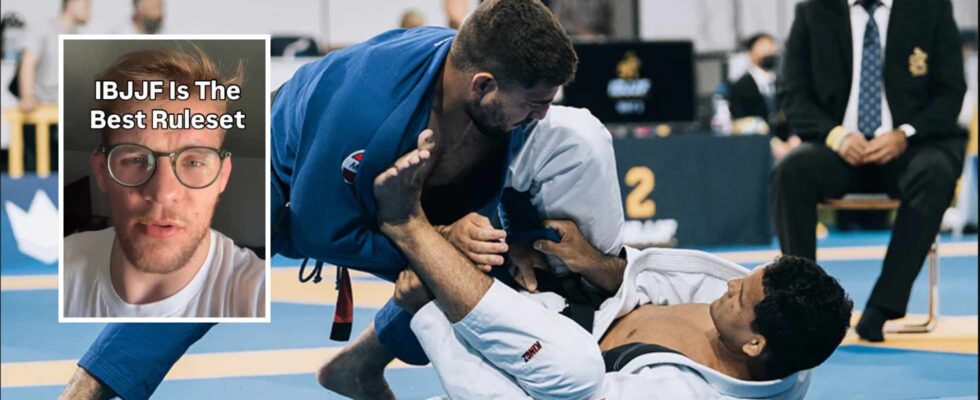
When Canadian black belt Max Hanson posted a video to his social media account, he led with the objection he knew was coming before he even made his case. The setup was direct.
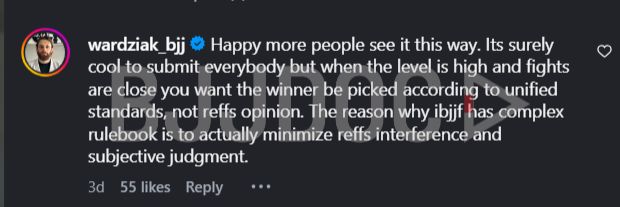
“Oh but the IBJJF is corrupt,” Hanson wrote in the caption, voicing the criticism himself before dismantling it. “I am a white dude from Canada who won my first Major Black Belt title against a dude from Manaus by gaming the system and applying the rules of IBJJF. Are there some lame calls? Of course, but the rules are clearly defined.”
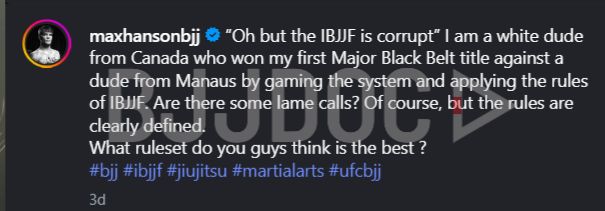
The video drew significant attention across the jiu-jitsu community, and one of the first prominent figures to respond in the comments was Adam Wardzinski, a decorated Polish competitor with titles at the highest levels of the sport. His endorsement of Hanson’s position was unambiguous.
“Happy more people see it this way,” Wardzinski wrote. “It’s surely cool to submit everybody, but when the level is high and matches are close, you want the winner to be picked according to unified standards, not the ref’s opinion. The reason why IBJJF has a complex rulebook is to actually minimize ref interference and subjective judgment.”
That point is one sub-only promotions have struggled to answer. Entertainment value is not the same as fairness, and when a promotion’s guiding principle is “be aggressive” or “don’t be boring,” those are instructions, not rules. Hanson took his argument further in the video itself.
“IBJJF is the best ruleset in jujitsu,” Hanson said in the video. “They’re one of the only organizations that has an actual rulebook. A lot of the other promotions, essentially every sub-only promotion, has terrible judging. Why? Because they have no rules.”
“They simply say attack submissions, be aggressive, don’t be boring. The IBJJF rulebook is like 60 pages, and the only other organization that has a rulebook like this is NAGA, which is an amateur competition tournament.”
“There are so many pro shows with so much money put on the line. You get invited to them. The biggest shows in the world. And what did they give you? A one-page rulebook. No other sport in the world has this. There are clear-defined rules for how to win in the IBJJF, which is why they are the gold standard for jiu-jitsu and will be for a very long time.”
The ADCC comparison surfaces often in this conversation, and the evidence is not flattering for the alternative format. ADCC is widely considered the most prestigious submission grappling event in the world, and yet its rules have left even its most accomplished champions uncertain about how outcomes are determined.
After his special match loss to Gordon Ryan at ADCC 2024, Felipe Pena stated publicly that he still was not entirely sure why the decision went the way it did. That is not a minor footnote. It is a fundamental question about how a top-level competitive result was reached under a system that prizes spectacle over documentation.
Perhaps no example captures the issue more clearly than Marcelo Garcia, a four-time ADCC champion regarded by many as one of the most gifted grapplers the sport has produced. In an interview, Garcia made an admission that raised eyebrows among devoted fans of the format.
“It would be fun if I can tell you that I don’t know the rules in the ADCC,” he said. “If you ask me for all the points scored, I don’t know.”
Garcia’s approach to competition has always been about finishing rather than accumulating points, and his record speaks for itself. But the fact that someone with four ADCC titles cannot fully explain how his own victories were scored says something concrete about how much the format depends on interpretation rather than a written standard.
Beyond the competitive integrity argument, there is a commercial dimension to this debate that Elisabeth Clay, a six-time No-Gi World Champion competing out of Six Blades in Fort Worth, laid out with clarity on the Weslee Weighs In podcast.
Clay is not opposed to high-profile super matches. She has competed in them and has made the deliberate choice to skip IBJJF majors when the pay made better sense. But she does not treat them as equivalent when it comes to long-term career value.
“It’s not the same as winning an IBJJF world title. It’s still not the same,” Clay said. “You won a match at the UFC. That’s good. Don’t get me wrong. You beat so-and-so. That’s great. The biggest thing you get from that though, at least at this point in any super fig ht, is the pay.”
Pay is not a trivial concern. The 2026 IBJJF World Championships awarded division champions between $7,000 and $10,000 depending on bracket size, with the absolute division winner taking home $18,000. Clay noted that many people in the jiu-jitsu community are unaware that IBJJF compensates athletes at all. But a single event payout, however significant, is not the same as what a title generates across a full career.
“I can’t market a super fig ht win the same way I can market an IBJJF world title,” she said. “I can market that to sponsors. I market that for seminars. I market that for privates.”
When the conversation turned to the exposure argument, the claim that high-profile independent events deliver bigger audiences and more visibility than IBJJF competitions, Clay was not persuaded.
“That’s the same argument almost everybody’s made over the year is exposure. Exposure doesn’t pay me.”
