
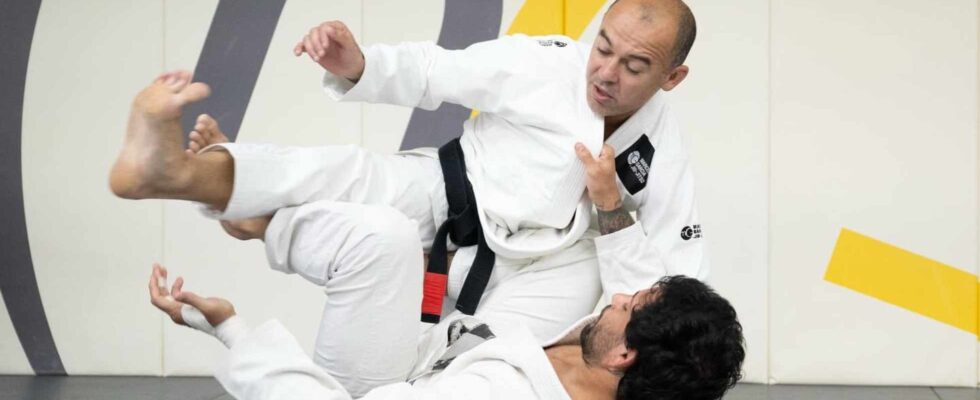
Paul Schreiner recently recalled his first encounter with Marcelo Garcia at a 2003 San Francisco seminar. In an interview, Schreiner stated that he couldn’t have known he was meeting someone who would reshape modern jiu jitsu.
As a black belt who spent 15 years teaching at Marcelo Garcia Academy in New York City, Schreiner offers a unique perspective on how one athlete’s approach fundamentally altered the sport’s landscape.
Garcia’s influence began with his breakout performance at the 2003 ADCC, where his technical approach looked distinctly modern compared to his contemporaries.
“Everyone got these VHS tapes, the X-guard tapes,” Schreiner remembers. “Everyone. Even Cameron Earle who competed against him a couple times was studying his tapes.”
The widespread adoption of Garcia’s instructional material wasn’t just about learning new techniques. It represented a shift in how practitioners thought about building their game.
What made Garcia special wasn’t simply his technique catalog. According to Schreiner, it was his mindset.
“He approaches things with a different perspective, but a different kind of clarity. He doesn’t take anyone’s word on anything. He wants to figure things out for himself, find what works.”
This investigative approach led Garcia to develop solutions that have become fundamental concepts in modern jiu jitsu.
The upper body control from back position, commonly known as the seat belt, existed before Garcia, but he gave it new emphasis and integration.
Front headlock positions, systematic hand figh ting, and understanding when to attack legs versus upper body depending on an opponent’s posture are now taken for granted. Garcia made these concepts explicit and showed how they connected into a complete system.
Schreiner points to specific innovations that emerged from Garcia’s problem solving.
“He mentioned at the seminar that he got good at taking the back because everyone was turning their back when he was passing the guards. He had to figure this out.”
Rather than accepting conventional wisdom, Garcia saw what was actually happening in his matches and built solutions from observation.
The MG in Action website, created in partnership with Josh Waitzkin, democratized access to Garcia’s training footage and teaching. Practitioners worldwide could study not just techniques but see them applied under full resistance. This transparency was revolutionary at a time when high-level instruction was harder to access.
Garcia’s philosophy was that sharing his game would ultimately benefit him because opponents studying his techniques would still be reacting to his system rather than developing their own.
At Marcelo Garcia Academy, Schreiner witnessed how this systematic approach developed world-class competitors from the ground up. The “Brown Belt Dream Team” that emerged included athletes like Marcos Tinoco, who developed what Schreiner calls “probably the most technical spider guard in the world at that time,” and others who took ownership of their jiu jitsu within Garcia’s framework of precision and organization.
What distinguished Garcia’s coaching was his adaptability.
“He doesn’t necessarily, you know, you don’t need to do the same stuff that he’s doing,” Schreiner explains. “He just wants the approach to be organized and understand why you’re doing things.”
This created athletes who were technically sound and systematic without being carbon copies of their instructor.
When comparing Garcia to other all-time greats, Schreiner places him alongside Roger Gracie and Rickson Gracie for achieving complete integration of their games.
“I still don’t think I’ve seen anyone other than Marcelo, Roger, and Rafa achieve that level of integration or perfection of their game.”
The completeness of Garcia’s system, with its clear funnels and decision trees, set a new standard for how jiu jitsu could be organized and taught.
The ripple effects extend beyond direct students. As Schreiner notes, techniques and concepts pioneered or popularized by Garcia appear in nearly every modern practitioner’s game, whether they realize the origin or not.
